
By Satyabrat Borah
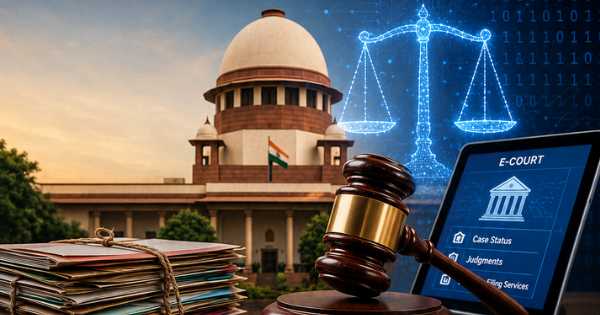
The pursuit of justice in India has long been a marathon through a labyrinth of paper and procedure. For decades, the halls of the judiciary have been defined by the scent of old files and the visual weight of stacked affidavits. Today, that landscape is undergoing a profound transformation as the legal system attempts to reconcile its ancient traditions with the speed of the digital age. Chief Justice of India Surya Kant recently introduced two major technological pillars designed to reshape this experience: a unified data platform known as One Case, One Data and an intelligent assistant named Su-Sahayak. These tools represent a significant leap toward a future where a legal dispute is no longer a fragmented series of disconnected events but a continuous digital narrative. To understand the gravity of this shift, one must look at the historical chaos of judicial record-keeping where a single case could look entirely different as it moved from a small district court to a high court.
The concept of One Case, One Data aims to eliminate this fragmentation by creating a single digital fingerprint for every legal dispute. In the current system, documents are often re-filed, manual verifications are repeated at every level of appeal, and statistics are frequently unreliable because of the sheer variety of software used across thousands of subordinate courts. By standardizing this data, the judiciary hopes to build a system where a judge in a higher court can see the entire history of a case with a single click. This isn’t just about convenience; it is about the integrity of information. When records are unified, the risk of losing critical evidence or missing a procedural step decreases significantly. This transparency allows administrators to pinpoint exactly where bottlenecks occur, making it possible to address delays that have historically kept litigants in limbo for generations.
Su-Sahayak acts as the public face of this digital revolution. It is an artificial intelligence chatbot integrated directly into the Supreme Court website, intended to guide users through the complexities of case statuses, judgments, and filing services. For a citizen who has never stepped into a courtroom, the Supreme Court portal can be an intimidating maze of legal jargon and broken links. Su-Sahayak seeks to act as a digital clerk, providing immediate answers to frequently asked questions and helping people find the specific orders they need. This follows in the footsteps of earlier tools like SUVAS, which focuses on translating judgments into regional languages, and SUPACE, which helps process vast amounts of legal precedents. The goal is clear: to make the highest court in the land feel a little more accessible to the common person.
While these advancements offer a glimmer of efficiency, they also bring into focus the deep-seated inequalities that define the Indian landscape. The digital divide is not a theoretical problem; it is a daily reality for millions of people. When we talk about digitizing the judiciary, we must ask who is being asked to carry the burden of that change. A large corporate law firm in a metropolitan city like Delhi or Mumbai can easily afford the high-speed scanners, cloud storage, and updated software required to maintain a seamless digital trail. These firms have IT departments and the capital to absorb the costs of transition. On the other hand, an independent lawyer practicing in a small taluka court may find these requirements overwhelming. If the system mandates a level of digital proficiency and infrastructure that smaller practitioners cannot provide, we risk creating a multi-tiered justice system where the quality of representation is tied to the quality of one’s internet connection.
There is also the very real danger of digital middlemen. In many parts of India, when government services move online, a new industry of unregulated operators often emerges to help those who are not tech-literate. These intermediaries charge fees to navigate portals, upload documents, and check statuses. If the e-filing process becomes too complex, the cost of justice might actually increase for the poor as they pay these unofficial gatekeepers to interact with a system that was supposed to be simpler. Su-Sahayak, for all its intelligence, remains a text-based tool. In a country where oral tradition and voice communication are dominant, a chatbot that requires typing and navigating menus might exclude the very people who need help the most. While other government initiatives have embraced voice-first technology to bridge the literacy gap, the judicial tools currently demand a high level of formal digital literacy.
There are profound ethical questions regarding the use of artificial intelligence in the realm of law. AI models are trained on historical data, and historical data often carries the weight of past prejudices. In India, marginalized communities have been disproportionately affected by the criminal justice system. If an AI tool is used to help process facts or identify precedents, there is a risk that it might unknowingly replicate the biases present in those older records. The judiciary has wisely kept AI in the role of an assistant rather than a decision-maker, focusing on substantive reasoning remains a strictly human endeavor. This distinction is vital. A machine can summarize a thousand pages of evidence in seconds, but it cannot understand the nuances of human dignity or the social context of a crime. Keeping the human element at the center of the courtroom is essential to prevent the law from becoming a cold, algorithmic calculation.
The security of this data is another pressing concern. A centralized platform containing the life stories and legal battles of millions of citizens is an incredibly sensitive asset. Ensuring the privacy of litigants while maintaining an open and transparent system is a delicate balancing act. Legacy records, often handwritten and decaying, must be digitized with extreme care to ensure their integrity. If a digital fingerprint is corrupted or accessed by unauthorized parties, the consequences for an individual’s life could be irreversible. The push for a unified judicial data platform must be accompanied by a robust framework for data protection and a massive effort to train court staff across the country to handle this information responsibly.
The transition to a digital judiciary is a journey that requires more than just code and servers; it requires a deep commitment to empathy. Technology should serve as a bridge, not a barrier. As we move toward a more automated future, the focus must remain on the person standing at the back of the courtroom waiting for news about their case. For that person, the success of One Case, One Data is not measured by the speed of the server but by the fairness of the outcome. The tools introduced by the Chief Justice are a bold step in the right direction, but their true value will be determined by how well they serve the most vulnerable members of society. If we can ensure that a lawyer in a rural district has the same ability to navigate the system as a lawyer in a glass tower, then we will have truly improved access to justice. The path forward is complex, but the goal of a faster, more transparent, and more equitable legal system is worth the effort of navigating these digital growing pains. We are witnessing the beginning of a new chapter in Indian law, one where the pen and paper are slowly making room for the pixel and the algorithm, and the hope is that this change will lead to a more just world for everyone.