
By Satyabrat Borah
Elon Musk occupies a strange and singular place in our collective imagination. He is the world’s only trillionaire, a title that carries with it an almost mythological weight. When we think of people with that much money, we tend to think of old-world magnates, oil barons, or real estate kings who built empires on tangible things. But Musk is different. He deals in the future. He sells us electric cars, rockets to Mars, brain implants, and artificial intelligence, wrapping them all in a narrative of human survival and cosmic destiny. Because his reach is so wide and his influence so deep, thinkers and writers have begun trying to look past the headlines and the social media antics to find the underlying structure of his world. They want to understand what makes his system tick. This system, this specific blend of political economy, ideology, and ambition, has earned its own name: Muskism.
To truly understand Muskism, you have to look closely at the kind of society it builds. It is a world where old laws, regulations, and institutional boundaries are constantly softened, bypassed, or completely dismantled. This is not done out of a simple desire to cause chaos, but to clear a path for absolute freedom of action. The authors of the book Muskism: A Guide for the Perplexed argue that if you want to understand this phenomenon, you have to look at the historical and cultural forces that shaped the man himself.
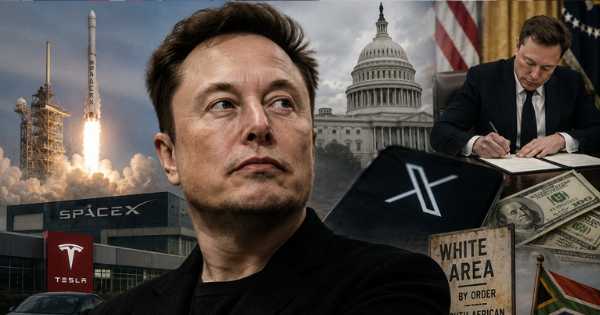
His worldview did not appear out of nowhere. It was forged in specific environments, beginning with the apartheid South Africa of his childhood in the 1970s, moving through his early days making a fortune in Silicon Valley, and expanding into the sprawling network of SpaceX, Tesla, X, and various artificial intelligence ventures he controls today.
There is a common misunderstanding that figures like Musk want to shrink the state. We often associate tech billionaires with a kind of libertarianism that wishes the government would simply disappear and leave the free market alone. But international history professor Quinn Slobodian and his co-author Ben Tarnoff point out that this is a fundamental mistake. Muskism does not want to destroy the state. It wants to partner with it. Musk has spent his entire career working in tandem with government power, using public resources, public money, and public infrastructure to build his private kingdom.
Consider his childhood home. The South Africa of the 1970s was a white supremacist state, but it was also a massive tech-political experiment. It was a nation isolated by the rest of the world, surrounded by hostile forces, and deeply militarized. To survive, the state had to turn inward and use advanced technology to achieve absolute self-reliance. The authors note that this historical version of South Africa, much like its close partner Israel during the same era, was a precursor to our modern world. It anticipated our current global landscape of trade wars, export restrictions, aggressive rearmament, and the desperate race to bring manufacturing back home. Apartheid South Africa taught a young Musk a fundamental lesson that remained with him long after he left for Canada in 1989. It taught him that technology can be used to forge a fortress of self-reliance in a world that is inherently unstable and dangerous. This idea did not leave him when he crossed the ocean. It travelled with him like a hidden spore in his luggage, ready to bloom in the fertile soil of the American tech sector.
This perspective gives rise to what the authors call fortress futurism. It is a philosophy built around a single, uncompromising promise: achieving total sovereignty through technology. You can see this thread running through every single one of his companies, whether they deal with the internet, space exploration, sustainable energy, cyber security, or artificial intelligence. There is a deep irony here because all these businesses are built directly on top of foundational technologies that were originally researched, developed, and funded by governments. The internet, GPS, advanced rocketry, and clean energy initiatives all began as public projects funded by taxpayers. Muskism looks at this history and sees sovereignty as a service. It views the state as an instrument to be used for private power and profit.
In this model, the government takes on all the initial risks. Agencies like DARPA, NASA, and various departments in Washington invest billions into moonshot projects and foundational research. They build the basic tools. Once those tools exist, the private innovator steps in to package them, streamline them, and sell them back to the public. The government then shifts from being the creator to being the customer. This is a state symbiosis, a deeply intertwined relationship where the private entity and the public institution become locked together.
This relationship goes far deeper than traditional government contracting. In the past, when the state hired a private company to build an airplane or a missile, the government still retained ultimate control over the design, the production, and the rules of engagement. Muskism flips this dynamic on its head. It forces the state to cede control over the very architecture of production and design.
Musk achieved this by fundamentally changing how government contracts work. For decades, the military and space agencies used a system called cost-plus contracting. Under this arrangement, the government would cover whatever costs a company incurred while developing a new technology, and then tack on a guaranteed profit margin on top of that. This system kept companies stable, but it also made them slow, bureaucratic, and highly dependent on government oversight. Musk pushed for a shift to fixed-price contracts. In this new paradigm, the government sets a flat fee for a service, like launching a satellite or delivering cargo to the space station. If the company can do it for less money, they keep the extra profit. If they fail, they absorb the loss.
This change forced a culture of relentless cost reduction. It also demanded a massive reduction in regulatory oversight. To move fast enough to survive under fixed-price contracts, you cannot wait for months of bureaucratic approval. You have to move fast and break things. As Musk himself famously noted, if the rules are written in a way that prevents you from making progress, then your job is to fight the rules. The ultimate goal of this strategy is to vassalize the government. It creates a reality where the state can only exercise its public authority by purchasing essential services from a single, monopoly provider.
We are already living in that reality. SpaceX, which began its life as a modest military contractor, grew at such an astonishing rate that by 2025, it was responsible for an unbelievable ninety-five percent of all United States orbital launches. More than that, it accounted for more than half of all space launches across the entire globe. The implications of this are staggering. If a modern government wants to put a spy satellite into orbit, monitor climate change, or provide internet to its troops in a war zone, it cannot rely on its own infrastructure. It has to go to Musk. If any government tries to unplug from his ecosystem, they quickly discover an uncomfortable truth: he owns the socket.
Another essential piece of Muskism is an intellectual and narrative strategy that the authors describe as financial fabulism. This is a way of speaking and thinking that borrows heavily from the literary genre of magical realism, where the boundaries between fantasy and cold reality become blurred. Musk possesses a rare talent for project management, but his real genius lies in his ability to make millions of people believe in an impending future that he alone can build. He uses the language of existential crisis and cosmic emergency. He warns us that humanity is running out of time, that climate change will destroy us, or that artificial intelligence will enslave us unless we colonize other planets and merge our minds with machines.
This constant state of emergency creates a sense of urgency that justifies bypassing normal ethical, legal, and financial guardrails. If you are trying to save the human race from extinction, things like labor laws, safety regulations, and insider trading rules start to look like petty distractions. Investors pour billions of dollars into his companies not based on their current earnings, but based on a shared faith in a spectacular tomorrow.
This desire to reshape the future explains his acquisition of Twitter, which he later rebranded as X. Many people viewed the purchase as a erratic, expensive whim of an eccentric billionaire. Muskism suggests it was a calculated political move. Musk saw the old Twitter as a platform that had been captured by what he termed woke culture. In his view, the platform had become a megaphone for social movements like Occupy Wall Street, Black Lives Matter, and MeToo, movements that challenged traditional power structures and advocated for equality. He bought the company to dismantle that specific ecosystem.
He replaced it with X, a platform designed to harness social media outrage and restructure the digital town square. Under his management, the platform began to emphasize a specific view of the world, one defined by clear hierarchies of rulers and the ruled. It became a space where fringe theories, nationalism, and anxieties about declining birth rates among specific populations could be mainstreamed. Musk did not see X merely as a business or a website. He understood social media as a vast cybernetic collective. He viewed it as a giant, interconnected web of human consciousness that was actively helping humanity evolve into a posthuman state.
This is where the ultimate, most radical ambition of Muskism becomes clear. If human beings become deeply, permanently connected with machines and digital networks, then nearly every single aspect of human life can be reduced to code. It can all be programmed. If you can program the economy, the media, human reproduction, and human thought, then you can also program political systems. Governments themselves lose their independent authority. They become legacy software programs that can be rewritten, updated, or completely replaced by the individuals who own and control the underlying technology.
This is the destination toward which Muskism points. It is a world where traditional ideas of democracy, public accountability, and citizen rights are replaced by an efficient, corporate feudalism. The state does not disappear, but it loses its soul. It becomes a customer, a defender, and a servant of the monopoly provider. The traditional politician is replaced by the tech-sovereign, an individual who controls the satellites in the sky, the cars on the road, the networks in our pockets, and eventually, the thoughts in our heads. It is a vision of the future that is breathtaking in its scope and deeply unsettling in its implications, presenting us with a world where the line between mankind and machine is erased, and where freedom is something you have to purchase as a subscription service from the man who owns the grid.