
By Dr. Niranjan S., and Dr. Punyakishore Maibam
It’s a sentence we hear increasingly often. Whether it’s advice from social media, fitness influencers, or well-meaning friends, rice has become the first thing many people remove from their plate when trying to eat healthier.
But what if cutting rice isn’t as simple as removing carbohydrates?
For generations, rice has been the foundation of Indian meals. It has fed farmers through long days in the field, powered workers through physically demanding jobs, and provided affordable nourishment to millions of households. Yet today, rice is often viewed as a dietary villain – blamed for weight gain, diabetes, and poor metabolic health.
The reality, however, is more complicated.
More Than Just Carbohydrates
Rice is usually discussed only in terms of calories and carbohydrates. While it is certainly a major source of energy, it also contributes protein, iron, phosphorus, zinc, manganese, and several B-complex vitamins to the Indian diet.
For many households, rice acts as a nutritional safety net. It may not provide everything the body needs, but it consistently delivers a broad range of nutrients at a relatively low cost.
When rice is removed from the plate, those nutrients do not simply disappear from the body’s requirements. They must be replaced somehow.
The Hidden Question Nobody Asks
Suppose you decide to reduce your daily rice intake.
The immediate benefit may be fewer calories and fewer carbohydrates. But what replaces the nutrients that rice was providing?
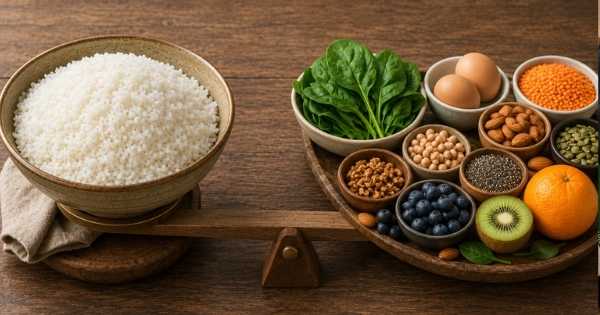
Iron can be replaced with leafy vegetables. Protein may come from eggs, pulses, or meat. Certain vitamins can be obtained from fruits and nuts.
The challenge is that replacing one food often requires adding several others.
And that replacement comes at a cost.
Is Replacing Rice Affordable?
Rice remains one of the most economical sources of energy and nutrients available to Indian households.
Replacing the nutrients found in rice may require spinach, eggs, seeds, fruits, pulses, nuts, or animal products. While these foods are valuable and nutritious, they are often more expensive, less accessible, and sometimes unavailable throughout the year.
For an urban professional with a diverse diet, this may not be a major concern. But for a low-income household, an elderly person, or someone living in a food-insecure region, replacing rice-derived nutrients can be difficult.
In such cases, reducing rice may not improve nutrition – it may simply shift nutritional risk elsewhere.
Who Can Reduce Rice Safely?
Not everyone faces the same consequences.
Individuals with higher incomes, access to diverse foods, and good nutritional awareness can often reduce rice while maintaining a balanced diet.
Others may struggle.
Physically active individuals require substantial energy. Elderly people may have limited appetites. Households with constrained food budgets often depend on staple foods to meet a large share of their nutritional needs.
For these groups, rice continues to play an important role in maintaining dietary adequacy.
Maybe the Problem Isn’t Rice
One reason rice has come under scrutiny is the rising prevalence of diabetes, obesity, and other lifestyle-related diseases.
But focusing solely on rice may oversimplify the issue.
Many health experts point out that declining physical activity is equally important. Modern lifestyles involve long hours of sitting, reduced manual work, and lower daily energy expenditure than previous generations.
In this context, cutting rice may be easier than increasing physical activity—but it is not always the most effective solution.
The Real Takeaway
The question is not whether rice should stay or go.
The real question is whether we are replacing what rice provided.
For some people, reducing rice may be appropriate. For others, it may create nutritional gaps that are neither recognised nor compensated.
Rice is more than a source of carbohydrates. It is an affordable package of energy and nutrients that has supported Indian diets for centuries.
Before removing it from the plate, it may be worth asking a simple question:
What exactly are we replacing it with—and can we afford that replacement in the long run?
Authors:
Dr. Niranjan S., and Dr. Punyakishore Maibam are Assistant Professors working at the Department of Basic Science and Humanities, College of community Science, Tura, Meghalaya.