
By Satyabrat Borah
The global gaze has shifted with an almost obsessive intensity toward the narrow stretch of water known as the Strait of Hormuz. As the latest conflict in the Gulf enters its second month, the diplomatic atmosphere is thick with a sense of impending finality. The proposal put forward by Donald Trump, a fifteen point plan aimed at a negotiated settlement, has met a wall in the form of a five point counter response from Tehran. While the world discusses nuclear capabilities and the reach of missile programs, the real struggle has localized around the control of this vital maritime artery. The American side insists that the waterway must be declared a free corridor with guaranteed passage for all nations while Iran maintains that it holds absolute sovereignty over these waters, even suggesting the implementation of transit fees similar to those seen at the Suez Canal.
While the modern military hardware and the high stakes of energy security dominate the headlines, a small and colorful island sitting just outside the port city of Bandar Abbas tells a much older story. This island is Hormuz, a place that seems to be experiencing a strange sense of repetition as it once again finds itself under the international spotlight. It is a land that has seen suitors come and go for centuries, all vying for control over one of the most strategic routes on the planet. If the island could speak, it would likely look toward India with a certain fondness, recalling a time when merchants from the Gujarat and Malabar coasts were the lifeblood of its economy.
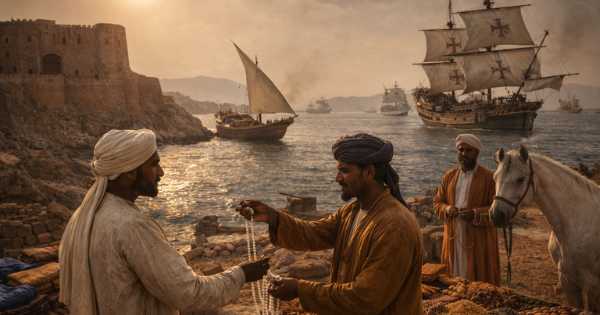
The history of the Kingdom of Ormuz, as it was famously called, reached its peak between the eleventh and fourteenth centuries. It was a golden age where the island transformed itself into a cosmopolitan hub that leveraged its location at the crossroads of global commerce. It was a magnet for people from all corners of the world. Merchants from Arabia, Persia, and China walked its streets, but it was the Indian presence that left the deepest mark. These traders brought with them the treasures of the subcontinent: spices that changed the flavor of European kitchens, cotton textiles that clothed the elites of the Middle East, indigo dyes, rice, and sugar. This was not just a transient business relationship. Many of these Indian merchants chose to make the island their permanent home, marrying into local families and blending their customs with the existing Persian and Arab traditions. This cultural fusion remains visible in the language and the cuisine of the region today.
In exchange for their goods, the Indians sought out the famous horses of Arabia and Persia, along with Basra pearls and dried fruits. They even acted as intermediaries for Chinese silks, selling them for massive profits back in the Indian markets. Even after the Mongol invasions of the fourteenth century forced the local rulers to move their administrative center to the mainland, the island remained a fortified and prosperous city. It was a place of bustling bazaars and massive warehouses, a testament to the power of trade over the politics of war.
The landscape changed dramatically in the fifteenth century when the Ottomans captured Constantinople. By seizing control of the traditional land routes to the east, they forced European powers to look toward the sea. Finding a direct route to India became the obsession of the age. When Vasco da Gama reached the shores of Kozhikode in fourteen ninety eight, the door was opened for Portuguese dominance along the western coast of India. By fifteen zero seven, Afonso de Albuquerque had established himself in Goa and Diu, declaring his role as the Portuguese Viceroy. He understood that controlling the trade with India required absolute mastery of the sea lanes. His first major move was to capture Hormuz and build the massive Fort of Our Lady of the Conception. For a long period, the Portuguese were the masters of the Gulf, taxing every ship that passed through and ensuring that no merchant could operate without their blessing.
This monopoly did not sit well with the British. The East India Company had its own ambitions and began its journey by sending representatives to the court of the Mughal emperor Jehangir. After securing a foothold in Surat in sixteen zero eight, the British realized that the Portuguese presence on Hormuz was the single greatest obstacle to their expansion into Persia. In sixteen twenty two, a naval force sent from Surat teamed up with the Persian emperor Shah Abbas to finally break the Portuguese hold on the island. This victory allowed the British to set up their own trading base in Bandar Abbas, marking the beginning of a long period of British influence in the region that was managed almost entirely from India.
The logistical and political control of the Gulf during this era was an extension of the British Raj in India. The Governor of Bombay and the Viceroy of India were the true architects of policy in the region. The Political Residents who managed the daily affairs of the Gulf were drawn from the Indian Political Service. They operated out of Bushehr and maintained naval squadrons in Hormuz and the neighboring island of Qeshm to protect British subjects and Indian interests. This arrangement lasted for nearly one hundred and seventy years, surviving various shifts in local power until the nineteen thirties. When the Persian state began to assert more direct control under Reza Shah Pahlavi, the British moved their naval contingent to Bahrain, where it remained until their final withdrawal in nineteen seventy one. It is a historical irony that the very facilities the British once used in Bahrain now serve as the home for the Fifth Fleet of the United States Navy.
In the contemporary era, the importance of this waterway to India has only grown. A significant portion of India’s foreign trade passes through this narrow strait. More importantly, over half of the country’s crude oil and liquefied natural gas imports move through these waters. The agricultural sector in India relies heavily on the urea and ammonia used for fertilizers, two thirds of which come through Hormuz. When tensions rise and transit is restricted, the impact is felt directly in the kitchens and farms across the Indian subcontinent. The history of shared connections is not just a collection of stories from the past but a living reality that dictates the economic survival of millions.
The current situation presents a massive challenge for global diplomacy. The Iranian insistence on sovereignty over the strait is based on a long memory of foreign intervention and a desire to leverage their geography against economic sanctions. On the other side, the international community views the freedom of navigation as a non negotiable principle of global trade. The friction between these two positions has turned the region into a powder keg. The small island of Hormuz, once a symbol of cosmopolitan trade and cultural exchange, now sits in the shadow of modern warships and surveillance drones.
Looking back at the centuries of interaction between India and the Gulf provides a different perspective on the current crisis. It reminds us that these waters were once a bridge rather than a barrier. The merchants of the past managed to create a thriving economy based on mutual benefit and cultural respect, even in the absence of modern international law. The ties between the Malabar coast and Bandar Abbas were built on the movement of goods and people, not just the movement of military assets. This historical depth suggests that a solution to the current impasse might require moving away from the rigid frameworks of military deterrence and toward a more nuanced understanding of regional history.
The island of Hormuz itself is a physical reminder of the transience of empires. The ruins of the Portuguese fort stand as a testament to a power that once thought it would rule the waves forever. The British influence that was once so absolute has faded into the archives of the India Office in London. The current dominance of the United States and the defiant stance of the Iranian state are part of a long cycle of power struggles that the island has witnessed many times before. The merchants of Gujarat and the residents of Bombay who once managed the affairs of the Gulf understood that stability was a product of long term relationships rather than temporary military victories.
As the fifth week of the war unfolds, the world remains on edge. The economic consequences of a full scale closure of the strait would be catastrophic, leading to a global recession and a massive spike in energy costs. The interconnected nature of the modern world means that no nation is truly insulated from the fallout of a conflict in the Gulf. For India, the stakes are particularly high. The historical links that once provided security and prosperity now serve as a reminder of the vulnerability that comes with geographic proximity and economic dependence.
The cultural footprint of India on the island of Hormuz is a subtle but persistent element of the local identity. The words used in the markets, the spices used in the kitchens, and the stories told by the older generations all hint at a time when the Indian Ocean was a unified space of commerce. This shared heritage offers a lens through which a different kind of diplomacy could be practiced. It suggests that the region is not just a strategic corridor for the transit of oil but a place of human connection and historical depth.
The demands for a free maritime corridor and the counter demands for transit fees are the latest iterations of a very old debate about who owns the sea. From the Portuguese to the British and now to the Americans and Iranians, the struggle for control remains the same. The difference today is the sheer scale of the potential destruction. The precision of modern missiles and the fragility of the global supply chain mean that a mistake in the Strait of Hormuz could have consequences that reach far beyond the immediate neighborhood.
If there is a lesson to be learned from the merchants who thrived on Hormuz centuries ago, it is that trade requires a certain level of pragmatism and a willingness to compromise. The Indians, Persians, Arabs, and Chinese who made the island a global hub were focused on the movement of goods and the generation of wealth. They understood that conflict was bad for business and that peace was the most profitable environment for everyone involved. In the high stakes world of modern geopolitics, this simple truth is often lost in the noise of nationalistic rhetoric and military posturing.
The island of Hormuz continues to sit quietly amidst the tension, its multi hued landscape a stark contrast to the gray steel of the warships patrolling the horizon. It remains a place of immense beauty and historical significance, caught once again in the middle of a storm. The wistful look toward India mentioned by observers is a recognition of a time when the relationship was defined by the exchange of silk and spices rather than the threat of sanctions and strikes.
The current geopolitical climate demands a return to a more balanced and historical understanding of the region. The focus on the five point or fifteen point plans often ignores the underlying reality of the people who live and work along these shores. The survival of the global economy and the stability of the Middle East depend on finding a way to share these waters that respects both the sovereignty of nations and the necessity of international trade.
The legacy of the British Raj and the administration of the Gulf from Bombay might seem like a distant memory, but the structures of power and the strategic importance of the region have remained remarkably consistent. The move from Bahrain to the Fifth Fleet is a direct line in history that connects the colonial past to the present day. Understanding this continuity is essential for anyone trying to navigate the complexities of the current crisis.
The challenge for India in the coming weeks will be to leverage its historical standing and its current economic weight to promote a peaceful resolution. The links that once made Hormuz an extension of the Indian commercial world provide a unique platform for mediation. It is a role that requires a deep appreciation for the history of the region and a clear understanding of the risks involved in a sustained conflict.
The Strait of Hormuz is more than a geographic chokepoint. It is a site of layered histories and deep cultural ties. The colorful island that stands at its mouth is a symbol of what the region could be if it were allowed to return to its roots as a hub of global interaction. As the world watches the latest Gulf war with anxiety, the story of Hormuz offers a reminder that the path to a stable future often involves a careful look at the lessons of the past. The merchants who built the Kingdom of Ormuz knew that the sea belongs to everyone and to no one at the same time. Their legacy is a call for a more human and historically grounded approach to the problems of the modern world.