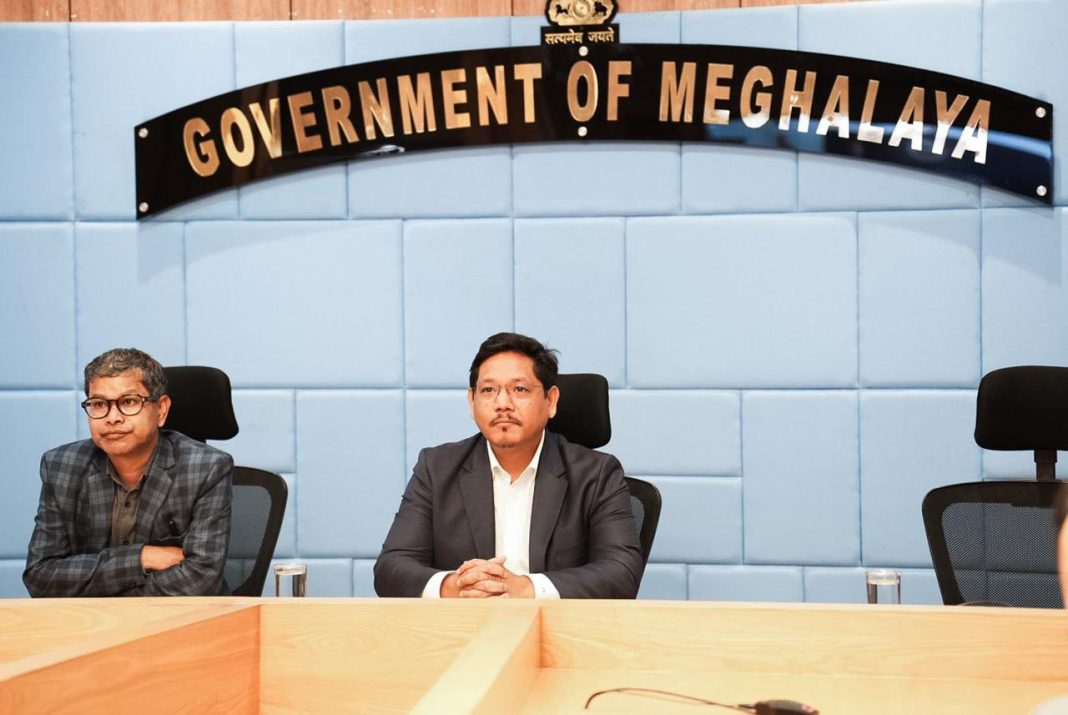

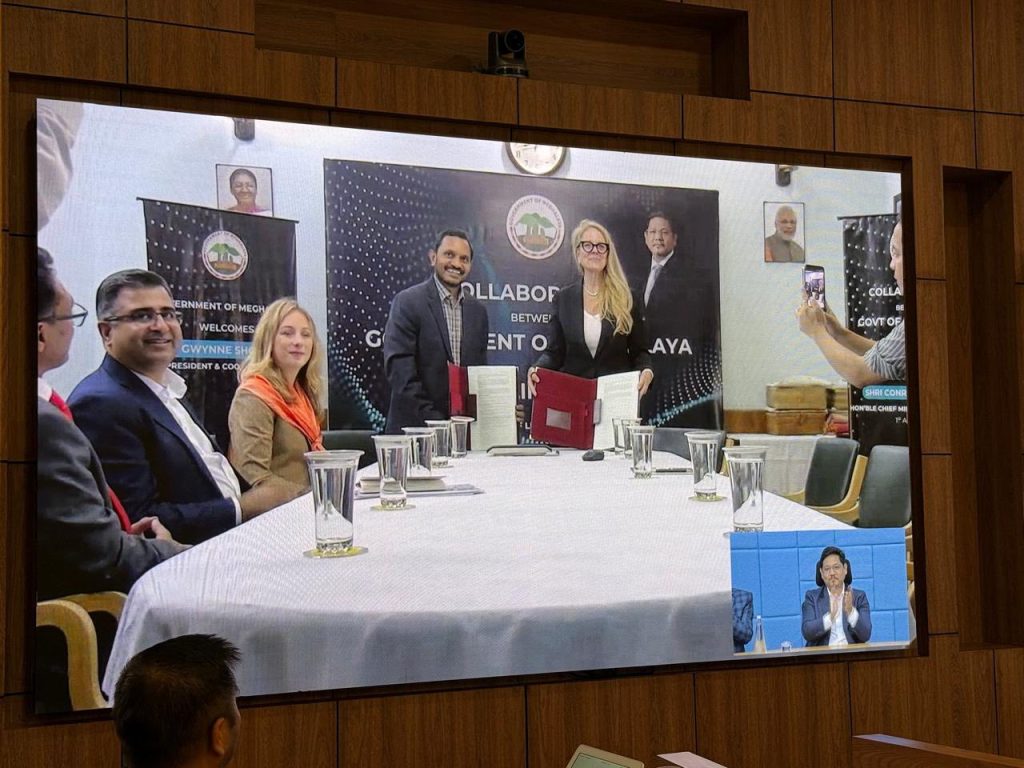
Shillong, April 1: Meghalaya moved a step closer to strengthening digital connectivity as Chief Minister Conrad K. Sangma on Tuesday witnessed the signing of a Letter of Intent (LoI) between the Government of Meghalaya and Starlink India—part of Elon Musk’s space company SpaceX—via video conference.
The initiative aligns with the state government’s broader vision of building a $10 billion economy by 2028, with digital connectivity seen as a key driver of inclusive growth and economic progress.
The signing ceremony was attended by Lahkmen Rymbui, Minister in-charge of Education; Sampath Kumar, Additional Chief Secretary and Development Commissioner; and other senior officials.
Representing Starlink were Gwynne Shotwell, President and COO of SpaceX; Lauren Dreyer, Vice President, Starlink Business Operations; Prabhakar Jayakumar, Country Head, Starlink India; and Parnil Urdhwareshe, Director, Starlink India.
Speaking on the occasion, Sangma highlighted Meghalaya’s development journey and the critical role of connectivity in driving inclusive growth. “Over the past eight years, we have focused extensively on infrastructure development, capacity building, and leveraging technology to bring governance closer to the people,” he said.
He noted that last-mile connectivity remains a persistent challenge. “We have been laying optical fibre networks to reach remote public health centres, schools, and villages, but this is a time-intensive process, and time is of the essence,” he added.
Expressing confidence in the partnership, the Chief Minister said the technology could have a transformative impact. “If it helps save even one life through better healthcare access, enables even one child to receive quality education, or improves a farmer’s income, it will be a meaningful success,” he said.
Outlining the state’s IT ambitions, Sangma said Meghalaya aims to develop Shillong into a hub for IT and IT-enabled services in the Northeast, with plans for data centres, submarine cable connectivity, and innovation in emerging fields such as artificial intelligence.
“While we may have started later than others, this is an opportunity to leapfrog. By adopting cutting-edge technologies like Starlink, we can overcome traditional limitations and accelerate our development trajectory,” he added.
He also stressed the urgency of implementation, stating that the immediate priority is to extend connectivity to the most remote and underserved areas.
Speaking at the event, Shotwell described the partnership as a “privilege” and a “significant step” toward connecting underserved communities. “Starlink’s mission is to provide reliable, high-speed connectivity to communities across India and the world,” she said.
She praised Meghalaya’s leadership in leveraging technology for equitable growth and said the collaboration would enhance access to education, healthcare, and economic opportunities, even in challenging terrains.
Reaffirming Starlink’s commitment, she added, “We are dedicated to working closely with the government to ensure this initiative delivers meaningful and lasting impact.”
Sampath Kumar highlighted that the collaboration would strengthen citizen-centric governance and improve last-mile service delivery, particularly in remote regions.
He said the partnership would open up transformative opportunities across sectors—improving healthcare services, enhancing educational outcomes, and accelerating inclusive growth.
Meghalaya’s hilly terrain and dispersed habitations have long posed challenges for conventional internet infrastructure such as optical fibre networks and mobile towers. In this context, satellite-based internet offers a practical and efficient alternative.
The partnership is expected to significantly enhance service delivery across sectors including education, healthcare, disaster management, governance, and rural development, while also creating new opportunities for entrepreneurship, skill development, and digital inclusion.