
By Dipak Kurmi
The intersection of private enterprise and global diplomacy has rarely been as visible or as contentious as it is in the contemporary relationship between Elon Musk and the Indian state. Recently, reports surfaced suggesting that Musk, the billionaire architect of SpaceX and Tesla, participated in a high-stakes telephone conversation between Indian Prime Minister Narendra Modi and United States President Donald Trump. While the New York Times initially characterized this involvement as a notable anomaly where a private citizen joined two heads of state during a period of international crisis, New Delhi was swift in its clarification. The Ministry of External Affairs, through spokesperson Randhir Jaiswal, asserted that the dialogue on March 24 was strictly a bilateral exchange between Modi and Trump focused on the volatile situation in West Asia. Despite this official denial, the mere suggestion of Musk’s presence underscores his burgeoning role as a quasi-diplomatic figure whose commercial interests are increasingly inextricably linked with the geopolitical stability of the Indo-Pacific and Middle Eastern regions.
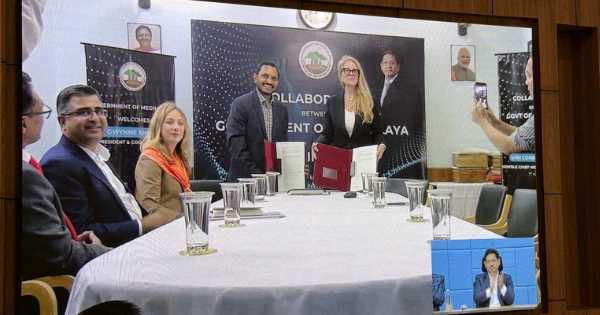
The administrative landscape in New Delhi has recently seen a flurry of activity involving Musk’s primary corporate vehicles, SpaceX and Starlink. Senior leadership from these entities, including SpaceX President and COO Gwynne Shotwell and Starlink Vice President of Global Business Lauren Dreyer, held high-level discussions with Union Communications Minister Jyotiraditya Scindia. This meeting signifies a deepening of ties that go beyond mere regulatory formalities, moving toward a strategic partnership that could redefine India’s digital infrastructure. Minister Scindia publicly acknowledged the meeting on the social media platform X, highlighting a growing synergy between the Indian government and Musk’s satellite ventures. This momentum is further evidenced by Starlink signing a letter of intent with the state of Meghalaya to explore high-speed internet solutions for the North-Eastern region, adding to a portfolio of preliminary agreements already established with major states such as Maharashtra, Gujarat, and Goa.
While Starlink secured the necessary regulatory approvals to operate in India as early as last year, the commercial rollout remains in a state of strategic suspension. New Delhi continues to conduct a rigorous evaluation of the security implications inherent in satellite communication technology, a cautious approach that reflects India’s broader concerns regarding data sovereignty and national security. Nonetheless, Musk clearly views India as a cornerstone of his global expansion strategy. The country represents a massive, largely untapped market for high-speed connectivity, particularly in rural or topographically challenging areas where traditional fiber optics struggle to reach. By aligning with regional governments and navigating the complex bureaucratic corridors of the capital, Starlink is positioning itself to be the primary provider in a market that Musk considers vital for the long-term viability of his space-based internet constellation.
The timing of Musk’s reported diplomatic engagement is particularly significant given the current global instability, specifically the escalating conflict in Iran and the subsequent disruptions in the Middle East. Analysts suggest that Musk’s companies face fresh vulnerabilities due to these tensions, which may have motivated his re-engagement with the American executive branch. Having previously experienced a public fallout with Donald Trump after the latter’s departure from government, Musk’s heavy support for Trump’s recent presidential bid appears to have restored his leverage within the Washington D.C. power structure. This renewed influence is essential as Musk navigates the economic ripples of the war, including the blockade of the Strait of Hormuz. Such disruptions threaten the global supply chain for critical materials like helium and petrochemicals, both of which are foundational to the operations of SpaceX and Tesla.
The economic stakes for SpaceX are particularly high regarding the availability of helium, a resource largely controlled by Qatar, which produces nearly one-third of the world’s supply. The blockade at the Strait of Hormuz has caused spot prices for helium to nearly double, creating a logistical nightmare for the pressurization of propellant tanks in Falcon 9 and Starship rockets. Furthermore, Tesla’s semiconductor supply chain is equally at risk, as the etching processes at major South Korean fabrication plants operated by SK Hynix and Samsung rely heavily on stable helium supplies. These pressures have created a window for Musk to present his interests as synonymous with American national interests, pivoting toward an administration that prioritizes securing specific business channels. Senior officials in Delhi have noted Musk’s belief that India could serve as a stabilizing force, potentially acting as a hedge or a partner in normalizing the fractured supply chains that currently haunt the global tech industry.
India’s role as a lucrative market extends beyond telecommunications to the automotive and artificial intelligence sectors. Tesla’s journey into the Indian market has been a saga of high-stakes negotiation and regulatory friction, primarily revolving around the country’s high import tariffs. For years, Musk criticized the 100 percent duties on foreign-manufactured electric vehicles, which he argued made Tesla’s products prohibitively expensive for the local population. In a move widely interpreted as a concession to Musk’s persistent lobbying, India recently announced a new EV policy that allows for the import of completely built-up units at a significantly reduced rate of 15 percent, provided certain conditions are met. This policy shift paved the way for Tesla to launch retail operations in Mumbai and the Delhi-NCR region. Although initial purchasing numbers have not yet reached an overwhelming scale, the presence of official showrooms marks a historic shift in Tesla’s commitment to a country where electric vehicle adoption is steadily climbing, currently sitting at approximately 8 percent of total car sales.
The evolution of Tesla in India is also visible in its labor strategy. While the company has yet to break ground on a domestic manufacturing facility, it has significantly ramped up its recruitment efforts within the country. In the past year, Tesla advertised for over a dozen key roles, including store managers, service advisors, and business operations analysts, suggesting a focus on building a robust service and sales network before committing to heavy industrial investment. This follows a period in 2022 when the company had briefly paused its manufacturing plans after initial hires were made, illustrating the sensitive nature of Musk’s “manufacture-where-you-sell” philosophy against the backdrop of India’s “Make in India” initiative. The current trajectory suggests a more cautious, phased entry that prioritizes market presence and brand loyalty while waiting for global economic conditions to stabilize, especially as SpaceX considers an initial public offering that could be jeopardized by continued international turmoil.
In the realm of satellite communications, Musk has demonstrated a surprising degree of pragmatism by partnering with India’s dominant telecom giants, Jio Platforms and Bharti Airtel. This collaboration was unexpected, as Starlink and Reliance-owned Jio were previously on opposite sides of a fierce debate regarding spectrum allocation. Jio had advocated for a traditional auction process, while SpaceX insisted on administrative allocation, which is the global standard for satellite services. Ultimately, the Indian government decided in favor of administrative allocation, a move that favored Musk’s model but required a degree of cooperation with local incumbents. These partnerships are critical for Starlink’s ability to navigate the complex telecommunications landscape of India, ensuring that it can integrate its high-latency-beating technology with existing ground networks to provide seamless connectivity to the furthest reaches of the subcontinent.
Despite these areas of cooperation, the relationship between Musk’s ventures and the Indian government is not without its sharp edges. The social media platform X and its integrated artificial intelligence service, Grok, have frequently found themselves at loggerheads with Indian authorities over issues of content moderation and digital ethics. Last year, X took the unprecedented step of suing the Indian government, challenging what it described as a parallel online content-blocking regime that infringed upon free speech. Although the company lost the initial case in the Karnataka High Court and is currently pursuing an appeal, the legal battle highlights the fundamental tension between Musk’s “free speech absolutist” philosophy and India’s stringent IT rules. Furthermore, the AI service Grok faced government scrutiny after it was discovered to be generating non-consensual, obscene images of women in response to user prompts. This prompted a stern missive from the government regarding the dignity and privacy of citizens, leading the company to eventually comply and restrict the offending features.
The multifaceted engagement between Elon Musk and India reflects a broader trend where the interests of global tech moguls are increasingly indistinguishable from statecraft. Whether it is through the strategic deployment of Starlink to bridge the digital divide in Meghalaya or the navigation of supply chain crises involving Qatari helium and South Korean semiconductors, Musk is operating on a plane that requires constant negotiation with sovereign powers. India, with its massive user base and growing appetite for high-tech solutions, offers Musk a unique opportunity to scale his vision, provided he can manage the intricate balance of local regulations and national security concerns. As global economic conditions remain precarious and the threat of further disruption in the Middle East looms, the partnership between the world’s most famous entrepreneur and the world’s most populous democracy will likely remain one of the most consequential dynamics in the modern industrial era.
(the writer can be reached at dipakkurmiglpltd@gmail.com)