
By Satyabrat Borah
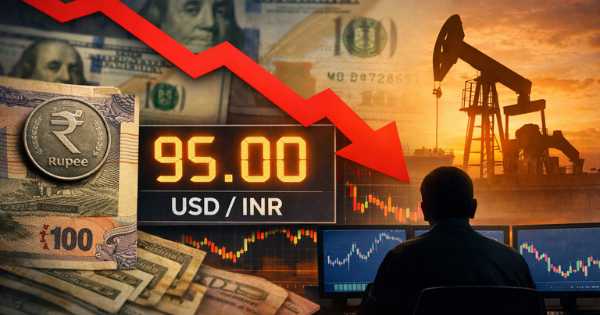
The current state of the Indian rupee presents a complex puzzle for policymakers and citizens alike as they navigate a global landscape filled with unpredictability. When the currency briefly touched the mark of ninety five against the dollar earlier this week it sent ripples of concern through the financial markets and prompted a wider discussion about how much the central bank should intervene. While there was a slight recovery toward the middle of the week the underlying trend shows a significant weakening over the past year. Looking at the broader picture of the 2025-26 period the rupee has lost nearly ten percent of its value which is a staggering figure for a major economy.
This decline was particularly sharp during the month of March when a drop of over four percent occurred in just a few short weeks. This situation is not happening in a vacuum because several other Asian economies like South Korea and Thailand are facing similar struggles as their currencies feel the heat from regional conflicts and changing global trade dynamics.
To understand why the rupee is feeling so much weight we have to look at the twin pressures coming from different parts of the balance sheet. India has a massive appetite for energy and relies heavily on imports to keep its lights on and its vehicles moving. This dependence means that any jump in global oil prices acts as a direct hit to the national pocketbook. During the recent period of volatility the cost of crude oil climbed significantly and this creates an immediate strain on the current account. Financial analysts suggest that even a modest increase in oil prices can widen the national deficit by a measurable margin which makes it harder to maintain a stable exchange rate.
The ongoing conflict in West Asia further complicates this because it threatens the flow of goods to major trading partners like the United Arab Emirates. When exports are blocked or delayed by war the inward flow of foreign currency dries up while the cost of necessary imports continues to rise.
On the other side of the ledger we see a massive shift in how investors are moving their money. Foreign portfolio investors who once viewed the local market as a land of opportunity have started pulling their funds out at an alarming rate. In a single month billions of dollars left the country as international money managers sought safety in the United States or other perceived havens. This exodus of capital is joined by a noticeable slowdown in direct foreign investment which usually represents longer term commitments to building factories and infrastructure. When both short term and long term investments slow down at the same time the demand for the local currency drops and its value inevitably slides against the dollar.
The Reserve Bank of India has not stayed idle while these events unfolded. It has taken several steps to try and steady the ship by imposing new rules on how much foreign exchange banks can hold and by using its own reserves to buy up rupees in the open market. We can see the evidence of this in the shrinking size of the national foreign currency assets which dropped by many billions in a very short span of time. The central bank is also taking positions in the futures market to signal its intent to support the currency.
While these actions are intended to prevent a total panic, they raise a fundamental question about whether it is wise to try and fight against the natural forces of the market. Many economists argue that trying to defend a specific number or level is a losing battle that only wastes precious resources.
There is a growing school of thought that believes the exchange rate should be allowed to act as a natural shock absorber for the economy. If the rupee is allowed to find its own level based on supply and demand it can actually help the country adjust to external changes. A weaker currency makes goods produced within the country cheaper for foreigners to buy which can give a much needed boost to exporters. At the same time it makes imported luxury goods more expensive which encourages people to buy local products and reduces the overall trade gap. By stepping back and letting the currency move the central bank can preserve its reserves for a time of even greater crisis instead of spending them all now to maintain an artificial price.
The history of economic crises around the world shows that central banks that try too hard to peg their currency to a certain value often end up facing even worse collapses when they finally run out of ammunition. It is often better to accept a gradual decline that reflects the reality of the global economy than to hold a line until it snaps. The former deputy governor of the bank suggested using specialized international credit facilities to provide liquidity without draining local gold or dollar hozens. This kind of creative thinking shows that there are ways to manage the transition without getting into a direct fight with market speculators who have much deeper pockets than any single nation.
As the next major policy meeting approaches everyone is waiting to see what the governor will say about the future path of the rupee. The language used in these official statements is just as important as the actual money spent because it sets the tone for expectations in the coming months. If the message is that the bank will do whatever it takes to stop the fall it might invite more speculation. If the message is that the bank values stability but accepts the new reality it could lead to a more orderly adjustment. The goal should be to manage the speed of the change so that businesses and families have time to adapt to the new costs without being overwhelmed by sudden shocks.
The pressure on the currency is a reflection of the interconnected nature of the modern world where a war in one region or a change in interest rates in another can have an immediate impact on a person sitting in a small town in India. While it is natural to want to see the national currency remain strong for reasons of pride and purchasing power, the health of the overall economy depends on being flexible. The current situation requires a delicate balance of careful monitoring and the courage to stay out of the way when the market is trying to tell us something important. Letting the rupee find its own path might be the most responsible choice for the long term prosperity of the country as it navigates through these stormy global waters.
The ongoing shifts in the global landscape suggest that the era of a very stable and cheap dollar is likely behind us for now. This means the country must focus on its internal strengths such as manufacturing and services to create value that is not purely dependent on the exchange rate. By improving the ease of doing business and upgrading infrastructure the nation can attract investment that stays put even when the global mood turns sour. The central bank has a massive responsibility to guard the gates of the financial system but its most powerful tool might be its ability to remain calm and let the natural economic cycles play out. If the rupee is under pressure the best response is often to let it breathe and adjust to the new world we find ourselves living in today.