
By Satyabrat Borah
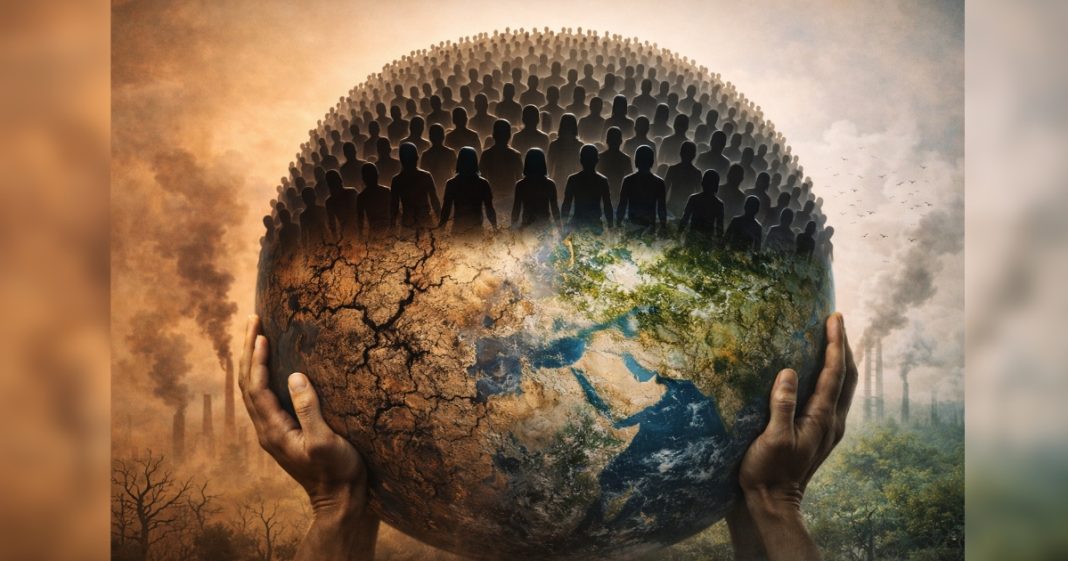
The story of our planet is often told through the lens of progress and expansion but a growing body of scientific evidence suggests we have reached a chapter where the physical limits of Earth are starting to push back against us. An international team of scientists recently published a study in Environmental Research Letters that serves as a sobering wake-up call for the modern world. Their findings indicate that the human population has already climbed past the level that our biosphere can support over the long term. This is not just a concern for the distant future because the research shows we have been living on borrowed time since the middle of the twentieth century. We are currently operating in a state of ecological deficit which means we are consuming natural resources much faster than the Earth can replenish them.
When we look back at the history of human development we see a massive spike in growth that began around 1950. This era brought about incredible advancements in medicine and technology and agriculture which allowed billions more people to survive and thrive. This same period marked a fundamental shift in our relationship with the environment. By 1970 the balance had tipped. For the first time in human history our collective footprint became larger than the planet itself. We began to use up the natural capital of the world instead of living off the interest generated by healthy ecosystems. This transition into a deficit means we are essentially draining the batteries of the Earth to keep our current civilization running.
The current model of success for most nations relies heavily on intensive resource use and the burning of fossil fuels. This approach has successfully raised the standard of living for many people across the globe but it creates a fragile foundation for the future. The study points out that the Earth cannot sustain the current human population or the even larger numbers expected in the coming decades without a complete overhaul of how we interact with land and water and energy.
Every piece of food we eat and every gallon of water we drink and every watt of electricity we use puts a tiny bit of pressure on the globe. When you multiply that pressure by eight billion people it becomes a weight that the natural systems of the world were never designed to carry.
Researchers predict that the global population could swell to nearly twelve billion people by the latter half of this century. This projection is particularly alarming when compared to what scientists consider an ecologically safe population.
Based on current levels of consumption and waste an environmentally stable world would likely only hold about two or three billion people. This massive gap between where we are and where we need to be highlights the scale of the challenge ahead of us. It suggests that even if we managed to stop population growth today we would still be facing a crisis of sustainability because our current numbers already far exceed the carrying capacity of the land.
The link between a rising population and the health of the planet is direct and powerful.
The study found that total population size is actually a much stronger predictor of environmental damage than the rising consumption rates of individuals. While it is true that a person in a wealthy nation uses more resources than a person in a developing one, the sheer number of humans on the planet is the primary driver of rising temperatures and carbon emissions and the loss of biodiversity. Every new person requires space and resources which often comes at the expense of forests and wetlands and the animals that live there. We are essentially crowding out the rest of life on Earth to make room for ourselves.
Even though the data feels heavy and the projections look grim the researchers believe there is still a path forward. The solution lies in a dramatic shift toward sustainable habits and a reduction in social inequality. We need to find ways to use our resources much more efficiently and move away from the idea that constant growth is the only way to measure success. A world with fewer people living more intentionally could provide a high quality of life for everyone without destroying the very systems that keep us alive. This would require a global effort to change how we think about everything from urban planning to the way we produce our food.
Events like Earth Hour show that people are becoming more aware of these issues. Seeing cities go dark for a moment is a powerful symbol of our shared responsibility to the planet. Symbolism alone will not fix the ecological deficit. We need to move into a phase of action where we respect the biological limits of the Earth. If we continue to ignore the fact that we are living beyond the means of our environment we risk a future where the planet can no longer provide the basics like clean air and fresh water and a stable climate. The goal is to build a world where humans and nature can exist in a true balance that lasts for generations. This study serves as a map showing us exactly where we have gone off course and it provides the motivation to start finding our way back to a sustainable path.