
By Satyabrat Borah
The decision by the People’s Republic of China to remain on the periphery of the escalating conflict in West Asia is a strategic move that carries deep implications for the future of global power. While many observers in the West might look at Beijing’s relative silence and conclude that the dragon lacks the teeth to intervene in such a volatile region, this interpretation misses the calculated patience that defines Chinese foreign policy. Just as the American involvement in the Gulf has been a series of active choices, China has made a deliberate choice to stay aloof. This is not a sign of weakness but rather a reflection of a culture that values long term observation over impulsive action.
The Chinese leadership is known for a specific kind of discipline that refuses to rush toward a judgment without first conducting an exhaustive study of the ripples every action creates. By maintaining a stance of quiet condemnation against the violence while refusing to commit its own resources to the fire, Beijing is playing a game of wait and see that may yield more rewards than any direct military intervention ever could.
This posture of passive observation masks a very active interest in the shifting tides of the war. As the conflict continues, the traditional structures of power that have governed the Middle East for nearly a century are beginning to fray.
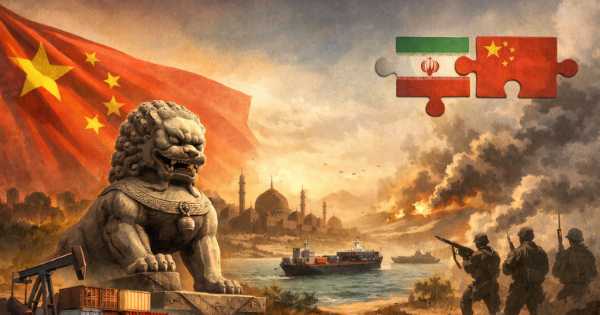
China understands that every day the United States spends focused on this geography is another day where American attention is pulled away from the Indo Pacific. The shadows cast by the current violence provide a convenient cover for Beijing to strengthen its ties with nations that feel increasingly alienated by Western military strategy. The benefits of this war for China are not immediate or explosive, but they are structural and enduring. One of the most significant outcomes is the inevitable tightening of the bond between Beijing and Tehran. Under the pressure of sanctions and physical attacks, Iran finds itself with fewer and fewer partners on the world stage. This isolation creates a natural vacuum that China is more than happy to fill.
In the aftermath of any conflict, the task of rebuilding becomes the next frontier of influence. Because China has stayed out of the actual fighting, it positions itself as a neutral economic titan ready to provide the capital and engineering expertise needed to restore shattered cities and broken energy grids. Iran will likely become significantly more dependent on Chinese investment for its survival. In exchange for this support, Beijing secures preferential access to Iranian crude oil, ensuring its own energy security for decades to come.
This relationship is not merely transactional but deeply strategic. The geography of Iran places it at the doorstep of two of the most critical maritime choke points in the world, the Strait of Hormuz and the Bab el Mandeb. By anchoring its influence in Iran, China effectively gains a foothold in the northern Indian Ocean. This could eventually lead to basing facilities or at the very least a permanent maritime presence that challenges the historical naval dominance of the West in these waters.
Furthermore, the war is accelerating the creation of a unified Eurasian bloc that operates independently of Western institutions. China has been the primary architect of this movement, carefully steering Iran into groups like the Shanghai Cooperation Organization and BRICS. The goal is to create a seamless network of trade and security that stretches from the Pacific to the edges of Europe. By binding Russia, Iran, and Pakistan into a cohesive alignment, China creates a massive buffer zone. This block serves as a shield against what Beijing perceives as American efforts to subvert its domestic stability in sensitive border regions like Xinjiang and Tibet. The chaos in West Asia, ironically, ends up reinforcing the walls of the Chinese fortress by forcing these neighboring powers to huddle closer to Beijing for protection.
Perhaps the most damaging realization for the old world order is the visible limit of Western power. For a long time, the global community operated under the assumption that the West held a total monopoly on the high ground of technology, finance, and military equipment. The current war has shown that this is no longer the case. When nations find themselves cut off from Western banking channels or denied access to specific weapon systems, China stands ready with alternatives. Whether it is satellite navigation systems that do not rely on GPS, artificial intelligence platforms for battlefield management, or robust shipping lines that ignore Western sanctions, the Chinese alternative is becoming a reality. This marks a profound shift in the global hierarchy. The era where one side could dictate the rules of engagement through technological superiority is fading.
China is watching the West struggle with the heavy burden of its own military commitments. Every missile fired and every diplomatic bridge burned by the traditional powers represents an opening for a different kind of influence. Beijing offers a narrative of stability and infrastructure as an alternative to the cycle of intervention and regime change. This appeal is growing in the Global South, where countries are tired of being caught in the crossfire of great power competitions. By staying on the sidelines, China preserves its own resources while its primary rivals exhaust theirs. The economic cost of war is immense, and while the United States pours billions into military aid and logistics, China continues to build its domestic economy and expand its commercial reaches across Africa and Southeast Asia.
The risk for China in this approach is the potential for regional instability to spiral so far out of control that it disrupts global trade entirely. As a major trading nation, China relies on the free flow of goods through the very waters that are currently under threat. However, the calculation in Beijing seems to be that the long term strategic gain of a diminished Western presence outweighs the short term pain of trade disruptions. There is also the matter of international reputation. By positioning itself as the voice of reason that calls for peace from the sidelines, China tries to capture the moral high ground in the eyes of the non Western world. It paints a picture of a responsible rising power that does not seek to impose its will through force, even as it builds the economic chains that bind other nations to its interests.
The war in West Asia is acting as a massive centrifuge, separating the world into distinct camps and spinning the old alliances into pieces. China is the quiet beneficiary of this process. It does not need to fire a single shot to see its national security goals advanced. The erosion of Western hegemony is happening in real time on the streets of the Middle East, and China is simply waiting to collect the pieces. The true test will be whether Beijing can manage this newfound influence without falling into the same traps of overextension that have plagued empires before it. For now, the dragon remains in the shadows, watching, learning, and preparing for a world where the old rules no longer apply. The choice to stay on the sidelines is the most powerful move China has made in years, proving that in the theater of global politics, sometimes the most important actor is the one who refuses to take the stage until the final act.