
By Satyabrat Borah
The decision by the government of Bangladesh led by Tarique Rahman to formally seek the support of China for the Teesta River Comprehensive Management and Restoration Project marks a defining moment in the shifting landscape of South Asian geopolitics. This move carries immense weight because the Teesta River is not just a body of water but a lifeline for millions of people and a flashpoint for diplomatic tension between Dhaka and New Delhi. By inviting Beijing to take a lead role in a project situated so close to the sensitive borders of India, Bangladesh is signaling a departure from its traditional foreign policy balance and leaning into a new era of strategic partnerships. The implications of this choice ripple far across the plains of Bengal and into the corridors of power in both India and China.
To understand the magnitude of this development, one must first look at the geography of the river itself. The Teesta originates in the high altitudes of the eastern Himalayas, cutting through the rugged terrain of Sikkim and the lush foothills of West Bengal before crossing into the northern plains of Bangladesh. For the people living along its banks, the river dictates the rhythm of life, providing water for the vast irrigation networks that sustain rice cultivation and supporting local fisheries.
For decades, the management of this transboundary river has been a source of friction. Bangladesh has long argued that the construction of dams and barrages on the Indian side has severely restricted the flow of water during the dry season, leading to drought conditions and economic hardship for its farmers. Conversely, during the monsoon, the sudden release of excess water often causes devastating floods and erosion.
The Teesta River Comprehensive Management and Restoration Project was conceived as a holistic solution to these recurring disasters.
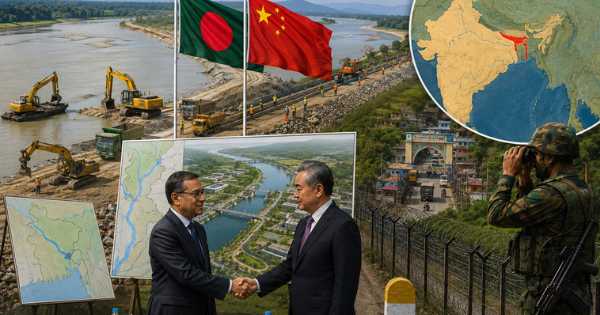
The plan involves massive dredging to deepen the riverbed, the construction of embankments to prevent flooding, and the creation of a series of reservoirs and satellite towns along the riverbanks. It is an ambitious undertaking that requires billions of dollars in investment and high level technical expertise. For several years, China has expressed a keen interest in financing and executing this project as part of its broader Belt and Road Initiative. The recent meeting in Beijing between Bangladesh Foreign Minister Khalilur Rahman and Chinese Foreign Minister Wang Yi confirms that this interest has now translated into a formal request for assistance.
The timing of this request is particularly notable given the recent political changes in Dhaka. The transition from the administration of Sheikh Hasina to the interim leadership of Muhammad Yunus and now the government of Tarique Rahman has brought a visible change in how Bangladesh engages with its neighbors. While the previous government maintained a delicate act of balancing the interests of India and China, the current leadership appears more willing to embrace Chinese investment even when it touches upon India’s most sensitive security concerns. This shift is viewed with significant apprehension in New Delhi.
India’s concern is rooted in the location of the project. The Teesta flows near the Siliguri Corridor, a narrow strip of land often referred to as the Chicken’s Neck. This corridor is the only land link between the main part of India and its eight northeastern states. Any significant foreign presence in this area, especially that of a strategic rival like China, is seen as a potential threat to India’s territorial integrity. If Chinese engineers, technicians, and workers are stationed along the Teesta for a long term project, New Delhi fears that this presence could be used for surveillance or to gain a tactical advantage in a region that has seen historical border disputes. The thought of Chinese footprints so close to this vital artery is a nightmare scenario for Indian defense planners.
In an effort to prevent this outcome, India made a proactive offer in 2024 to provide its own technical and conservation assistance for the Teesta basin. This was a clear attempt to provide Dhaka with an alternative to Chinese involvement. By offering to help manage the river, India hoped to address Bangladesh’s water security needs while keeping the project within the sphere of bilateral cooperation. The fact that the Rahman government has chosen to move forward with China suggests that the Indian offer did not meet the specific financial or structural requirements of the project, or that Dhaka is making a conscious choice to diversify its dependencies.
The dialogue between Foreign Minister Khalilur Rahman and Wang Yi highlights the deepening of the China Bangladesh Comprehensive Strategic Cooperative Partnership. China has positioned itself as a reliable partner for infrastructure development, offering a model of high quality cooperation that aligns with Bangladesh’s national strategies. Wang Yi’s statement that China’s ties with South Asian countries do not target any third party is a standard diplomatic refrain, but it does little to ease the anxieties of those in New Delhi who see a pattern of encirclement. From the development of ports to the building of bridges and power plants, Chinese capital is now woven into the fabric of the Bangladeshi economy.
Bangladesh is currently facing significant economic pressures, and the lure of large scale investment is strong. China is already the fourth largest lender to the country, and the promise of further investment in traditional areas like infrastructure and trade is a compelling proposition for a government looking to stabilize the economy and deliver on development promises. The commitment by Dhaka to the One China principle and its opposition to Taiwan independence are part of the diplomatic price for this economic support. This alignment shows a high level of mutual trust and a shared vision for the future of the region.
The water sharing issue remains the most emotional and politically charged aspect of the relationship between India and Bangladesh. The 1996 Ganges Water Treaty is nearing its expiration, and the lack of progress on a formal Teesta treaty has left many in Bangladesh feeling that bilateral negotiations with India have reached a dead end. In this context, the Chinese project is seen by some in Dhaka as a way to take control of their own water destiny. Instead of waiting for a treaty that may never come, they are looking to engineering and management solutions to mitigate the impact of water scarcity. This approach prioritizes immediate internal needs over the sensitivities of a neighbor.
The relationship between India and Bangladesh has historically been described as a golden chapter of diplomacy, characterized by cooperation on security, connectivity, and trade. The fall of the Hasina government and the subsequent rise of a leadership that is perceived to be closer to China and Pakistan has strained this bond. India now finds itself in a position where it must navigate a much more complex and perhaps less friendly political environment in its backyard. The decision to bring China into the Teesta project is a physical manifestation of this new reality.
As the project moves from the stage of formal requests to implementation, the regional dynamics will continue to evolve. China’s role as a primary developer in South Asia is expanding, and its ability to offer massive financial packages makes it an attractive partner for nations seeking rapid growth. For Bangladesh, the Teesta project represents a chance to transform a region that has long suffered from the whims of nature and the delays of diplomacy. For India, it represents a challenge to its traditional influence and a test of its ability to offer viable alternatives to its neighbors.
The conversation between Dhaka and Beijing reflects a world where middle powers are increasingly assertive in choosing their partners based on pragmatic interests. The historical ties of culture and geography that bind India and Bangladesh are being tested by the hard realities of modern geopolitics and the vast resources of a global superpower. The Teesta River, once a symbol of shared heritage and natural beauty, is now a stage for a high stakes game of influence. The decisions made in the coming months will determine whether the river becomes a bridge for regional cooperation or a fault line for future conflict. The people living in the Teesta basin care most about the water in their fields and the safety of their homes, but their future is now being shaped by decisions made in distant capitals where the maps are drawn with a focus on power and strategy. This is the reality of a changing world where the flow of a river can change the course of history.