
By Satyabrat Borah
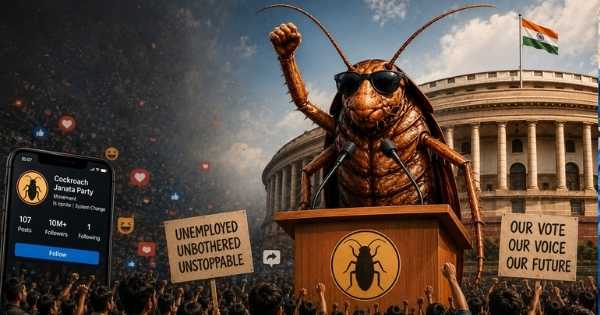
A fascinating shift is taking place across the digital landscape of India, where political conversations are often heavy, polarized, and deeply structured. A new entity has emerged out of nowhere, capturing the collective imagination of millions of young citizens almost overnight. It goes by the unusual and intentionally provocative name of the Cockroach Janta Party. If you spend any time scrolling through social media platforms, you have likely seen its crest, its memes, and its rapidly climbing follower count, which managed to zoom past the official accounts of some of the country’s most powerful, established political machines within a matter of days. This sudden explosion of digital popularity raises a highly compelling question for anyone watching the subcontinental political theater. Can a movement that started as a hyper ironic online joke translate into a force capable of causing a monumental shift in Indian politics, or is it destined to remain a fleeting moment of digital defiance.
To understand the potential of this movement, one has to look closely at its origin story, which is deeply rooted in anger, alienation, and a sharp sense of institutional betrayal. The spark that ignited this entire phenomenon was a comment made during a high profile courtroom hearing. When public remarks compared unrepresented, unemployed young people trying to find their footing through digital media, activism, or alternative professions to pests and parasites attacking the system, a nerve was hit. For a generation already dealing with a highly competitive environment and a stark lack of traditional jobs, the analogy felt like a direct insult from the highest corridors of institutional power. Instead of responding with standard political rallies, legal petitions, or solemn press statements, a thirty year old public relations student and former political social media strategist named Abhijeet Dipke decided to fight back using the language of the modern internet. He created a registration link, built a quick website with the help of artificial intelligence, and invited everyone who felt ignored, insulted, or labeled by the system to claim the identity proudly. The Cockroach Janta Party was born, using the very label meant to devalue young citizens as a badge of honor.
The response was immediate, massive, and entirely unprecedented in the history of Indian digital movements. Within hours, thousands of people registered. Within five days, the party’s Instagram presence exploded past ten million followers, leaving long established political parties trailing in its digital wake. Prominent national politicians and well known social media influencers began engaging with the platform, requesting membership or boosting its reach. The eligibility criteria listed for prospective members were intentionally absurd, requiring people to be unemployed, physically lazy, chronically online, and capable of ranting professionally. This self-deprecating, deeply ironic stance resonated instantly with Gen Z and millennial Indians who feel stuck in a loop of endless examinations, paper leaks, rising living costs, and an economy that seems unable to absorb their skills. By wrapping their genuine anxieties in layers of sharp sarcasm, the creators of this movement managed to bypass traditional political exhaustion. They turned a feeling of absolute helplessness into a massive, participatory digital festival.
When evaluating whether this phenomenon can leave a lasting scar on the traditional political landscape, it helps to analyze the specific demands put forward by this group. Their manifesto is a brilliant, tightrope walk between laugh out loud parody and dead serious systemic critique. They demand a complete ban on post retirement Rajya Sabha seats for Chief Justices, a direct swipe at perceived judicial alignment with ruling establishments. They argue for a twenty year election ban on any elected representative who switches political allegiances, addressing the rampant problem of political defection that often makes a mockery of ordinary votes. They call for fifty percent reservation for women in both the parliament and the cabinet without increasing the overall size of the legislature. They even target everyday student grievances, demanding that the Central Board of Secondary Education eliminate high rechecking fees, which they describe as institutional extortion targeting young people for errors made by examiners. They have taken a stand on national examination controversies, directly aligning themselves with the frustrations of millions of students. By mixing grand constitutional reforms with everyday student struggles, they have built a platform that feels incredibly real to the average youth.
The true strength of this movement lies in its mastery of modern communication. Traditional Indian politics relies heavily on massive physical mobilization, expensive billboard campaigns, television news cycles, and complex caste alliances. The Cockroach Janta Party operates on a completely different playing field. Their primary weapon is the mobile phone, which they have jokingly declared as their official election symbol. Their campaign material consists of high quality, AI generated anthems, nostalgic aesthetic templates, and relatable short videos that explain complex institutional failures through humor. They speak the native language of the internet, a space where mainstream political parties often struggle to appear authentic. Traditional parties invest massive amounts of money into IT cells to manufacture trends and push rigid narratives. The Cockroach Janta Party achieved organic, explosive growth simply by reflecting the unvarnished feelings of its audience. This demonstrates that the monopoly over political narrative is shifting away from centralized party offices and into the hands of decentralized digital creators.
There is a massive gulf between collecting millions of digital clicks and building an actual, functioning political organization capable of fighting elections in India. Social media metrics are notoriously deceptive. A double tap on a smartphone screen requires virtually zero effort, zero personal risk, and zero financial investment. Standing in a long line at a polling booth, facing local intimidation, organizing grassroots workers at the booth level, and convincing rural voters who are completely disconnected from Instagram trends are entirely different challenges. India’s electoral machinery is vast, brutal, and deeply dependent on money power, physical muscle, and entrenched local networks. A movement that thrives on being chronically online inherently alienates vast sections of the population who do not spend eleven hours a day on the internet. For this party to become a genuine political challenger, it would need to transform its digital followers into foot soldiers willing to do the tedious, unglamorous work of ground level organizing.
We are already seeing early signs that the leaders of this digital rebellion want to test these deeper waters. There are discussions about fielding a candidate in an upcoming assembly by election in Bihar. This move represents a critical turning point. It shows a desire to transition from an online pressure group into a tangible electoral option. If they follow through, it will be a fascinating experiment in political science. It will show whether viral fame can be converted into actual votes when stacked against traditional political giants who possess decades of experience and massive resources. A single candidate in a regional election will not change the balance of power in New Delhi, but it could serve as a proof of concept. If an independent candidate backed entirely by a meme movement manages to secure a respectable number of votes, it will send a shiver down the spines of mainstream politicians who have long assumed that the youth vote can be easily managed through standard rhetorical promises.
The immediate reaction from the establishment has been a mix of confusion and quiet anxiety. The withholding of the party’s official account on certain social media platforms within India points to a familiar pattern of institutional nervousness. When a movement cannot be easily categorized into traditional boxes, the default response from those in power is often to restrict its visibility. This heavy handed approach usually backfires in the digital age. Censorship often acts as fuel for alternative movements, giving them an aura of anti-establishment resistance that attracts even more young people. Every time an account is restricted or a post is deleted, it validates the party’s core narrative that the system is terrified of the voice of ordinary, unrepresented citizens. The establishment finds itself in a difficult position because you cannot easily fight an opponent whose primary weapon is self aware ridicule. When you try to penalize a group that openly calls itself lazy and unemployed, traditional methods of political intimidation lose their effectiveness.
It is worth looking at global parallels to see how similar movements have played out in other parts of the world. History shows that satirical political movements are not a new invention. From the Five Star Movement in Italy, which started partly as an anti establishment protest led by a comedian, to various pirate parties across Europe, humor has frequently been used to disrupt rigid political systems. In many cases, these movements successfully channeled widespread public anger to win seats, alter policy discussions, and force traditional parties to change their strategies. They often faced a common dilemma once they entered the formal system. The moment a satirical, anti establishment movement wins power, it becomes part of the very establishment it promised to dismantle. It has to deal with administrative realities, compromise on its ideals, and handle governance challenges that cannot be solved with a clever joke or a viral video. If the Cockroach Janta Party ever finds formal electoral success, it will face this exact crisis of identity.
The ultimate impact of this movement might not be measured in terms of seats won or governments formed. Its true significance lies in its role as a mirror reflecting the deep structural flaws of modern India. The fact that millions of educated young people found solace in a group dedicated to the identity of a cockroach is a severe indictment of the current socio economic reality. It highlights a massive crisis of aspiration. India is home to one of the largest young populations in the world, a demographic dividend that is constantly praised in economic forums. On the ground, graduate unemployment rates are worryingly high, and the competition for a limited pool of stable jobs has created an environment of intense psychological stress. When traditional avenues of protest feel closed, ineffective, or dangerous, satire becomes the ultimate form of democratic expression. The Cockroach Janta Party has successfully created a safe space where young people can express their systemic exhaustion without the fear of being lectured or dismissed.
Even if this movement loses its momentum in the coming months, the underlying causes that allowed it to explode will remain completely unaddressed. The frustration surrounding examination scandals will persist. The lack of meaningful employment opportunities for university graduates will continue to be a pressing challenge. The desire for a more transparent, accountable, and empathetic governance system will not disappear. The Cockroach Janta Party has provided a highly visible template for future political mobilization. It has shown that a small group of creative individuals using basic digital tools can challenge the narrative dominance of multi billion dollar political organizations. Future leaders and activists will undoubtedly study this moment to understand how to capture public attention instantly.
The mainstream political entities would be making a grave error if they dismiss this phenomenon as a meaningless digital fad. They need to recognize that the millions of followers shifting toward this satirical platform represent a highly critical voting bloc that feels completely alienated by traditional political rhetoric. Young voters are growing tired of old narratives centered entirely on identity divisions and grand promises that rarely materialize into concrete employment letters. They are looking for a political language that acknowledges their daily struggles, their anxieties, and their desire for genuine systemic fairness. If the established parties fail to adapt and address these core issues, the space for alternative, unconventional movements will continue to expand.
The Cockroach Janta Party stands at a highly critical crossroads. It can choose to remain a brilliant piece of performance art, a digital sanctuary where frustrated citizens gather to laugh at the absurdity of the system while maintaining their distance from the harsh realities of electoral politics. It can attempt the incredibly difficult journey of becoming a structured, ground level political force that challenges the status quo in physical polling booths. Both paths carry significant challenges. Remaining purely online risks turning the movement into a temporary trend that fades away once the next viral sensation captures the internet’s attention. Transitioning to the ground risks dilute the unique, chaotic humor that made it popular in the first place.
What this entire episode proves is that Indian politics is entering a highly unpredictable era driven by digital native generations who refuse to follow the old rules of engagement. They have discovered that humor can be a highly potent tool for democratic accountability. By taking an insult and turning it into a national movement, they have forced a conversation about youth unemployment, institutional elitism, and the quality of public discourse. The Cockroach Janta Party has already succeeded in shifting the political conversation and demonstrating the power of decentralized digital expression. Whether they ever win an election is secondary to the fact that they have permanently altered the way young Indians perceive their own power to disrupt the political landscape from the screens of their mobile phones.