
By Dipak Kurmi
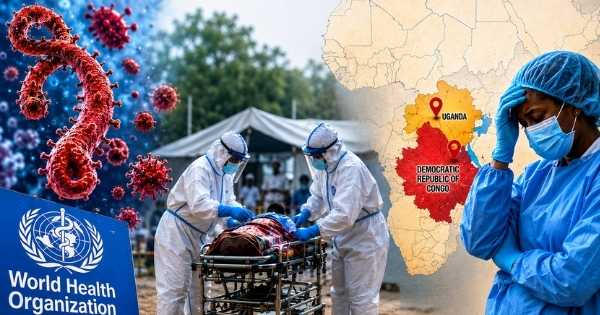
The recent announcement by the World Health Organisation declaring the escalating Ebola outbreak in Uganda and the Democratic Republic of Congo a public health emergency of international concern highlights the persistent vulnerabilities within the global health security architecture. Over the past fortnight alone, more than five hundred individuals have contracted the highly lethal viral disease, and at least one hundred and thirty people have already succumbed to its devastating physiological manifestations across both nations. Compounding the gravity of these figures, the global health agency has issued explicit warnings indicating that the true scale of the transmission network is likely far larger than current epidemiological surveillance suggests. This particular crisis involves the notoriously lethal Bundibugyo strain of the Ebola virus, a variant that presents extraordinary clinical challenges because there are currently no approved vaccines or targeted therapeutics available to mitigate its spread or lower its high mortality rate. Unlike the Zaire strain, which was successfully combated in previous West African epidemics using newly developed countermeasures, the Bundibugyo strain remains heavily neglected by therapeutic development pipelines, leaving affected populations entirely reliant on supportive clinical care and rudimentary containment strategies.
The unfolding humanitarian crisis has assumed even graver proportions because the World Health Organisation’s structural capacity to mount a rapid, coordinated, and effective field response has been severely undermined by a series of catastrophic institutional funding cuts. This fiscal destabilization reached a critical juncture following the official withdrawal of the United States from the organization in January, an executive decision that stripped the agency of its historically largest state contributor and sent shockwaves through its operational programming. Far from being an isolated instance of national retrenchment, this geopolitical pivot triggered a domino effect among Western nations, with Germany, France, the Netherlands, and the United Kingdom subsequently slashing their respective financial commitments to the agency. Collectively, these severe budgetary reductions forced the global health body to diminish its core 2026-2027 biennial budget by approximately 8 per cent. This systemic contraction of resources has directly crippled critical frontline defense mechanisms, noticeably weakening disease surveillance systems, laboratory diagnostics, and contact-tracing networks within conflict-ridden, volatile geographic regions like the eastern provinces of the Democratic Republic of Congo, where armed instability already complicates containment efforts.
The timing of this resource deprivation is particularly tragic given the collective lessons that the international community supposedly internalized during the devastating wreckage of the Covid pandemic. In the immediate aftermath of that global catastrophe, a broad and seemingly immutable consensus emerged among heads of state, public health authorities, and international diplomats that the world urgently required a legally binding international framework to govern future responses to transboundary health emergencies. The formal adoption of the Global Pandemic Treaty in May of last year initially generated widespread optimism that the international community, notwithstanding the stark refusal of the United States to participate, could successfully unite to forge a resilient, equitable, and legally enforceable health-security architecture. The treaty was envisioned as a historic milestone that would compel signatory nations to share epidemiological data transparently, finance localized public health infrastructure, and ensure that the hoarding of medical countermeasures seen during the early 2020s would never be repeated in a civilized global society.
However, the structural integrity of this international treaty was placed under profound stress even before the ink could dry or the ratification processes could be completed by individual sovereign parliaments. Wealthy industrialized nations have consistently demonstrated a profound reluctance to commit to any clauses mandating the compulsory transfer of intellectual property or technology, nor have they been willing to accept binding legal obligations regarding the equitable distribution of scarce medical resources during global emergencies. This recalcitrance stems from a desire to protect domestic pharmaceutical conglomerates and prioritize national stockpiles, effectively hollowing out the treaty’s most transformative mechanisms. Consequently, developing nations continue to deeply distrust a global health system that actively perpetuated vast, institutionalized inequalities during the Covid vaccine rollout, leaving the Global South exposed to the vagaries of philanthropic charity while wealthier nations secured surplus manufacturing capacity for booster doses.
This persistent systemic diplomatic impasse is deeply paradoxical when contrasted with the undeniable scientific advancements achieved in the post-Covid years, where the collective capacity to detect emerging zoonotic threats and develop highly sophisticated medical countermeasures has improved appreciably. Driven by massive capital infusions and regulatory overhauls during the pandemic, pharmaceutical researchers can now leverage revolutionary vaccine platforms, particularly messenger RNA technology, to design, test, and scale novel inoculation programmes at a substantially faster pace than was ever conceivable in pre-Covid times. The conceptual timeline for sequence-to-vaccine development has been truncated from decades to a matter of mere months or weeks, offering a powerful technological shield against novel pathogens. Yet, technology alone cannot bridge the gap between scientific innovation and field deployment if political will and equitable distribution networks are absent, leaving these advanced molecular tools as exclusive privileges of wealthy societies rather than global public goods accessible to all.
The tragic disconnect between technological capability and structural readiness is precisely what animated the latest consensus report issued by the Global Preparedness Monitoring Board, a high-level body co-convened by the World Bank and the World Health Organisation. In their sobering assessment of international defense systems, the board explicitly concluded that despite the nominal policy adjustments made over the last several years, the world remains fundamentally unready to take on the next pandemic threat. The structural vulnerabilities highlighted by the board are currently manifesting in real-time within the forests and villages of Uganda and the Democratic Republic of Congo, proving that advanced science means little when basic healthcare systems lack gloves, clean water, and functional isolation wards. The current Bundibugyo Ebola outbreak serves as a stark, unyielding reminder to contemporary statesmen that containing highly infectious diseases cannot be achieved through reactionary panic or isolationist policies; rather, it demands sustained, long-term public investment in grassroots healthcare infrastructure, unfettered scientific cooperation, and a genuine commitment to international collaboration that transcends geopolitical rivalries.
(the writer can be reached at dipakkurmiglpltd@gmail.com)