
By Dipak Kurmi
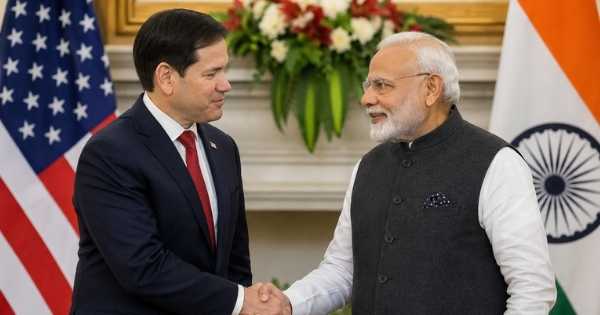
The four-day visit of United States Secretary of State Marco Rubio to India from May 23 to 26, 2026, marked a critical juncture in contemporary geopolitics, representing a concerted effort to manage fractures in a vital bilateral relationship. As Rubio’s maiden official voyage to the subcontinent since assuming office in January 2025, the diplomatic mission occurred against a backdrop of complex and evolving interactions. Over the past twenty-five years, ties between New Delhi and Washington have experienced progressive expansion, characterized by deepening strategic convergence and robust economic exchange. The commencement of the second Trump administration initially mirrored this upward trajectory, highlighted by an early and substantive stand-alone visit by Indian Prime Minister Narendra Modi to the White House on February 13, 2025. This early engagement was widely interpreted as an affirmation of the enduring partnership, indicating that the strategic alignment forged over consecutive administrations would survive the transactional currents of Washington’s renewed political landscape.
However, the optimistic narrative was quickly challenged by a sequence of unilateral economic and diplomatic measures implemented by Washington. In an unexpected development that disrupted bilateral trade stability, the United States imposed 25 percent tariffs on a wide range of imports from India on April 3, 2025. This protectionist measure was compounded on May 10, 2025, when President Donald Trump unilaterally announced a ceasefire between India and Pakistan regarding the intense, four-day Operation Sindoor conflict. This announcement occurred before New Delhi had formalized its own public statement, and India subsequently declined to validate the American assertion of having mediated the cessation of hostilities. Friction increased further when Washington levied an additional 25 percent penalty tariff on Indian goods, citing New Delhi’s continued procurement of Russian crude oil. The punitive nature of this policy became a significant point of contention in Indian political circles, particularly as alternative major energy importers, most notably Beijing, which recorded higher volumes of Russian oil and gas consumption, remained entirely unaffected by equivalent economic sanctions.
The structural strain on the alliance was further exacerbated by public rhetoric and shifting regional dynamics. Throughout the preceding year, a series of derogatory remarks emerged from senior officials within the United States administration and the broader right-wing political base supporting the White House. While President Trump frequently offered public compliments to Prime Minister Modi during this period, these statements were often perceived by Indian analysts and the public as patronizing when contrasted with the parallel rhetorical challenges directed at India and its citizens. Furthermore, Indian strategic planners observed with growing concern a perceptible shift in regional balancing, as Washington appeared to be actively cultivating closer ties with both Pakistan and China, nations historically viewed by New Delhi as its primary geopolitical adversaries. Consequently, Secretary Rubio’s visit was framed not merely as a routine diplomatic engagement, but as an urgent exercise in bilateral damage control and strategic stabilization.
During his dense itinerary, which included cultural and institutional stops in Kolkata, Agra, and Jaipur alongside formal engagements in New Delhi, Secretary Rubio engaged in comprehensive high-level discussions. He called on Prime Minister Modi, held rigorous bilateral talks with External Affairs Minister S. Jaishankar, and met with National Security Adviser Ajit Doval, while also participating in the broader Quadrilateral Security Dialogue foreign ministers’ forum. Economic and energy security occupied a central position on the bilateral agenda. Prior to his departure from Washington, Rubio had publicly signaled an intention to encourage India to transition its energy dependency away from sanctioned jurisdictions by increasing its procurement of American and potentially Venezuelan energy resources. In their direct dialogues, Jaishankar and Rubio emphasized the strategic necessity of concluding an interim trade agreement designed to foster reciprocal and mutually beneficial market access. For India, securing access to affordable, reliable, and diversified energy streams remains a foundational domestic priority to support its population of 1.4 billion people, a reality that shaped the discussions on expanded civil nuclear energy cooperation following a preparatory visit by an American technical delegation.
The defense and security dimensions of the bilateral meetings yielded several concrete institutional outcomes aimed at reinforcing maritime and technological alignment. The two nations formalized a comprehensive underwater domain awareness roadmap, a strategic mechanism designed to enhance monitoring capabilities across the increasingly contested waters of the Indian Ocean Region. Furthermore, the deliberations placed significant emphasis on secure supply chains and technological resilience, specifically highlighting collaboration in critical minerals and the Pax Silica framework. This culminated in the signing of a bilateral agreement intended to promote deep partnerships and ensure trusted, resilient supply chains in fields essential to advanced technological manufacturing and defense applications. On the diplomatic front, External Affairs Minister Jaishankar explicitly raised the protracted administrative challenges and delays encountered by legitimate Indian travelers seeking United States visas, conveying India’s firm expectation that lawful professional and academic mobility should not be restricted by domestic immigration policies. Additionally, both sides reiterated the critical importance of sustained, uncompromising counter-terrorism cooperation, emphasizing a policy of zero tolerance toward political violence and cross-border militancy.
The timing of the Quad foreign ministers’ meeting on May 26, 2026, provided an important opportunity to evaluate the broader architecture of Indo-Pacific security. Marking the third such ministerial gathering since the political transition in Washington in early 2025, the meeting occurred amidst noticeable apprehension within Indian academic and foreign policy institutes. This disquiet stems from the cancellation of the high-profile Quad Summit that India was scheduled to host in 2025, alongside a persistent lack of clarity regarding the rescheduled date and venue for the leadership meeting. Analysts have frequently cited this administrative drift as evidence of a diminishing American appetite for the multilateral framework, contrasting sharply with the historical trajectory of the forum. In 2017, during the first Trump term, the Quad was revitalized after a decade of inactivity, driven by Washington’s explicit designation of China as a systemic competitor possessing both the capability and intent to alter the prevailing global order. In the current political term, however, following significant economic pushback from Beijing via stringent export controls on critical minerals, the American administration has adjusted its rhetoric, frequently characterizing China less as a fundamental strategic threat and more as an aggressive commercial competitor.
Despite these shifting definitions, the ministerial meeting offered a timely platform to reaffirm the foundational rationale of the four-nation alliance. It remains a consensus among the member nations that Beijing’s assertive maritime posture presents a tangible security challenge across the Indo-Pacific, necessitating active, sustained United States engagement to preserve regional peace, stability, and a rules-based maritime order. To this end, the ministers resolved to expand functional cooperation under the established Indo-Pacific Partnership for Maritime Domain Awareness framework. A major institutional outcome of the session was the launch of the Indo-Pacific Maritime Surveillance Collaboration, an initiative engineered to streamline data sharing and improve practical coordination in regional maritime reconnaissance. The joint proceedings concluded with a strong condemnation of terrorism in all its manifestations, with the ministers explicitly denouncing cross-border militancy and making a direct reference to the tragic terrorist attack in Pahalgam that occurred in April 2025, thereby validating India’s long-standing security concerns within the shared multilateral text.
Ultimately, the success of Secretary Rubio’s mission will be measured not by the rhetoric of diplomatic courtesy, but by the structural consistency of follow-through. Recognized as an articulate interlocutor with a record of supporting strong ties with New Delhi, Rubio sought to mitigate the friction generated by a year of unpredictable, unilateral policy shifts from Washington. By merging a demanding bilateral agenda with the multilateral obligations of the Quad ministerial, the visit attempted to stabilize a volatile phase in the partnership and inject new momentum into a regional architecture that had shown signs of stagnation. As both nations navigate an era defined by economic nationalism and fluid regional alignments, the systematic and timely execution of the agreements signed during these four days will serve as the primary indicator of whether the United States and India can successfully convert tactical damage control into an enduring strategic equilibrium.
(the writer can be reached at dipakkurmiglpltd@gmail.com)