

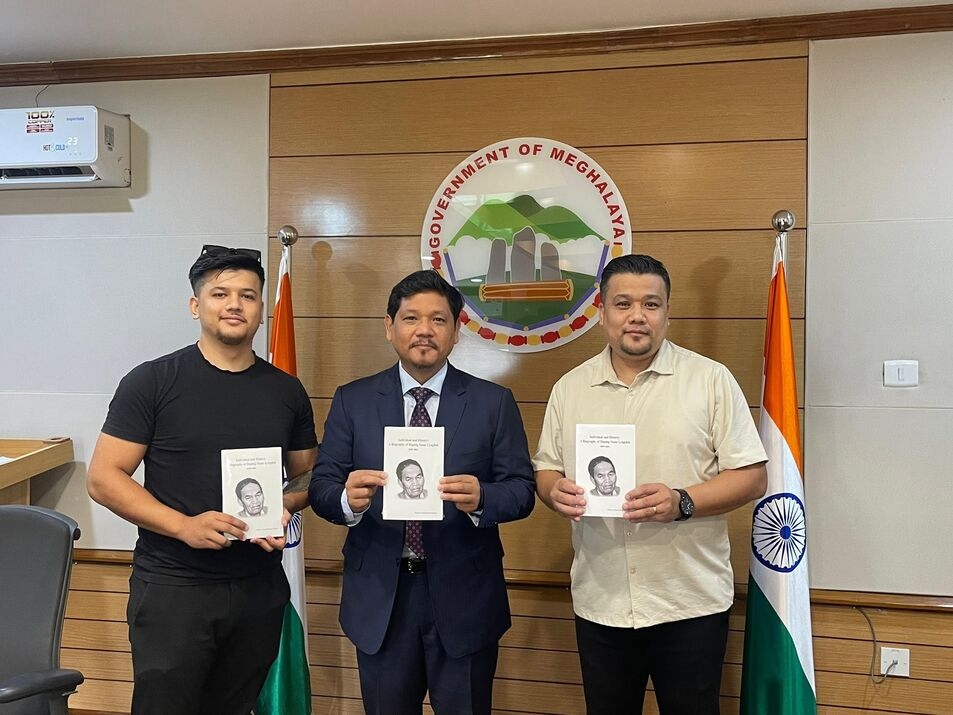
Shillong, June 23: Chief Minister Conrad K Sangma on Tuesday formally released a book “Heritage of the Khasi Hills: Architecture, Society and Change in the Nineteenth and Twentieth Centuries” authored by Dr David Arnold Kharchandy.
At the function at held at Taraghar State Guest House, Sangma said, the release marked an important step in documenting and interpreting the state’s built heritage for future generations.
The book, rooted in years of research for his PhD, records the built environment of the Khasi Hills as more than brick, wood and stone.
It treats traditional houses, civic structures, and colonial-era buildings as living archives that tell how Khasi society adapted to landscape, belief, technology, and time.
The work delves into the Iing Sad, hearth-centred homes, and the rituals and taboos that shaped them.
It highlights how indigenous materials and community labour produced architecture that mirrored ecological wisdom, matrilineal organization, and sacred values.
A key theme is the central role of Khasi women, described as the “silent architects” of domestic space, who sustained households, passed down building knowledge, and gave deeper meaning to the idea of home.

Dr Kharchandy also traces the shifts that reshaped the region’s architecture from the 19th century onward – the arrival of British rule, missionaries, and Christianity, the spread of education, the rise of Sohra and Shillong as hill stations, and the 1897 earthquake all left their mark.
The book documents the emergence of bungalows, Assam-type houses, churches, schools, mission compounds, administrative buildings, and sanatoriums alongside traditional forms.
By weaving together continuity and change, the book argues for preserving Khasi architectural memory as part of Meghalaya’s cultural inheritance.