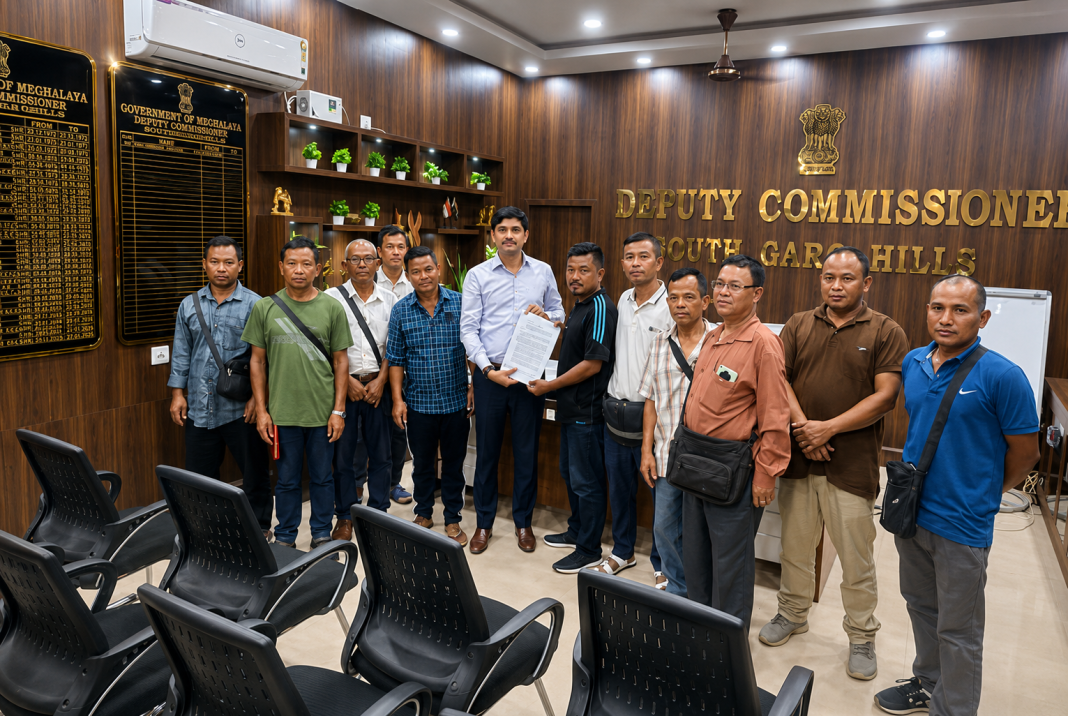

Baghmara, June 29: In a fresh flashpoint over a long-pending road project in South Garo Hills, the Garo Students’ Union (GSU) Siju Regional Unit has submitted a strongly-worded joint memorandum to the Deputy Commissioner of South Garo Hills demanding the immediate allotment of work for the proposed Karukol–Siju–Dabalgre–Rongmigre–Chokpot road, while simultaneously urging authorities to outright reject a counter-petition filed by residents of Emangre village opposing the project.
The memorandum, submitted on Monday and jointly signed by village elders, youth leaders, and residents of Nokatgre, Tolegre, Nengrugittim, Siju, and Dabalgre, accuses the Emangre residents of attempting to stall a project that the GSU describes as a lifeline for several transit villages that have remained cut off from basic services for generations.
The GSU memorandum paints a grim picture of life without all-weather road connectivity. Critically ill patients and pregnant women, the union argues, regularly face life-threatening delays trying to reach the District Hospital. Farmers watch perishable produce rot because it cannot be transported to markets in time. And eco-tourism around the famed Siju Caves and Wari Chora — natural assets the union says are drawing international attention — remains stunted by dangerous, broken terrain that discourages visitors.
“This road is not a luxury; it is a fundamental right to healthcare and survival,” the memorandum states, adding that the overwhelming majority of residents in the affected villages are “desperately waiting” for the project to begin.
The roadblock, however, comes from Emangre village, whose residents have apparently submitted a separate representation to the administration seeking either an alteration of the road’s approved alignment or a halt to the project altogether. While the specific objections raised in the Emangre petition were not made public, the GSU countered that those concerns relate to engineering and environmental anxieties that can be addressed through contractual safeguards — such as slope stabilisation, retaining walls, and debris management — without altering the approved route.
The GSU warned that any change of alignment at this stage would “completely derail the project, forfeit sanctioning funds, and push our villages back into isolation for another several decades.”
Complicating matters is the fact that the work has not yet been allotted to any contractor, leaving the project in a state of administrative limbo even as the two sides wage a representational battle before the district administration. The union expressed deep concern over the delay and demanded that a competent contractor be appointed immediately so that ground-level mobilisation can begin.
The GSU also urged the PWD to strictly oversee the future contractor to ensure eco-scientific and high-quality execution of the road, suggesting the engineering concerns of the opposing group be addressed through the contract’s terms of reference rather than by scrapping or rerouting the project.
The Deputy Commissioner’s office is yet to make any official statement on the duelling petitions- and, given the passions on either side, the decision is unlikely to come without controversy.