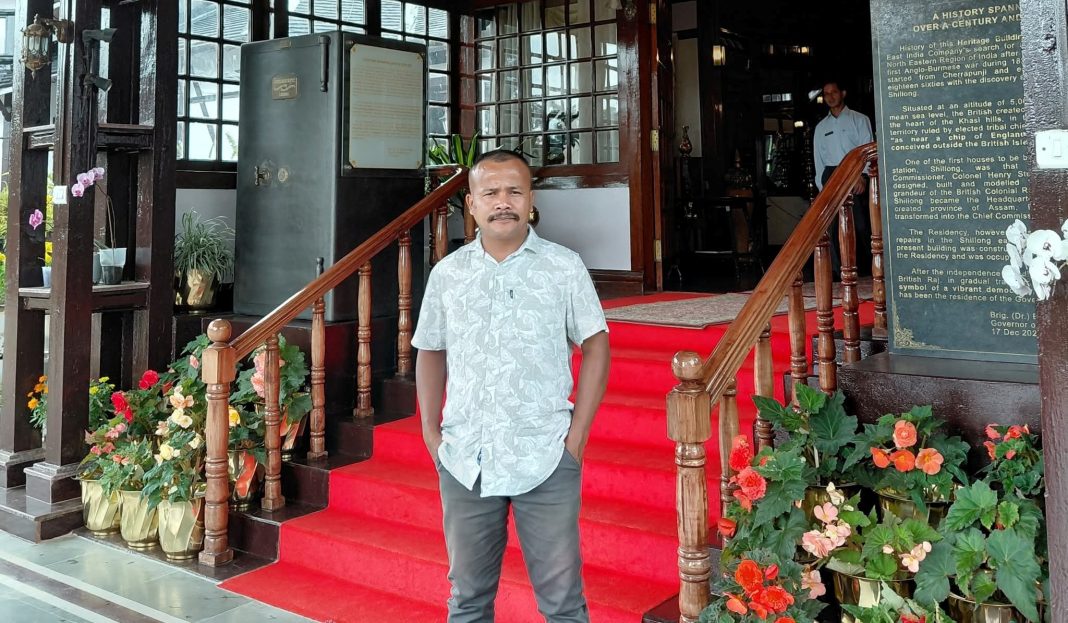

Social worker flags concern over GHADC jurisdiction on A’king land
Shillong, Aug 9: The demand for a Regional Council for minority Scheduled Tribes in Garo Hills has been opposed by a social worker, who urged the authorities concerned to examine its constitutional and land implications of the demand before taking any call.
“The legitimate rights of minority ST communities must be protected, but that does not automatically mean carving out a separate Regional Council within an existing Autonomous District,” social worker Cherian G Momin said in a statement issued on Sunday.
Momin said the demand by the Regional Council Demand Committee on behalf of the Hajong, Koch, Rabha, Boro-Kachari and Mann communities must not be mistaken for an automatic right under the Sixth Schedule.
“Representation and territorial autonomy are two different constitutional questions,” he said.
Momin argued that Paragraph 1(2) of the Sixth Schedule only gives the Governor an enabling power, not a mandate, to create autonomous regions.
He also stressed that Scheduled Tribe recognition under Article 342 does not by itself confer a right to territorial autonomy.
The statement flagged concerns over the jurisdiction of Garo Hills Autonomous District Council (GHADC) on the A’king land system.
“The GHADC derives its authority from Article 244(2) and the Sixth Schedule. Any proposal that alters its territory must be treated with the highest constitutional caution,” Momin said.
“A’king land is central to Garo customary institutions and cannot be treated as an administrative afterthought.”
He questioned the specifics of the RCDC proposal, asking what area, villages and powers were being sought, and what impact it would have on GHADC and Nokmaship jurisdiction.
“Minority status and demographic presence alone cannot determine autonomy. The proposal must be tested against geography, demography, customary institutions, administrative viability and financial sustainability,” he said.
Momin urged the state government and GHADC to seek the full proposal with maps and details and subject it to a comprehensive review before taking any decision. “Until that is done, the GHADC should not give blanket ‘in-principle’ support,” he said.
“Opposing this proposal is not opposing minority communities. It is about ensuring constitutional due process and protecting the customary and territorial rights of the Garo people as well.”
He concluded that inclusive governance and equitable development should be pursued without fragmenting the existing constitutional structure of Garo Hills.