Exclusive | The Meghalayan Express | By Prarthana Hazarika
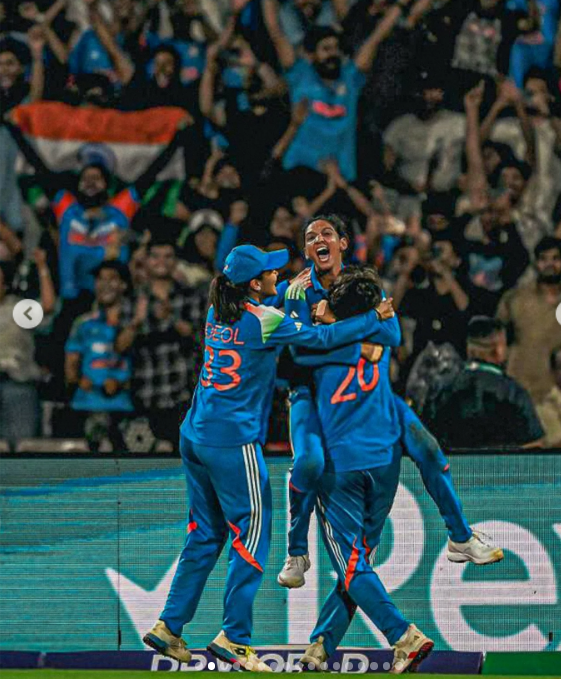
Guwahati, Nov 3: A year ago, Indian women’s cricket conquered its biggest mountain. On November 2, 2025, Harmanpreet Kaur’s India defeated South Africa by 52 runs in Navi Mumbai to lift their maiden ICC Women’s Cricket World Cup title, ending decades of waiting and rewriting the country’s cricketing history.
Twelve months later, the significance of that triumph goes far beyond the trophy. It marked a defining moment in the transformation of women’s cricket in India, taking the sport from the margins of public attention to the centre of the country’s sporting conversation.
For generations, Indian women cricketers fought for recognition, better facilities, financial security and opportunities comparable to their male counterparts. The World Cup victory did not begin that transformation, but it gave it unprecedented momentum.
India’s triumph was built on a collective performance. Shafali Verma’s explosive 87 and Deepti Sharma’s composed 58 powered India to 298 for seven in the final. Deepti then claimed five wickets for 39 runs as South Africa were bowled out for 246.
It was a victory that changed expectations.
From underdogs to world champions
India had previously finished runners-up in the 2005 and 2017 World Cups, but the 2025 triumph finally ended the wait for a global ODI title.
More importantly, it changed the team’s psychology. India were no longer merely challengers capable of producing occasional upsets but world champions expected to compete for major honours.
That confidence has been reflected across formats. India’s landmark 270-run Test victory over England at Lord’s in July 2026 further demonstrated its growing authority in red-ball cricket, while continental successes have strengthened its international standing.
The WPL revolution: A bigger professional future
Perhaps the biggest structural change has been the Women’s Premier League (WPL), launched in 2023. The tournament has transformed the professional landscape by bringing international stars and emerging Indian cricketers together in a competitive franchise environment.
Corporate investment, commercial visibility and exposure to world-class coaching have created opportunities that were previously limited for domestic players.
Royal Challengers Bengaluru’s successful chase of 204 runs against Delhi Capitals to win their second WPL title in 2026 further illustrated the league’s growing competitiveness.
Now, the next phase could be even bigger. The Board of Control for Cricket in India (BCCI) is considering increasing the number of WPL teams from next year to provide more opportunities for women cricketers.
If implemented, expansion would create additional squad positions and widen the professional pathway for domestic talent. It could also benefit players from regions traditionally outside India’s established cricketing centres.
However, a larger league must be supported by stronger domestic competitions and wider talent-identification networks to ensure that opportunities reach emerging players.
Financial recognition and a changing system
The transformation has also been supported by important policy decisions.
In October 2022, the BCCI introduced equal international match fees for men and women cricketers: Rs 15 lakh for a Test, Rs 6 lakh for an ODI and Rs 3 lakh for a T20 International.
It was a significant step towards recognising women’s cricket as a professional career.
However, international financial parity must be matched by investment at the grassroots. Regular domestic competitions, age-group cricket, qualified coaching, sports science and better facilities remain essential to building a sustainable talent pipeline.
The Northeast: An opportunity waiting to be explored
For the Northeast, India’s World Cup triumph should also be viewed as an opportunity.
The emergence of Assam’s Jintimani Kalita in the national women’s cricket pathway demonstrates the region’s potential. But isolated breakthroughs are not enough.
Young girls from Assam, Meghalaya, Manipur, Mizoram, Nagaland, Tripura and Arunachal Pradesh need access to quality coaching, competitive exposure and a structured pathway from district cricket to the national level.
An expanded WPL and stronger scouting networks could help bring more regional talent into professional cricket. State associations must ensure that international success translates into sustained investment at the grassroots.
A new leadership chapter
The post-World Cup era has also brought a leadership transition. Harmanpreet Kaur’s captaincy was central to India’s historic achievement, but the responsibility has now passed to Smriti Mandhana as full-time captain.
Her tenure began with a 3-0 T20I series clean sweep against Zimbabwe, offering an encouraging start to a new chapter.
Mandhana’s challenge will be to sustain the standards established by the World Cup-winning generation while building a team capable of competing consistently across formats.
The real legacy of November 2
One year after the historic triumph, Indian women’s cricket is in a different place. The World Cup brought recognition, the WPL created a professional platform and equal match fees strengthened financial recognition. The prospect of an expanded league points towards further growth.
But the ultimate measure of that victory will not simply be the number of trophies India wins or the commercial value of its players.
It will be the number of young girls who now believe that representing India is an achievable dream.
India made history in Navi Mumbai a year ago. The next chapter must ensure that no girl with cricketing ambition is left without an opportunity to pursue it.