
Eight gold medals at Glasgow underline a remarkable shift in Indian sport, but for three former international athletes, the real story lies in the journey behind the numbers
By Prarthana Hazarika
TME, Aug 08 : For the first time since 2002, Indian women finished a Commonwealth Games with more gold medals than the men.
At Glasgow 2026, the women won eight gold medals, compared to five by the men — a statistic that is striking on its own, but perhaps even more significant for what it says about the changing face of Indian sport.
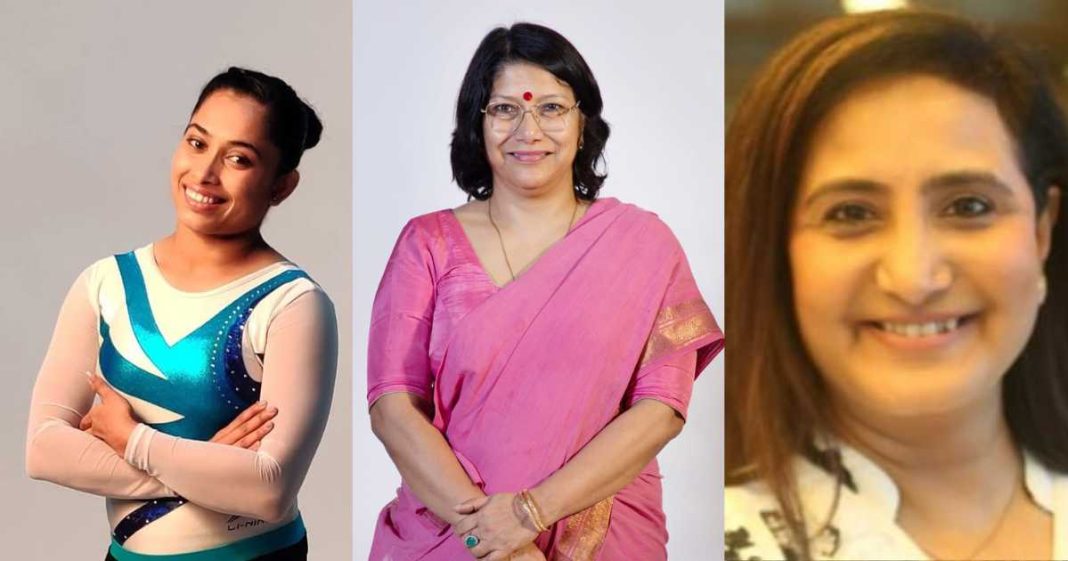
For three women who have experienced Indian sport from the inside — Olympian gymnast Dipa Karmakar, former international paddler Monalisa Baruah Mehta and former international shuttler Krishna Hazarika Rao — the numbers are not merely about Glasgow.
They are the result of a much longer transformation.
Karmakar, who herself became one of the defining faces of Indian women’s sport, believes the qualities displayed by women athletes have played a major role in this change.
“I think the passion that women athletes have is a great factor for the changing Indian sports and I have seen the kind of patience Indian women athletes like Mirabai Chanu and the others have is another factor for such growth.”
Passion and patience — qualities that have often defined India’s most successful women athletes.
Karmakar’s own journey is a reflection of that perseverance. Her fourth-place finish in the vault final at the Rio Olympics brought gymnastics into India’s mainstream sporting conversation and showed that an Indian woman could compete with the world’s best in a discipline with little traditional presence in the country.
Today, that sense of possibility has expanded across sporting disciplines.
For Monalisa Baruah Mehta, the Glasgow achievement is the culmination of years of perseverance and changing sporting structures.
“This is far more than a remarkable statistic — it is a reflection of years of perseverance, discipline, determination, and consistently outstanding performances by our women athletes.”
She believes the transformation has been driven by better coaching, improved support systems and the growing confidence of women athletes.
The change is also visible in participation.
Women are no longer simply breaking into sports traditionally associated with men; they are establishing themselves as medal contenders across disciplines and competing with the expectation of winning.
That change has an impact beyond the podium.
“Every podium finish sends a powerful message to young girls across the country that dreams are achievable with dedication, resilience, and the right opportunities,” Mehta says.
And that, perhaps, is where the real significance of the Glasgow numbers lies.
The success of one generation creates the possibility for another.
Krishna Hazarika Rao places the transformation in an even wider context.
More than two decades after 2002, India itself has changed — economically, socially and technologically. Greater connectivity has brought athletes and aspiring athletes access to information, opportunities and sporting models that previous generations simply did not have.
“These have raised the aspirations of the new generations. And these have reflected in the glory of the Indian women in the recent CWG,” Rao says.
For Rao, there is also something intrinsically powerful about the character of Indian women athletes.
“Indian women are traditionally hardworking, passionate and intense in their commitments. No doubt, it’s their time to rise and shine now on any global platform.”
Her pride is particularly personal as a former international sportsperson from the North-East.
“Their achievements truly make me proud as an erstwhile woman sportsperson of India, and especially from the North East.”
The Glasgow statistic, therefore, should not be viewed simply as women winning three more gold medals than men.
It is a marker of how far women’s sport has travelled.
There was a time when an Indian woman winning on the international stage was treated as an exceptional story. Today, the achievements are increasingly part of a larger pattern — one built on better opportunities, stronger support structures and generations of athletes refusing to accept limitations.
But the achievement also brings responsibility.
The next challenge is to ensure that the girl watching these champions from a small town, village or school playground has the opportunity to follow the same path.
As Mehta puts it, investing in women’s sport is not simply about medals. It is about confidence, leadership, equality and opportunity.
The eight gold medals at Glasgow are therefore more than numbers on a medal table.
They are a statement.
Indian women are no longer waiting for their moment in sport. They are creating it.