
By Dipak Kurmi
In the richly layered cultural landscape of Assam, few places embody the spiritual and artistic vitality of the region as completely as Barpeta. Often celebrated as the “Land of Satras,” this historic town stands not merely as a geographical location but as a living archive of the Neo-Vaishnavite renaissance initiated by the saint-scholar Srimanta Sankardeva in the fifteenth century. At the heart of Barpeta’s enduring cultural magnetism lies the resplendent celebration of Doul Utsav, a festival that transforms devotional theology into a participatory public spectacle of colour, music, and collective emotion. Each spring, the town becomes a theatre where sacred narrative and community memory converge, revealing how deeply the Bhakti imagination reshaped Assamese social life. The festival is not simply a regional version of Holi but a refined cultural expression rooted in centuries of disciplined spiritual practice, artistic innovation, and institutional continuity. In Barpeta, devotion does not withdraw from the world; it dances, sings, and moves through the community with remarkable vitality.
The intellectual and spiritual foundations of this cultural efflorescence are inseparable from Sankardeva’s Neo-Vaishnavite philosophy, which represented one of the most transformative reform movements in northeastern India. Born in 1449 at Alipukhuri in Bardowa in present-day Nagaon district, Sankardeva emerged at a time when Assamese society was fragmented by ritual hierarchy and sectarian complexity. His doctrine of Ek-Saran-Namdharma, centred on absolute surrender to a single supreme deity identified with Krishna, offered a radically simplified yet emotionally powerful path to spiritual fulfilment. Rejecting excessive ritualism and caste exclusivity, he emphasised congregational prayer, devotional music, ethical living, and the remembrance of the divine name as sufficient means of liberation. The anthropological insight of Edward Burnett Tylor—that culture constitutes a complex whole of knowledge, belief, art, and custom—finds a striking embodiment in this Assamese movement, which fused theology with everyday social practice. Sankardeva’s vision drew from Vedantic monism, the emotional fervour of the Bhakti movement, and a deeply humanistic concern for social harmony, creating a religious culture that was at once philosophically sophisticated and socially accessible.
The institutional backbone of this movement took shape through the creation of the Satra system, a uniquely Assamese monastic network designed to sustain devotional practice, artistic training, and community education. Among the many Satras that emerged, Barpeta Satra occupies a pre-eminent position. Established by the saint’s foremost disciple Madhavdeva, the Satra soon acquired the reverential title of “Ditiya Vaikuntha,” or the Second Heaven, reflecting its centrality in the Neo-Vaishnavite spiritual geography. What distinguishes Barpeta Satra is not only its religious authority but also its remarkably democratic administrative structure. The Bhora Satriya serves as the religious head and ex-officio president, while the Deka Satriya functions as the deputy, and the managing committee is elected for fixed terms in a process that consciously mirrors participatory governance. Such organisational sophistication illustrates how the movement sought to align spiritual discipline with collective responsibility, thereby embedding religious life within a broader civic ethos. Architecturally, the Satra complex reflects Sankardeva’s aesthetic minimalism: the central Kirtan Ghar contains no anthropomorphic deity but instead houses three Guru Ashans symbolically representing the divine through the lineage of teachers. Surrounding structures such as the Bhaj Ghar, Pat Chang, and Khatkhati Ghat together form a spatial narrative of devotion, learning, and communal life.
It is within this carefully cultivated spiritual environment that the Doul Festival of Barpeta achieves its fullest expression. Though synchronized with the pan-Indian Holi season, the local observance possesses a ritual sophistication and dramatic depth that distinguish it from more purely recreational colour festivals elsewhere. The celebration typically spans three to five days, with the shorter version known as Deka Doul and the more elaborate observance called Bura Doul. The ceremonial cycle begins with Gandha or Banhutsava, when devotees gather reeds for the ritual bonfire and ceremonially escort the images of Mahaprabhu Doul Govinda and Kalia Thakur from the Manikut Ghar to Mathar Chotal. The lighting of the sacred fire and the seven circumambulations performed by the deity create a powerful visual metaphor of purification and renewal. On the following day, Bhar Doul unfolds through Naam Prasanga, Ojapali narrative performances, and the resonant devotional music of Gayan-Bayan ensembles. The electrifying Dhuliya Nritya, with its thunderous drum rhythms and dynamic choreography, transforms the Satra courtyard into a pulsating arena of sacred energy.
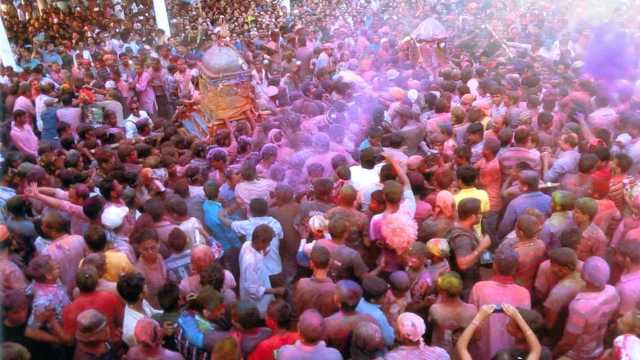
The emotional climax arrives on Phakua, when the deities are placed on an ornate palanquin and carried in grand procession to Kanara Satra in a symbolic visit to Ghunucha’s household. The air fills with conch blasts, cymbal clashes, and the lyrical Holigeets composed by Sankardeva and Madhavdeva, including the evocative verse celebrating Krishna’s playful Holi in Brindaban. Yet the most dramatic moment unfolds upon the deity’s return to the Kirtan Ghar, where the entrance is deliberately barred with bamboo poles to enact Lakshmi’s mythic displeasure. What follows is a ritualised confrontation between opposing devotional groups, culminating in the breaking of the barrier and a symbolic reconciliation. This theatrical episode reveals the genius of Neo-Vaishnavite pedagogy: profound theological emotions are communicated through participatory drama that allows the entire community to experience divine love as a lived human relationship. The ritual thus becomes both performance and prayer, blending aesthetics with metaphysics in a uniquely Assamese idiom.
Equally vital to Barpeta’s cultural legacy is the evolution of the Satriya dance tradition, one of the most significant artistic contributions of the Neo-Vaishnavite movement. Originally created by Sankardeva to accompany his Ankiya Nat devotional dramas, Satriya developed within the disciplined environment of the Satras, where it was performed exclusively by male bhakats as part of their spiritual regimen. Over time, the dance expanded beyond monastic confines and entered the public cultural sphere, with women performers now playing a major role in its dissemination. The form encompasses multiple stylistic genres such as Apsara Nritya, Chali Nritya, and Dasavatara Nritya, all grounded in the aesthetic principles of classical treatises like the Natyasastra. Musical accompaniment relies heavily on Borgeets composed by the saint and his followers, performed with khol drums, cymbals, and flutes, while costumes woven from indigenous pat silk preserve the region’s textile heritage. National recognition came in November 2000 when the Sangeet Natak Akademi, under the chairmanship of Bhupen Hazarika, formally acknowledged Satriya as one of India’s classical dance forms. This milestone elevated the tradition from regional reverence to national prominence, though many practitioners still argue that sustained institutional support remains insufficient.
Perhaps the most socially transformative dimension of Sankardeva’s movement was its radical inclusivity. At a time when caste stratification governed access to religious life, the Neo-Vaishnavite faith welcomed disciples from diverse ethnic and social backgrounds. Historical records mention followers such as Chandasai, a Muslim; Gobinda, a Garo; Jayantahari, a Bhutia; and Srirama, a Kaivarta, illustrating the movement’s broad social appeal. Women were likewise granted unusual spiritual agency, participating in Nama-Kirtana, receiving initiation, and even assuming leadership roles. The example of Kanaklata, Sankardeva’s granddaughter-in-law who later headed a Satra and appointed multiple Satradhikars, demonstrates how the movement quietly reconfigured gender norms within devotional space. Observers from outside Assam also recognised this inclusive ethos. During his visit to Barpeta, Mahatma Gandhi famously remarked that the Vaishnava revival had rendered Assamese society notably humane and free from the harsher forms of untouchability visible elsewhere in India. Such testimony underscores the movement’s enduring ethical significance.
In contemporary times, Barpeta Satra continues to function as both pilgrimage centre and cultural institution, drawing tens of thousands of devotees during the Doul Festival. The celebrations temporarily relax certain traditional restrictions, allowing broader public participation and reinforcing the festival’s role as a social integrator. Yet the preservation of this heritage faces tangible pressures. Scholars and cultural activists have pointed to inadequate institutional funding for Satriya training, encroachment on Satra lands, and the broader challenge of sustaining traditional arts in an era of rapid digital transformation. Cultural historian Birendra Nath Dutta once described Assam as a remarkable synthesis of Aryan and non-Aryan, tribal and non-tribal influences; the Neo-Vaishnavite tradition remains one of the clearest embodiments of that synthesis. Safeguarding Barpeta’s living heritage therefore requires not only reverence but also policy attention, community engagement, and scholarly documentation.
The enduring power of Barpeta’s Doul Utsav lies in its ability to translate metaphysical devotion into collective cultural experience. Within the rhythmic pulse of khol drums, the disciplined grace of Satriya movement, and the joyous clouds of spring colour, one witnesses a rare continuity between medieval bhakti vision and modern community life. The festival demonstrates that spiritual traditions survive not by rigid preservation alone but by dynamic participation that renews meaning across generations. As Assam negotiates the pressures of modernity, the sacred rhythms of Barpeta continue to offer a compelling model of cultural resilience rooted in inclusivity, artistic excellence, and devotional depth. In that annual flowering of colour and song, the Neo-Vaishnavite legacy still speaks with remarkable clarity to the present.
(the writer can be reached at dipakkurmiglpltd@gmail.com)