
The surveyed households received a combined Rs 46.3 crore in remittances between 2019 and 2024, with an average annual remittance of Rs 4.59 lakh per migrant.
ROOPAK GOSWAMI
Shillong, Oct 4: Money earned by Meghalaya residents working abroad is finding its way back into households across the state, with Europe, North America and the Gulf emerging as important sources of remittances.
A study by Andrena S. Malngiang, Assistant Professor at St Anthony’s College, Shillong, has found that overseas remittances are providing significant financial support to households in East Khasi Hills, although only a small portion of the money is being converted into business investment.
The study, “Exploring the Impact of International Remittances on Entrepreneurial Activities in East Khasi Hills District, Meghalaya,” is part of the Chief Minister’s Research Grant (CMRG) Report 2024–25 and is based on a survey of 1,008 remittance-receiving households.
Importantly, the study is not confined to one community. According to Malngiang, the respondents included residents from different communities in East Khasi Hills district.
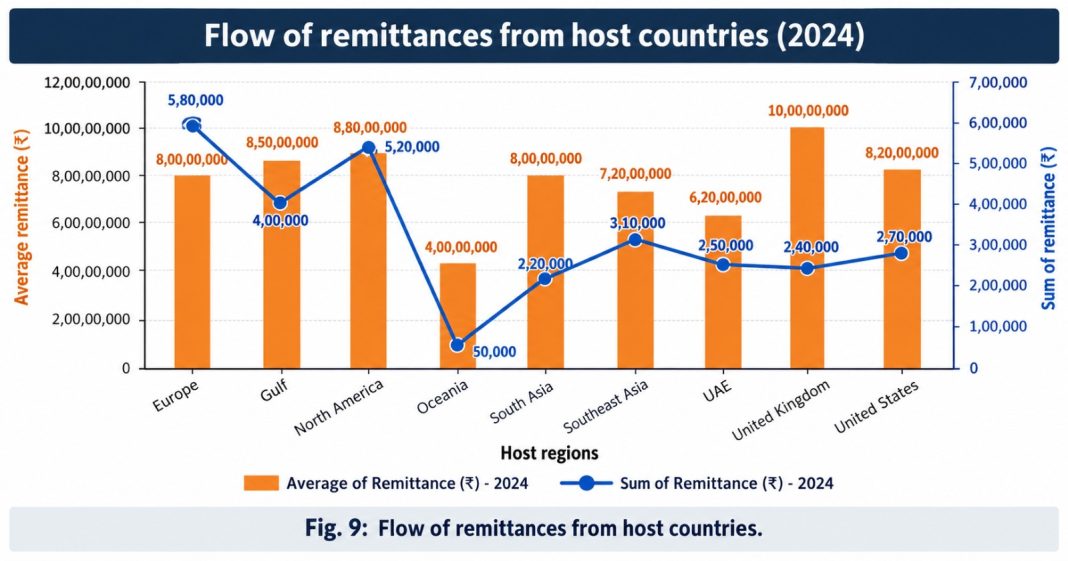
The study found that the surveyed households received a combined ₹46.3 crore in remittances between 2019 and 2024, with an average annual remittance of ₹4.59 lakh per migrant.
Europe accounted for the largest share at ₹9.78 crore, followed by North America and the Gulf. The United Kingdom recorded the highest per-capita remittance, at ₹5.78 lakh per migrant.
The findings offer a glimpse into the increasingly global nature of employment among Meghalaya’s residents. The study says overseas migrants are predominantly young and work in sectors including hospitality, nursing and airlines, with migration extending to the Gulf, Europe, East and Southeast Asia and Western economies.
Most of the money goes into the household
Despite the size of the inflows, remittances have yet to become a major source of business capital.
Of the 1,008 households surveyed, 319, or 31.6 per cent, were engaged in entrepreneurial activities, while 68.4 per cent had not used remittance income for entrepreneurship.
Only 2.1 per cent of remittances went directly towards business support, the study found.
The largest shares went towards everyday and social needs: 21.4 per cent for basic needs, 18.2 per cent for celebrations, 16.4 per cent for family support and savings, 13.2 per cent for education and 12.6 per cent for healthcare.
For many households, therefore, overseas earnings are first being used as a financial safety net rather than as venture capital.
Malngiang said the study provides the first systematic picture of how such overseas earnings are being used at the household level in Meghalaya.
“Until now, we had no systematic picture of what overseas earnings do once they reach Meghalaya. These 1,008 households show international remittances are a significant force, but they work mostly as a household safety net, with families covering basic needs, healthcare and education first.”
She said the low share going into businesses should not necessarily be interpreted as a lack of entrepreneurial ambition.
“That 2.1 per cent reaches business does not mean a lack of entrepreneurial interest. Where families have access to training, credit and markets, as with the Mawkhar bakery, the money can create jobs. The task now is to build those pathways.”
When overseas money becomes local business
The Mawkhar bakery provides a concrete example.
Euphemia Kharchandy, who started the bakery in 2011, used remittances from a family member working in the United States. The money, averaging around ₹2 lakh annually, helped her undertake professional training in Bengaluru, upgrade her kitchen and open a 400-square-foot café. Her bakery now employs six people.
The case illustrates what the study sees as the larger opportunity: overseas earnings could potentially do more than support household consumption if migrants and their families have better access to credit, markets, training and business support.
But significant barriers remain. Market information gaps, access to credit, limited financial literacy and lack of business training were identified as major challenges by respondents.
For Meghalaya, therefore, the issue is no longer simply how much money residents working abroad send home, but what happens to that money once it arrives.
The study concludes that remittances currently function mainly as a household welfare mechanism, but could become a stronger driver of local enterprise if supported by appropriate financial and institutional mechanisms.
The money trail already stretches from Meghalaya to workplaces across the world. The bigger question is whether more of those overseas earnings can eventually be turned into businesses, jobs and investment back home.