
By Satyabrat Borah
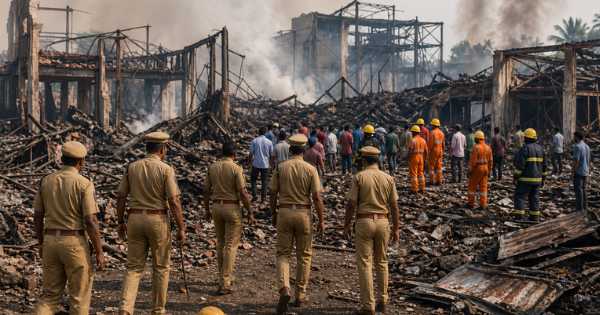
The recurring tragedy in the southern district of Virudhunagar serves as a devastating reminder of the high price paid for systemic negligence and the persistent disregard for human life within hazardous industries. When a massive explosion ripped through a fireworks manufacturing unit on April 19, it claimed the lives of twenty five workers and left several others battling for their survival. The scale of the horror only expanded when subsequent blasts injured twenty more individuals, including the very first responders, policemen and firefighters, who had rushed to the scene to save lives.
This specific event is not an isolated occurrence but rather a dark chapter in a long history of preventable disasters that have plagued this region of Tamil Nadu. Over the last four years, the statistics tell a story of consistent failure with at least one hundred and thirty four deaths and nearly ninety injuries recorded in this single district. To call these events accidents feels like a profound misuse of language. An accident implies an element of surprise or a freak occurrence that could not have been predicted. In the context of the Virudhunagar fireworks hub, every stakeholder is acutely aware that they are working with volatile chemicals and that the slightest deviation from safety protocols leads directly to catastrophe.
The workers who enter these units every morning carry the weight of this knowledge with them. Even without formal sensitization programs, the inherent danger of their daily tasks is understood as a fundamental reality of their existence. These individuals primarily belong to the most economically vulnerable sections of society, people who often feel they have no choice but to trade their safety for a meager daily wage. The response from official quarters has historically followed a predictable and hollow pattern.
Statements of condolence are issued, monetary compensation is promised to the families of the deceased, and then the collective attention of the state and union authorities shifts elsewhere until the next plume of smoke rises over the horizon. This cycle of mourning without meaningful reform has allowed a culture of laxity to take root. The fundamental duty of the government is to protect its citizens, a duty that is clearly being neglected through the absence of rigorous, consistent, and meaningful monitoring of these high risk environments.
Investigation into the latest incident reveals a series of blatant violations that suggest a complete breakdown of regulatory oversight. The unit was operating on a Sunday, a day that is officially designated as a holiday for the entire industry to allow for cooling periods and maintenance. It appears this work was being carried out without any specific permission or legal standing. Furthermore, the licensing conditions strictly limit the number of people allowed inside a single unit to twelve workers at any given time to minimize potential casualties in the event of a mishap.
On that tragic Sunday, forty people were crowded into the workspace. This level of overcrowding is not an anomaly restricted to one rogue operator. It is a widespread practice that persists because the enforcement of laws is treated as a ritualistic exercise rather than a life saving necessity. Inspections are often superficial, hampered by claims of manpower shortages within the monitoring agencies, which provides a convenient excuse for why illegal units and safety violations continue to proliferate across the arid landscape of the district.
The challenge for the authorities lies in balancing the urgent need for strict enforcement with the economic realities of the region. Virudhunagar is an area where rain fed irrigation is unreliable and agriculture offers little stability. Consequently, the fireworks industry has become the primary source of livelihood for hundreds of thousands of people. Shutting down the industry is not a viable solution, nor is a style of supervision that relies on the harassment of legitimate business owners. Instead, the focus must shift toward a genuine transformation of how these units operate. While the officials must come down heavily on unlicensed operations and those who habitually ignore safety standards, they must also work as partners with the industry to modernize.
The path forward requires a move away from the heavy reliance on manual labor in the most dangerous parts of the production process. The industry leaders and stakeholders need to prioritize the integration of automation to replace human hands in the mixing and filling of explosive compositions. Reducing the number of people physically present in hazardous zones is the only way to ensure that if a spark does occur, it does not result in a mass casualty event. This shift toward technology requires investment and a change in mindset from both the government and the factory owners. It demands a commitment to seeing the workers not as replaceable parts in a machine but as human beings whose lives possess intrinsic value.
Until the authorities move past the stage of simple reactive measures and engage in deep, structural changes to safety enforcement and industrial modernization, the air in Virudhunagar will remain heavy with the threat of the next explosion. The memory of those lost on April 19 should serve as an urgent call to action to end this cycle of negligence and ensure that no more lives are sacrificed for the sake of a firework. Progress must be measured not by the volume of production but by the safety of the hands that make it. This requires a sustained effort to build a culture of accountability where every violation is met with consequences and every worker is granted the basic right to return home safely at the end of the day. The cost of doing nothing is simply too high to bear any longer.