
By Dipak Kurmi
The air in the Northeast is often thick with the scent of rain and the echoes of ancient history, but recently, it has been electrified by a transformative legislative resonance. Language is far more than a mere vehicle for transactional communication; it is the vital marrow of a community, the vessel that carries the weight of ancestral wisdom and the nuanced cadence of a people’s soul. In an era where the relentless tides of unbridled globalization threaten to erode the unique contours of local cultures, the Meghalaya government has emerged as a vanguard of heritage. By officially adopting the Khasi and Garo languages as state languages alongside English, the state has not merely updated a legal statute but has effectively fortified the psychological and cultural ramparts of its indigenous tribes. This epochal shift marks a departure from the historical hegemony of English and signals a renaissance for native tongues that have long yearned for the imprimatur of officialdom.
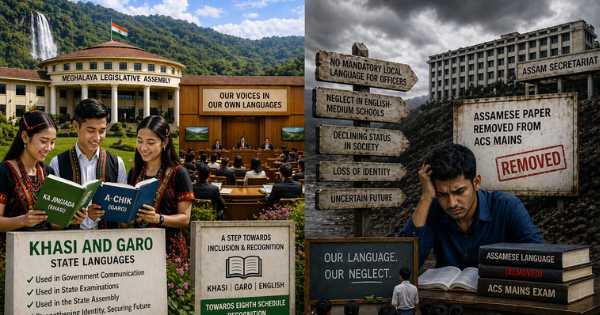
This legislative metamorphosis is the culmination of an arduous, decades-long crusade by the Khasi and Garo people to preserve their ethnic distinctiveness against the creeping shadows of linguistic homogenization. The new ordinance, which decisively repeals the Meghalaya State Language Act of 2005, functions as a powerful instrument of reclamation. It immediately authorizes the use of these indigenous tongues in government communications, state examinations, and, perhaps most symbolically, within the hallowed chambers of the State Assembly. This recognition is not merely a symbolic gesture of inclusion but a pragmatic infrastructure for the future, ensuring that the legislative debates and administrative decrees that shape the lives of the citizens are articulated in the very languages that define their existence. Such a move provides a formidable impetus to the persistent demand for the inclusion of Khasi and Garo in the Eighth Schedule of the Constitution, a status that would grant them national prestige and federal protection.
The demographic reality of Meghalaya underscores the profound necessity of this transition. For a state where roughly 48 percent of the population identifies as Khasi and approximately 34 percent as Garo, the reliance on a foreign tongue for governance was an unsustainable disconnect between the state and the spirit of its people. When administrators speak the language of the governed, the distance between the ivory towers of power and the dusty paths of the grassroots is bridged by a shared vocabulary of trust. The identity of a community is intrinsically woven into its phonetics and syntax, and the previous sidelining of these regional languages stood to inflict an irreversible and adverse trauma upon the cultural fabric of the tribes. By enshrining these languages in the official machinery of the state, Meghalaya has ensured that its indigenous identity will not become a fossilized relic but will remain a living, breathing component of its modernization.
However, the alacrity and foresight displayed by the leadership in Shillong stands in a stark, almost somber contrast to the linguistic malaise currently observed in the neighboring state of Assam. While Meghalaya is actively expanding the horizons of its native speech, the Assamese language—despite being the official language of the expansive Brahmaputra Valley—appears to be navigating a turbulent sea of government apathy. The linguistic landscape of Assam is complex, with Bangla and Bodo holding official status in the Barak Valley and the Bodoland Territorial Region respectively, yet the core linguistic identity of the state feels increasingly besieged from within. A few years ago, the State Cabinet took the baffling step of excising the Assamese language paper from the Assam Civil Services (ACS) Mains examination. This decision remains a point of profound contention, as it effectively signaled that a deep understanding of the local tongue was no longer essential for the bureaucrats tasked with steering the state’s destiny.
Across the broader canvas of the Indian union, several states have implemented rigorous mandates requiring Central civil service officers to attain proficiency in the local language within a specific duration. This practice is rooted in the fundamental realization that effective governance is impossible without a linguistic connection to the masses. Yet, in Assam, this requirement remains conspicuously absent, creating a paradoxical situation where the state is seemingly banishing its own official language from the very corridors of its civil service exams. When the state itself devalues the medium of its heritage, it inadvertently encourages a wider societal neglect. Some progressive states in India have even extended these requirements to the public sector, making it mandatory for cab drivers to learn the local language to ensure better service and social integration. Assam’s current trajectory, however, suggests a withdrawal from such protective measures, leaving the Assamese language to languish in a state of institutional abandonment.
The long-term well-being of the Assamese language is further jeopardized by the shabby and often derogatory treatment it receives within many English-medium educational institutions. There is a burgeoning and disturbing trend where the local language is treated with a step-motherly disdain, relegated to the periphery of the curriculum while a colonial linguistic preference is celebrated. The government, unfortunately, appears to have forsaken its cardinal responsibility to arrest this decline, allowing private education to dictate a future where the youth are disconnected from their linguistic roots. When a child is taught to view their mother tongue as a secondary or inferior tool, the psychological impact on the community’s self-esteem is profound. This institutional negligence risks creating a generation of elite administrators and citizens who are effectively linguistic strangers in their own land, unable to articulate the aspirations and grievances of the rural populace.
The statistics from the 2011 Census paint a sobering picture of this linguistic flux, noting that Assamese speakers accounted for about 48.38 percent of the population, a figure that has faced steady pressure from migration and shifts in cultural prestige. In comparison, Bengali speakers constitute nearly 29 percent and Bodo speakers around 4.5 percent, illustrating a multi-ethnic tapestry that requires careful linguistic stewardship rather than administrative indifference. To take governance to the grassroots, it is an absolute imperative that the administrative class connects with the common man in the local vernacular. Without this, the democratic process becomes a distant and alien ritual rather than a participative dialogue. The move by the Meghalaya government provides a blueprint for what is possible when political will aligns with cultural preservation, offering a sharp rebuke to the lethargy seen elsewhere.
The official recognition of Khasi and Garo is a testament to the belief that progress does not require the sacrifice of one’s origins. It is a bold assertion that the future belongs to those who can navigate the complexities of a globalized world while remaining firmly anchored in the echoes of their own soil. As Meghalaya paves the way for a more linguistically inclusive future, the hope remains that its neighbors will awaken from their apathy and recognize that to lose a language is to lose a unique perspective of the human experience. The struggle for the Eighth Schedule inclusion and the fight against the step-motherly treatment in schools are both facets of the same larger battle for dignity. In the grand tapestry of the human story, every language is a unique thread, and the vibrant colors of the Northeast must be protected with the same ferocity with which they were forged in the crucible of history. We stand at a precipice where the choices made today will determine whether our children speak with the voices of their ancestors or in the hollow echoes of a forgotten heritage.
(the writer can be reached at dipakkurmiglpltd@gmail.com)