
By Dipak Kurmi
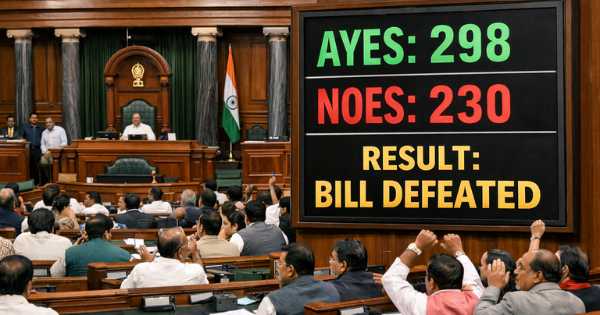
The hallowed halls of the Lok Sabha became the stage for a profound legislative drama this Friday, as the government’s ambitious attempt to overhaul the nation’s democratic architecture met a decisive and historical roadblock. At the heart of the storm was the Constitution (131st Amendment) Bill, 2026, a high-stakes piece of legislation designed to amend existing laws on the reservation of seats for women in Parliament and state Assemblies, while simultaneously expanding the size of the Lok Sabha and initiating a fresh delimitation of constituencies. Despite a marathon two-day debate characterized by high rhetoric and emotional appeals, the Bill was ultimately defeated. While 298 members voted in favor and 230 voted against it, the motion fell significantly short of the two-thirds majority required for a Constitutional amendment to clear the House. In a chamber with 540 members currently presiding, the mathematical threshold for victory stood at 360 votes; the resulting deficit of 62 votes marks a rare and stinging parliamentary setback for the current administration.
This legislative failure is particularly significant as it represents the first time in twelve years that a Constitutional amendment Bill introduced by the Modi government has failed to pass the House. The gravity of the situation was immediately apparent as Union Minister for Parliamentary Affairs, Kiren Rijiju, moved to halt proceedings on two accompanying Bills concerning the resizing of the Lok Sabha and the delimitation process. Since these measures were intrinsically linked to the fate of the 131st Amendment, the collapse of the primary Bill rendered the others moot for the time being. The defeat occurred despite the existing 2023 women’s reservation law remaining on the books, as the 2026 Bill sought to introduce specific amendments that would tie the implementation of reservation to the broader and more controversial processes of census data and seat redistribution.
The debate preceding the vote was nothing short of a political firestorm, with Prime Minister Narendra Modi and Home Minister Amit Shah leading a concerted effort to sway the House. Both leaders framed the legislation not merely as a policy choice, but as a moral imperative for the nation’s “Nari Shakti” or woman power. In a pointed post on X hours before the vote, the Prime Minister asserted that the government had systematically addressed all apprehensions and misconceptions with facts and logic, arguing that after four decades of inordinate delay, it was finally time to give half the population their rightful due in decision-making. He urged all political parties to reflect carefully and take a sensitive decision, subtly warning that the sentiments of crores of women across India were at stake. This sentiment was echoed by Amit Shah during the floor debate, where he accused the Opposition of manufacturing excuses to block progress and cautioned that the women of the country were watching their intent and would not easily forgive a betrayal of their aspirations.
Conversely, the Opposition’s resistance was rooted in a deep-seated suspicion regarding the government’s ultimate objectives. While ostensibly supporting the principle of women’s reservation, the United Opposition accused the administration of using the gender quota as a “Trojan Horse” to push through a delimitation exercise that would fundamentally redraw the country’s electoral map. The primary concern raised by leaders from various parties was that a fresh delimitation based on current population metrics would unfairly penalize southern states, which have more successfully implemented population control measures, thereby shifting the balance of power toward the northern “Hindi heartland” where the BJP traditionally holds more sway. A senior Opposition leader confirmed that while the government made last-ditch overtures to parties like the Samajwadi Party to break the impasse, the bloc remained firm in its conviction that delimitation must be deferred to protect federal proportionality.
The strategic calculations behind the scenes revealed a government prepared for the possibility of a tactical defeat. As the realization dawned that the numbers were not in their favor, high-level meetings chaired by Amit Shah shifted the focus from legislative victory to political optics. Internal sources indicated that the NDA leadership decided against withdrawing the Bill, viewing a defeat on the floor as a more potent political weapon than a quiet retreat. By forcing a vote, the government sought to frame the Opposition as the primary obstacle to women’s empowerment. One NDA leader noted that they had “no option but to become martyrs” on this issue, suggesting that the defeat would be weaponized in the public square. Indeed, by 6 pm on the day of the vote, party ministers were already coordinating plans to “go to the people,” effectively transitioning the debate from the floor of Parliament to the campaign trail.
The procedural requirements for a Constitutional amendment in India are intentionally rigorous, demanding a special majority that reflects a broad national consensus. Under the rules, such a Bill must be passed by a majority of the total membership of the House and by a majority of not less than two-thirds of the members present and voting. The failure to secure 360 votes out of the 540 members present highlights the depth of the political divide. While the government argued that the link between reservation and delimitation was a logistical necessity to ensure a fair and updated electoral roll, the Opposition viewed it as a partisan maneuver. The rejection of the 131st Amendment effectively stalls the resizing of the Lok Sabha, an issue that has been looming over Indian politics as the 2026 deadline for the freeze on seat allocation approaches.
The fallout of this defeat is likely to resonate through the Indian political landscape for months to come. For the government, the loss of this Bill is a rare blemish on its record of legislative dominance, yet it provides a powerful narrative of “obstructionism” to present to the electorate. For the Opposition, the successful blocking of the Bill serves as a testament to their newfound unity and their role as defenders of the federal structure against perceived central overreach. However, the collateral damage remains the immediate implementation of the expanded women’s quota, which now remains entangled in the complex web of census delays and delimitation disputes. As both sides prepare to take their arguments to the citizens, the fundamental question of how to balance gender equity with regional representation remains one of the most volatile and unresolved challenges facing the world’s largest democracy.
(the writer can be reached at dipakkurmiglpltd@gmail.com)