
ROOPAK GOSWAMI
Shillong, Sept 22: Meghalaya may not be known as rhino country today, but historical records tell a different and surprisingly complex story.
From rhinos being hunted around Tikrikilla in the Garo Hills in the 19th century to a possible medieval rhinoceros carving in the Jaintia Hills, the animal has left a little-known trail across Meghalaya.
A detailed historical account by zoological historian L.C. (Kees) Rookmaaker, published as Chapter 37, “Historical Records of the Rhinoceros in Meghalaya,” in his book The Rhinoceros of South Asia https://www.degruyterbrill.com/document/isbn/9789004691544, brings together records spanning more than a century. The chapter, published by Brill, covers pages 457-462.
Rookmaaker, however, cautions against the assumption that rhinos once ranged widely across Meghalaya.
“The absence of regular and persistent reports from the hills” suggests that the greater one-horned rhinoceros (Rhinoceros unicornis) did not favour Meghalaya’s hill and forest habitats, he writes. The reliable historical records are concentrated mainly in the west, close to the Brahmaputra valley.
Twenty-nine rhinos killed at Tikrikilla
One of the most striking episodes comes from Tikrikilla, in present-day West Garo Hills.
In March 1864, British army officers Charles Richard Cock and Abraham Charles Bunbury travelled into the area from Goalpara. According to Cock’s hunting diary, they encountered rhinos around the foothills and plains near Tikrikilla.
On March 19, Cock shot a female rhino and captured its young. By the time the expedition ended, their hunting tally included 29 rhinos.
Rookmaaker’s account records that Cock and Bunbury had moved from the Goalpara area towards Tikrikilla, where they found rhinos at a salt lick and continued hunting in the surrounding plains. The expedition lasted into April.
The episode offers a stark glimpse into a period when rhinos were treated as hunting trophies rather than protected wildlife.
Rhinos in the Khasi Hills too
The historical trail does not end in Garo Hills.
Records from the Khasi Hills are considerably fewer, but one account from 1898 is particularly intriguing.
A writer identified as Synteng described a low-lying swamp belt near Jyrung (Jirang), about 50 km south of Guwahati, where rhinos were reportedly “tolerably abundant”. The animals were described as shy and living in a secluded wetland landscape.
Rookmaaker places this record close enough to the Brahmaputra valley to conclude that the animals were most likely greater one-horned rhinoceroses.
A rhino carved into a Jaintia Hills rock?
Perhaps the most unusual piece of the story comes from Tongseng Nongkhlieh in southeast Meghalaya.
The study records a large slab of rock engraved with what is said to be a rhinoceros. The carving is attributed to U Sajar Nangli, described as a legendary medieval local leader and artist.
Rookmaaker notes that no photograph of the carving could be located and raises an intriguing question: did the animal depicted have one horn or two?
The record is particularly interesting because it potentially links the rhinoceros not merely to Meghalaya’s natural history but also to its cultural history.
What happened to the rhinos?
The historical evidence suggests that rhinos were never a widespread hill species in Meghalaya.
Rookmaaker says records from the Garo Hills are concentrated around the foothills where the hills meet the Brahmaputra valley. The greater one-horned rhino certainly occurred there, while claims about other rhino species are much less certain.
The Khasi Hills produced only occasional records, while evidence from the Jaintia Hills is also limited.
There is, however, a much later record.
In 1975, a dead rhino was reportedly found near the border of the Mikir and Jaintia Hills. The study says it was believed to have strayed from the Nagaon plains of Assam.
Rookmaaker similarly records a dead rhino found in the northern Jaintia Hills in the 1970s, describing it as a stray from Nagaon district.
A history clouded by mistaken identification
The study also shows how historical wildlife records can become distorted over time.
An 1837 record cited by British naturalist Edward Blyth was long interpreted as evidence of a rhinoceros in the Garo Hills. But Rookmaaker went back to the original source and found that the locality, Gozgotto, was actually near Rangpur in present-day Bangladesh.
Blyth had also identified the animal as the smaller Javan rhinoceros based on its reported size and subsequently suggested that both single-horned rhino species extended into the Khasi and Jaintia Hills. Rookmaaker says that conclusion was based on a mistaken locality and cannot be supported by the evidence.
This makes the Meghalaya record particularly valuable: it is not simply a catalogue of old sightings but an attempt to re-examine historical claims against the original evidence.
A forgotten chapter in Meghalaya’s wildlife history
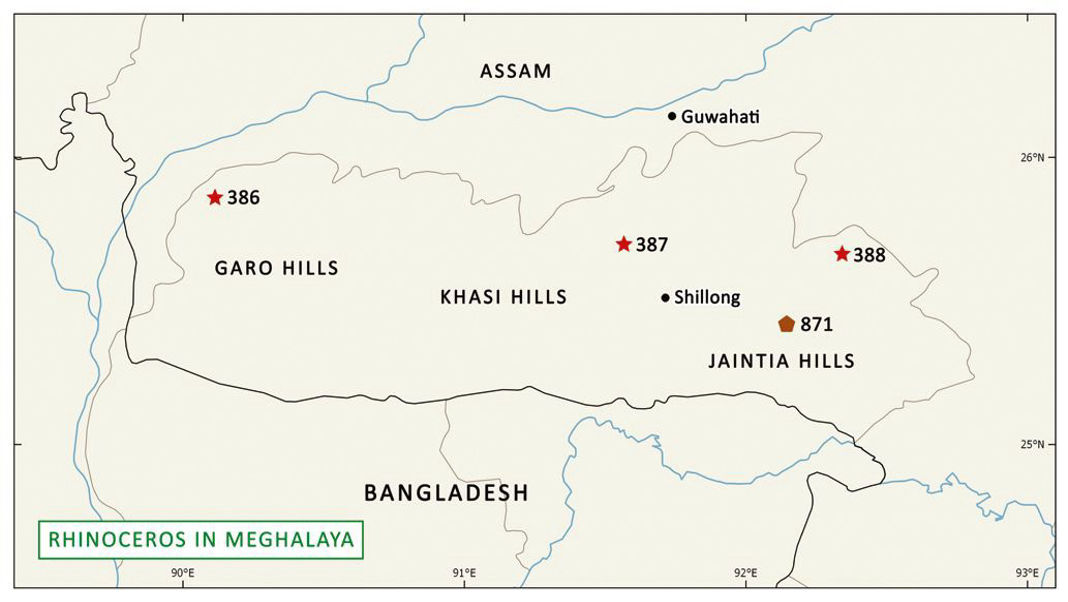
The records mapped by Rookmaaker cover the three traditional regions of Meghalaya — Garo, Khasi and Jaintia Hills — but the distribution is uneven. The documented localities include Tikrikilla, the foothills south of the Brahmaputra, Jirang and parts of the Jaintia Hills.
The story therefore offers a different way of looking at Meghalaya’s wildlife past.
The state is now better known for elephants, hoolock gibbons, clouded leopards, pangolins and other hill-forest species. But the historical record shows that the rhinoceros once appeared along the state’s western lowlands and foothills — close to the great river systems of Assam.
On World Rhino Day, the story is a reminder that wildlife histories do not always follow today’s political or ecological boundaries.