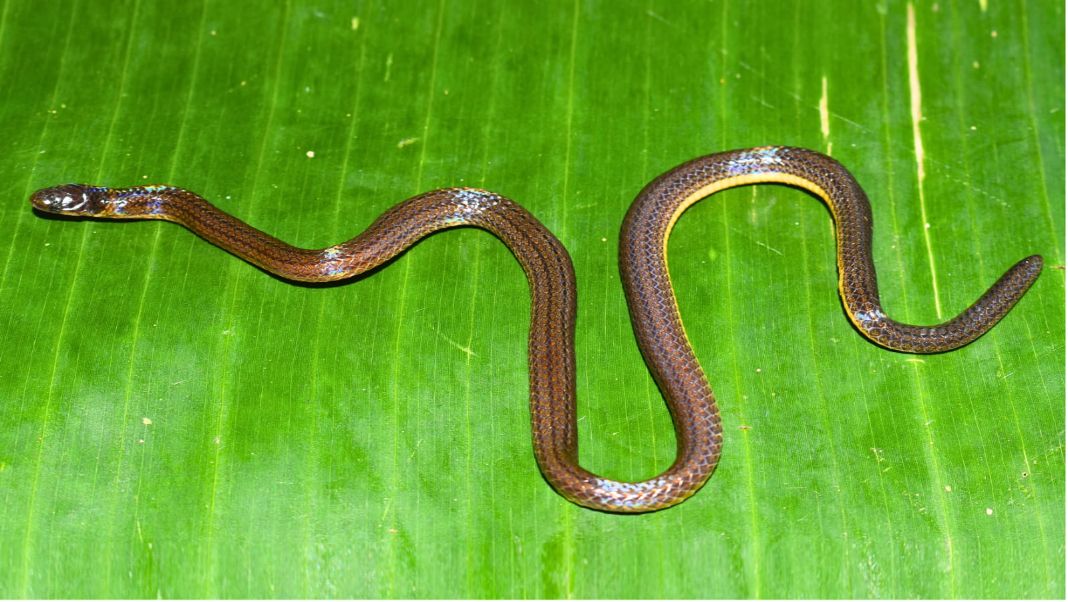

Shillong, April 14: A forest in Meghalaya’s Garo Hills has thrown up an unexpected find—a new species of snake that spent years hiding in plain sight, consistently mistaken for a species already on the books.
Researchers have described the species, Calamaria garoensis, a small, burrowing reed snake, following detailed field surveys in West Garo Hills. The study, published in the peer-reviewed journal Taprobanica, involved scientists from institutions including Help Earth, Cotton University, Assam Don Bosco University, Mizoram University, the Zoological Survey of India, and Indonesia’s BRIN.
The find traces back to Oragitok in Rongram Block. The snake had escaped notice for years—partly because of its secretive, burrowing lifestyle, and partly because it looks strikingly similar to other reed snakes already known from the area.
Using a combination of detailed morphological study and mitochondrial DNA analysis, researchers confirmed that the Meghalaya population represents a distinct evolutionary lineage. Genetic evidence indicates that the species is closely related to Calamaria mizoramensis, but it differs significantly, with approximately 6.3% divergence.
What sets Calamaria garoensis apart is a unique mix of features—a short, non-tapering tail ending in an obtuse tip, a distinct black stripe along the underside of the tail, and smooth dorsal scales arranged in 13 rows. Its slender, earth-toned body with faint striping helps it blend seamlessly into leaf litter, making it difficult to detect even during targeted surveys.
Importantly, the study also resolves a long-standing taxonomic confusion in the region. For decades, similar snakes from Northeast India were broadly identified as Calamaria pavimentata. The new findings show that this name has been applied too loosely and actually represents a complex of multiple distinct lineages rather than a single widespread species.
Researchers say the discovery carries wider implications beyond taxonomy. “The Garo Hills are a treasure trove of biodiversity that is still largely unexplored,” said Chesime M. Sangma, a researcher from Assam Don Bosco University. “This finding shows that many species are still hidden in these forests, and we must invest more in research and conservation here.”
Echoing this, Manmath Bharali of Cotton University noted that fossorial snakes like this are often overlooked despite their ecological importance. Documenting them, he said, is the first step towards ensuring their conservation.
Currently, Calamaria garoensis is known only from the Garo Hills, pointing to a potentially restricted range and underscoring its conservation significance. Scientists believe that such discoveries highlight a broader reality—despite being part of a global biodiversity hotspot, Northeast India remains insufficiently explored, especially when it comes to lesser-known groups, such as reptiles and amphibians.
As research continues to uncover new species from the region, the message is becoming clearer: beneath the forest floor and within its dense landscapes, Northeast India still holds many secrets waiting to be discovered.