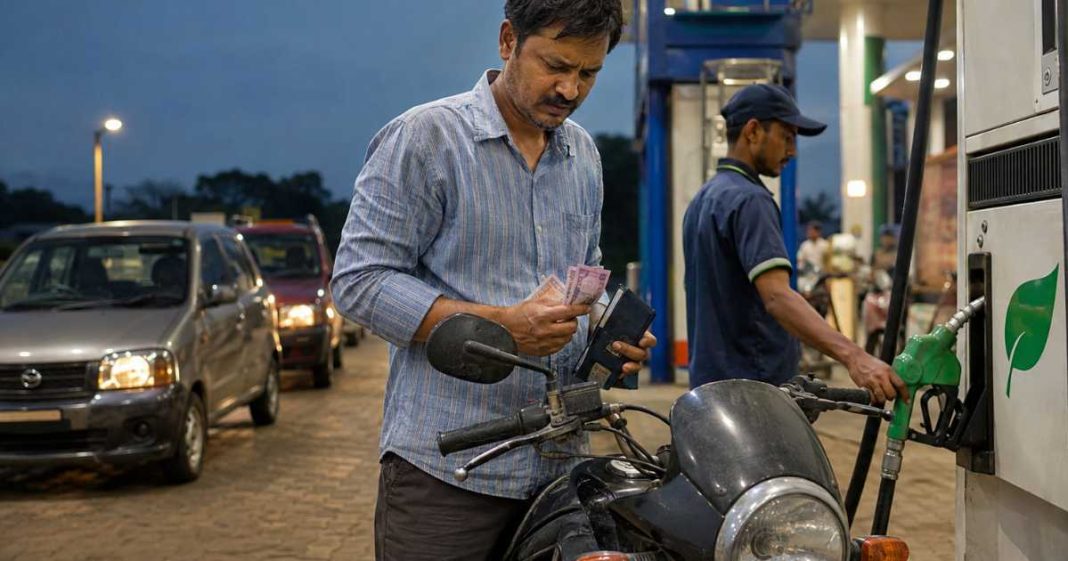

By Satyabrat Borah
The ongoing debate around E20 petrol blend has taken over street corners, family dinner tables, and digital feeds across the country. Drivers and riders everywhere are noticing a clear drop in their distance per liter, feeling the financial sting every time they pull up to a gas station. People are bearing the hidden cost of lower fuel efficiency while paying the exact same rate at the pump as they always did. This situation brings up fundamental questions about market freedom, everyday economics, and how public policy interacts with the lives of ordinary citizens. Understanding why this issue strikes such a sensitive chord requires looking at how lower middle income families manage their daily routines and financial decisions.
For millions of households, fuel is not an optional luxury. It is a daily necessity required to reach offices, commute to college, transport produce, or run small local businesses. Every family operates on a finely balanced budget where even minor price shifts create ripple effects across monthly spending. When a vehicle yields fewer kilometers per tank, the owner is forced to refuel more frequently. This subtle shift acts as an invisible price hike, draining wallets over time without any official change in retail numbers. Drivers find themselves spending noticeably more by the month to cover the exact same distances they traveled effortlessly in previous years.
The main frustration comes down to the complete absence of choice at the pump. When consumers enter a filling station today, they are given a single option that has been predetermined for them. If a driver owns an older vehicle that was never built to run on higher ethanol blends, they cannot opt for traditional unblended fuel or even a lighter mix. They are forced to accept whatever comes out of the nozzle. In a healthy market economy, options allow individuals to decide what works best for their specific machinery and personal financial limits. Removing options takes away consumer autonomy, creating a feeling of powerlessness that naturally turns into public discontent.
To see why people feel shortchanged, one must look at how ethanol blending alters basic fuel performance. Ethanol contains less chemical energy per unit volume compared to pure gasoline. Mixing twenty percent ethanol into petrol inherently reduces the total energy density of the liquid in the tank. The mechanical result is straightforward. Engines need to burn slightly more fluid to produce the same power output, which translates directly to reduced distance per liter. While a drop of five to eight percent might sound minor on paper, it builds up rapidly for someone commuting long distances every day.
Vehicle health adds another layer of genuine anxiety for long term owners. Ethanol naturally attracts moisture and acts as a mild solvent. Older engines featuring standard rubber hoses, plastic seals, and conventional metal tanks were engineered exclusively for pure petrol or minimal blend levels. Exposure to higher ethanol levels over prolonged periods can degrade these components, leading to clogged lines, corroded parts, and unexpected engine breakdowns. Owners of older two wheelers and compact cars face the double burden of higher daily running costs and the looming threat of steep mechanical repair bills.
The public reaction to these changes is grounded in personal experience rather than political leanings. People observe the numbers on their odometers dropping, notice their fuel gauges dropping faster, and calculate the extra cash leaving their bank accounts. When official announcements focus purely on long term environmental benefits or national energy goals without addressing these immediate personal costs, a communication gap emerges. Citizens feel that their daily struggles are being brushed aside in favor of grand targets, making them far less receptive to government messaging.
There is a clear economic disconnect that bothers the average motorist. Producing ethanol from agricultural products like sugarcane and surplus grains generally costs less than importing and refining crude oil. When a significant portion of expensive petrol is replaced with a cheaper alternative, the overall production expense for the fuel mix drops. Consumers logically expect some portion of those savings to be passed down to them. Receiving lower energy content at the original price point feels inherently unfair, as if the burden of policy implementation is placed entirely on the shoulders of the consumer while the financial benefits stay elsewhere.
Inside policy circles, tuned in officials recognize these rising concerns. They see that mileage and affordability drive consumer behavior far more than abstract concepts. Minds are actively working to analyze what could have been done differently during the rollout to cushion the blow for everyday drivers. Strategic discussions are taking place regarding potential steps that might win back public confidence and restore a sense of fairness to the retail market.
The challenge of offering multiple fuel options comes down to logistics and infrastructure. Equipping thousands of filling stations across the country with separate storage tanks, dedicated underground lines, and distinct dispensing units requires massive financial investment and physical space. Many older or smaller retail outlets simply lack the room to add extra storage systems. Establishing parallel supply chains for different fuel grades creates operational complexities that fuel distributors are hesitant to embrace without substantial financial guarantees.
Adjusting the retail price of blended fuel presents its own set of economic puzzles. While ethanol itself may cost less to produce, the process of transporting it to refineries, maintaining strict quality control, and managing storage adds extra expenses. The tax structure surrounding fuels is a primary source of revenue for national and regional development projects. Cutting taxes on blended fuel to lower retail prices directly impacts public treasuries, creating a delicate balancing act for economic planners who must weigh consumer satisfaction against state revenue needs.
Looking at how other nations navigated similar transitions reveals useful lessons. Countries that successfully adopted high blend fuels prioritized two key strategies: aggressive price incentives and clear options at the pump. In markets where ethanol blends are widely used, the alternative fuel is priced significantly lower than pure gasoline. This price gap provides an immediate reward for choosing the blend, giving drivers a clear reason to accept lower mileage. These regions made sure that flexible fuel vehicles capable of running on any blend ratio were widely available before making major shifts in fuel supply.
Restoring consumer trust requires a combination of practical financial adjustments and honest communication. A direct reduction in retail prices for higher blend fuel would instantly change public perception. When motorists see a lower price tag on the pump, the drop in mileage transforms from an unfair burden into a conscious economic tradeoff. Drivers can calculate the savings and decide for themselves if the price discount offsets the minor loss in distance.
Introducing flexible fuel technology on a mass scale offers a durable long term solution. Flexible fuel engines feature upgraded sensors and resistant materials that allow them to run smoothly on any combination of petrol and ethanol without risk of mechanical damage. Pushing automobile manufacturers to make flex fuel capability standard across all budget vehicles ensures that future car buyers will not have to worry about engine degradation or performance drops.
Expanding access to alternative fuel choices in major urban centers would give drivers back their sense of control. Even if every small station cannot host multiple fuels, setting up designated pumps that offer varied blends allows owners of older vehicles to source the precise fuel their engines require. Choice fosters trust, demonstrating that policy design respects individual needs rather than forcing a single standard onto diverse users.
Public policy succeeds when it aligns seamlessly with the daily realities of the people it affects. Converting national energy initiatives into positive outcomes requires listening to the lived experiences of commuters, small business owners, and family drivers. Acknowledging the real world impact on fuel economy and offering balanced pricing creates a cooperative environment where environmental goals and personal budgets can comfortably coexist.