
By Satyabrat Borah
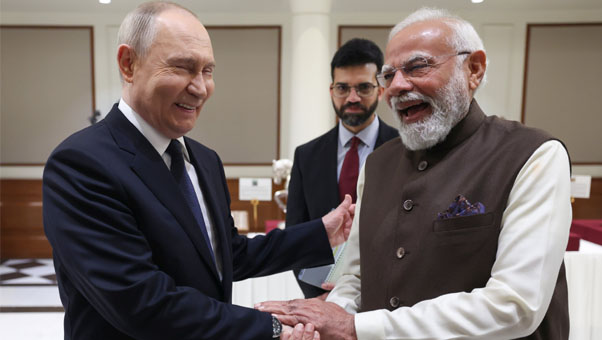
Russian President Vladimir Putin arrived in New Delhi on the evening of December 4, 2025, stepping off his aircraft at Palam Air Force Station where Prime Minister Narendra Modi waited to greet him with a warm embrace that immediately captured global attention. In a rare break from protocol, Modi personally received the Russian leader, a gesture that underlined the exceptional depth of trust between the two nations. The two men shared a brief conversation on the tarmac before travelling together in the same car to Modi’s official residence at 7 Lok Kalyan Marg. This two-day state visit, centred on the 23rd India-Russia Annual Summit, takes place at a moment of profound global tension, with the continuing war in Ukraine, shifting power balances in Asia, and the return of Donald Trump to the White House creating new uncertainties for every major capital.
The personal chemistry between the two leaders was on full display when Modi hosted Putin for a private dinner that lasted almost four hours, reciprocating the hospitality Putin had extended during Modi’s visit to Moscow the previous year. During the meal, Modi presented his guest with a Russian translation of the Bhagavad Gita, a symbolic gift that highlighted India’s philosophical tradition of duty and non-violence while reinforcing the cultural bridge between the countries. The next day’s schedule included delegation-level talks at Hyderabad House, a joint media interaction, a business round-table with Indian industry captains, a visit to Rajghat to pay homage to Mahatma Gandhi, and a state banquet hosted by President Droupadi Murmu. Though compact, the programme carried the weight of seven decades of uninterrupted strategic partnership.
The roots of this relationship run deep. From the Soviet era’s support during India’s wars with China and Pakistan to the supply of critical defence equipment and space technology that no Western country was willing to share, Russia has been India’s most reliable partner in times of crisis. Even after the collapse of the Soviet Union, successive Russian leaders have treated India as a privileged strategic partner. The present visit, Putin’s first full state visit to India since the Ukraine conflict began, demonstrates that neither Western sanctions nor intense diplomatic pressure has managed to fracture the bond. Bilateral trade has surged on the strength of heavily discounted Russian oil, helping India keep domestic fuel prices stable while providing Moscow with vital hard-currency revenue. Beyond energy, the two countries are expanding cooperation in nuclear power, pharmaceuticals, diamonds, information technology, and advanced manufacturing.
For India, the economic benefits from the relationship remain immediate and substantial. Russian crude now accounts for a significant share of India’s total oil imports, shielding the economy from the worst effects of global price spikes. Refineries along India’s western and southern coasts have been reconfigured to process heavier Russian grades, creating thousands of jobs and strengthening energy security. At the same time, Russian investment in the Kudankulam nuclear power project continues to grow, promising cleaner electricity for millions of households. Defence ties, always the backbone of the partnership, are moving toward genuine co-development and co-production. Joint ventures already manufacture BrahMos supersonic cruise missiles in India, and talks are advancing on additional licensed production of aircraft engines, air-defence systems, and small arms. These initiatives directly support Prime Minister Modi’s Make in India programme by building domestic industrial capacity and reducing long-term dependence on imports.
The summit is also expected to breathe new life into stalled infrastructure and connectivity projects. Russia has expressed interest in the Chennai-Vladivostok maritime corridor, which would dramatically shorten shipping times between the two countries and open up Russia’s Far East for Indian investment. Greater use of national currencies for trade settlement, expansion of the International North-South Transport Corridor, and collaboration in artificial intelligence and quantum computing are all likely to feature in the final joint statement. For ordinary Indians, the partnership translates into affordable medicines (India is the largest buyer of Russian pharmaceuticals), thousands of university seats for medical and engineering students, and a steady supply of fertilisers that keep food prices from spiralling.
From Washington’s perspective, however, the sight of Modi rolling out the red carpet for Putin at this particular moment is deeply uncomfortable. The second Trump administration has made clear that it wants a swift end to the Ukraine war, preferably on terms favourable to American interests, and views any country that sustains Russia’s economy as indirectly prolonging the conflict. Recent American sanctions on Russian energy companies and shipping firms have already begun to disrupt India’s oil imports, forcing refiners to cut purchases and look for costlier alternatives. At the same time, new tariffs imposed on Indian exports to the United States have strained bilateral trade relations that were once considered the brightest spot in the partnership.
American analysts worry that India’s refusal to join Western sanctions gives Putin diplomatic cover and undermines the collective pressure on Moscow to negotiate. The timing is especially awkward because senior Trump administration officials have been engaged in back-channel discussions with the Kremlin, trying to broker a ceasefire framework that would freeze the current front lines and postpone Ukraine’s NATO membership indefinitely. Putin’s ability to fly directly from those talks to a triumphant summit in New Delhi weakens Washington’s leverage and signals to other non-Western nations that they can maintain profitable relations with Russia without paying a meaningful price.
Yet the United States also recognises that pushing India too hard risks driving it closer to Russia and, by extension, to China, the very outcome American strategy in Asia is designed to prevent. India has steadily increased its purchases of American military hardware, from Apache attack helicopters and Poseidon maritime patrol aircraft to advanced artillery systems, demonstrating that it is diversifying its sources rather than remaining wedded to a single supplier. Washington’s own defence industry has a strong stake in the relationship, with billions of dollars in potential orders hanging in the balance. Technology cooperation in semiconductors, critical minerals, and space launch vehicles offers additional avenues for partnership that Russia simply cannot match.
The reality is that India has chosen strategic autonomy over alignment with any single power bloc. It cooperates closely with the United States, Japan, and Australia in the Quad, conducts more joint military exercises with American forces than with any other country, and shares Washington’s concerns about Chinese expansionism. At the same time, it refuses to sacrifice decades-old relationships or accept dictates on its foreign policy choices. This multi-alignment allows New Delhi to extract maximum benefit from all sides: Russian energy and Middle Eastern oil at discounted prices, American and European investment and technology, and growing markets across Southeast Asia and Africa.
For Russia, the visit is a diplomatic victory that breaks the narrative of total isolation. By securing India’s continued economic engagement, Moscow ensures a steady flow of foreign exchange needed to finance its military campaign and domestic stability. The warmth displayed in New Delhi also strengthens Putin’s domestic standing, projecting an image of Russia as a global power that retains loyal friends even under unprecedented pressure.
When Putin boards his aircraft for the return journey, he will carry with him a basket of new agreements that are likely to include an ambitious trade target for the end of the decade, long-term arrangements for nuclear fuel and reactor construction, and fresh initiatives in digital payment systems and Arctic resource development. India will gain greater predictability in energy supplies, deeper defence industrial cooperation, and enhanced leverage in its negotiations with every other major power. The United States will be left to recalibrate its approach, deciding whether confrontation or pragmatic accommodation offers the better path to keeping India firmly in the democratic camp while countering Chinese influence.
In an era of renewed great-power competition, India’s partnership with Russia serves as a powerful reminder that the world is no longer neatly divided into rival blocs. Nations in the Global South, led by examples such as India, are determined to chart their own course, maintaining relations with all sides according to their national interest rather than ideological conformity. The embrace between Modi and Putin on a December evening in New Delhi was more than a photo opportunity; it was a statement that strategic autonomy is here to stay, and that old friendships endure, and that the global order is becoming genuinely multipolar. How the United States chooses to respond to that reality will shape the Indo-Pacific, and indeed the world, for decades to come.