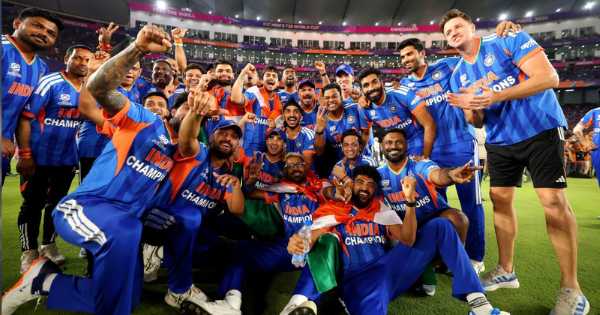

India’s Historic T20 World Cup Triumph
By Dipak Kurmi
The cricketing world witnessed a monumental shift in the balance of power on Sunday, March 8, 2026, as India clinicaly dismantled New Zealand to claim the ICC Men’s T20 World Cup trophy. In a high-octane final hosted at the majestic Narendra Modi Stadium in Ahmedabad, the Men in Blue secured a resounding 96-run victory, effectively exorcising the ghosts of past heartbreaks at the same venue. The atmosphere was electric as Suryakumar Yadav’s side executed a perfect game plan, blending aggressive strokeplay with a masterclass in defensive bowling. This victory marks a significant milestone in India’s T20 history, as they not only dominated the scoreboard but also displayed a level of tactical superiority that left the Black Caps searching for answers. The win is particularly sweet for the Indian contingent, considering the venue was where they suffered a cruel defeat in the ODI World Cup final not too long ago, making this triumph a poetic act of redemption in front of a capacity home crowd.
The day began with New Zealand skipper Mitchell Santner winning the toss and opting to bowl first, a decision that initially seemed pragmatic given the high-stakes nature of a final. However, the Indian top order had other plans, as they unleashed an unprecedented assault on the Kiwi bowling attack. Sanju Samson was the undisputed star of the first innings, slamming a magnificent 89 that anchored the innings and allowed the middle order to flourish. He was ably supported by Ishan Kishan and Abhishek Sharma, both of whom struck aggressive half-centuries to keep the run rate soaring. As the innings reached its crescendo, Shivam Dube arrived at the crease to play a blistering cameo, propelling India to a massive total of 255/5 in their allotted 20.0 overs. This score stands as the highest ever posted in a T20 World Cup final, setting a daunting mountain for New Zealand to climb under the relentless pressure of a championship chase.
India’s journey to this final was characterized by a solitary stumble against South Africa during the Super 8 stage, a defeat that forced the team into a period of intense introspection and must-win scenarios. Since that loss, Suryakumar Yadav’s men have been in imperious form, navigating a treacherous path that included a high-pressure encounter against the West Indies. The semi-final against England at the Wankhede Stadium was a particularly tense affair, where India managed to defend a total of 253 runs to win by a narrow margin of seven runs. This momentum carried them into Ahmedabad with a sense of destiny. In contrast, New Zealand entered the final on a high of their own, having humbled an unbeaten South African side in the semi-finals. That victory was headlined by Finn Allen’s record-breaking unbeaten century off just 33 balls, a feat that had initially made the Kiwis the favorites in the eyes of many analysts heading into the Sunday showdown.
When the chase began, New Zealand’s aspirations were quickly dampened by a disciplined and lethal Indian bowling battery. Axar Patel drew first blood early in the innings, dismissing the dangerous Finn Allen for just 9 runs off 7 balls, a crucial breakthrough that prevented the opener from repeating his semi-final heroics. Patel continued his dominance by removing Glenn Phillips for 5 and Daryl Mitchell for 17, finishing with impressive figures of 3/27. Meanwhile, Jasprit Bumrah proved why he is considered the gold standard of modern fast bowling. Bumrah snapped up the wicket of Rachin Ravindra early on, but his real masterclass came later in the game. He castled Jimmy Neesham and Matt Henry in back-to-back deliveries and subsequently cleaned up Mitchell Santner for his fourth wicket, pushing New Zealand further into the abyss. Bumrah finished the match with a staggering 4/15 from his four overs, effectively breaking the back of the Kiwi resistance.
The middle overs saw Hardik Pandya piling on the pressure, as he sent back Mark Chapman for 38, ensuring that no meaningful partnership could develop. Despite the falling wickets, Tim Seifert showed some resistance, reaching a fighting half-century with 52 runs off 26 balls, including two boundaries and five towering sixes. However, his valiant effort was cut short when he fell to the guile of Varun Chakaravarthy, caught by Ishan Kishan. The Kiwis struggled to maintain the required run rate as the Indian spinners and pacers worked in tandem to stifle the scoring. Arshdeep Singh provided steady support with a four-over spell for 32 runs, while Abhishek Sharma chipped in by taking the final wicket of Jacob Duffy, who was caught by Tilak Varma for 35. New Zealand was eventually bowled out for 159 in 19.0 overs, falling well short of the target and handing India a historic victory.
The statistical breakdown of the match highlights the total dominance of the Men in Blue. India’s 255/5 was built on the back of a collective batting effort that saw three players cross the fifty-run mark, a rarity in T20 finals. On the bowling side, the fall of wickets for New Zealand told a story of constant struggle, starting from 1-31 in the third over and ending at 10-159 in the nineteenth. The umpiring panel, consisting of Richard Illingworth, Alex Wharf, and Allahudien Paleker, oversaw a game that was played with high intensity but remained largely free of controversy. For India, the contribution of the support staff and the leadership of Suryakumar Yadav cannot be overstated, as they managed to rotate their bowlers effectively and maintain an aggressive field set even when Seifert was momentarily threatening to break free. The 96-run margin of victory is one of the largest in the history of ICC tournament finals, reflecting the gulf in performance on the day.
This victory is not just about a single match but represents the culmination of a long-term vision for Indian T20 cricket. The inclusion of young talents like Abhishek Sharma and the resurgence of experienced campaigners like Sanju Samson have created a balanced squad capable of handling diverse conditions. The Narendra Modi Stadium, which has a capacity of over 130,000, provided a coliseum-like backdrop for this triumph, and the roar of the home fans as the final wicket fell was a testament to the nation’s passion for the sport. As the Indian players celebrated with the trophy under the floodlights, the narrative of the 2026 T20 World Cup was firmly written in blue ink. New Zealand, while gracious in defeat, will reflect on a missed opportunity, but they can hold their heads high after a tournament where they proved to be one of the most resilient teams on the global stage.
As the dust settles on this magnificent final, India stands atop the cricketing world as the 2026 T20 World Cup champions. The team’s ability to bounce back from their Super 8 defeat and maintain a clinical edge through the knockout stages serves as an inspiration for future generations. The names of Bumrah, Samson, and Patel will be etched in gold for their contributions in this high-pressure encounter. This victory also provides a significant boost to the profile of T20 cricket in India, reinforcing the country’s status as a powerhouse in the shortest format of the game. With the next cycle of ICC tournaments on the horizon, the Men in Blue have set a incredibly high standard for themselves and their rivals, proving that with the right mix of aggression and tactical discipline, no target is too high and no heartbreak is permanent.
(the writer can be reached at dipakkurmiglpltd@gmail.com)