
By Dipak Kurmi
The literary imagination of Terry Pratchett once conjured the sprawling, chaotic city-state of Ankh-Morpork, a primary setting for his celebrated Discworld novels that offered a satirical masterclass in political science. Pratchett famously described the city’s unique interpretation of democratic principles through the lens of a “One Man, One Vote” system, where the Patrician, Lord Vetinari, was the Man and consequently held the only Vote. This whimsical yet biting commentary on absolute authority provides a remarkably apt framework for understanding the highly efficient, if entirely illusory, electoral models found in the modern geopolitical landscape. In such systems, there is a mathematically zero chance of the elected government failing to live up to the electorate’s expectations, primarily because the government and the electorate are essentially the same entity. The efficiency of this model lies in its ability to bypass the messy, unpredictable nature of genuine public discourse, replacing it with a choreographed display of national unity that functions more as a ritual than a contest.
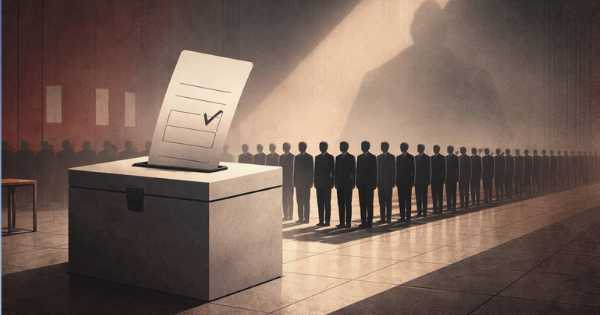
Parallel to this fictional construct, the Democratic People’s Republic of Korea has developed an equally commendable and strictly regulated model for its parliamentary elections. In this reality, the public is invited to the polls in each constituency to cast their ballots for a sole, pre-approved candidate, leaving no room for the factionalism or debate that characterizes liberal democracies. While the system appears absolute, it is theoretically liberal enough to accommodate dissent; technically, a voter may choose to cross out the name on the ballot in a private booth. However, the practical implications of such an act are understood by all participants, as the atmosphere of “NOTA” fans clapping—or else—remains a chilling underlying reality. This performance of choice serves as a psychological anchor for the state, reinforcing the concept that the leadership is not merely imposed but is instead “validated” by the collective will of the people in a recurring national pageant.
The most recent iteration of this political theater occurred on March 15, when the Workers’ Party of Korea predictably secured all 687 seats in the Supreme People’s Assembly. While the total seat count remained stagnant, the statistical nuances of the results provided a curious point of interest for international observers. The official reports indicated that the party won 99.93 percent of the vote, representing a statistically minute but narrative-heavy decline from the 99.99 percent recorded during the 2019 elections. Much has been made of this supposed “drastic” decline in vote share, leading some to wonder if a handful of brave souls are finally raising their heads above the parapet of state control. However, a more cynical and likely more accurate interpretation suggests that the figure of 99.93 percent is a calculated administrative choice. In the optics of modern authoritarianism, a fractional imperfection looks slightly more convincing than a perfect 100 percent, providing a veneer of plausibility to a process that is otherwise entirely predetermined.
This strategy of allowing for a “tolerated opposition” or a marginal dip in support is a common hallmark of long-standing dictatorships. By permitting a few seats to be bagged by minor, state-aligned parties or reporting slightly less-than-perfect victory margins, these regimes attempt to mimic the statistical “noise” of a functioning democracy. In the case of North Korea, the Supreme People’s Assembly serves as a classic example of how the rituals of democracy can enjoy a vibrant pantomime existence even when they are functionally irrelevant to the actual levers of power. The assembly meets infrequently and largely exists to rubber-stamp the decisions made by the central leadership, yet the state continues to invest heavily in the logistical spectacle of the election process. This investment suggests that even the most absolute rulers feel a persistent need to clothe their authority in the traditional garments of popular sovereignty, even if the fabric is transparent.
The reality of the North Korean political structure mirrors the Ankh-Morporkian ideal: there is really only one voter who matters. Kim Jong Un, the third-generation leader of the Kim dynasty, continues to consolidate power while simultaneously shifting his public persona to meet evolving propaganda needs. While he was once famously dubbed “little rocket man” by a “big rocket man” on the global stage, the internet has recently discovered a softer, more domestic side to the Chairman. Through a series of carefully curated public appearances with his daughter, Ju Ae, the world has been introduced to the leader as a “girldad,” a branding shift that complicates the terrifying image of a nuclear-armed autocrat with the relatable tropes of fatherhood. This dual identity—the ruthless commander and the doting parent—serves to humanize the regime for a domestic audience while perhaps signaling a potential succession plan that keeps the bloodline at the center of the state’s identity.
In the final analysis, whether one considers the satirical Patrician of Discworld or the very real Supreme Leader in Pyongyang, the underlying principle remains the total centralization of the “Vote.” Within this framework, the leader is perceived as deserving of 100 percent of the support, regardless of whether the official tallies are tweaked to 99.93 percent for the sake of appearances. The Supreme People’s Assembly will continue its role as a legislative theater, and the citizens will continue their march to the polling stations to affirm a choice that was made for them long ago. As long as the distinction between the “Man” and the “Vote” remains blurred, these electoral exercises will remain a fascinating study in the persistence of democratic forms in the absence of democratic substance. The world watches these statistical shifts not because they signal a change in policy, but because they reveal the subtle, shifting anxieties of a regime that must constantly reinvent its own legend to maintain control.
(the writer can be reached at dipakkurmiglpltd@gmail.com)