
By Satyabrat Borah
The concept of national sovereignty is often discussed in hushed tones within the halls of power, but its true weight is felt only when a country faces a choice that carries a heavy price tag. India currently finds itself in such a position, standing at a crossroads where the path forward is obscured by the shadow of global geopolitics and the heavy hand of a long distance ally. For decades, New Delhi has prided itself on a foreign policy that refuses to be tethered to any single bloc, a philosophy that has allowed it to navigate the choppy waters of the Cold War and the subsequent era of unipolarity with a certain degree of grace.
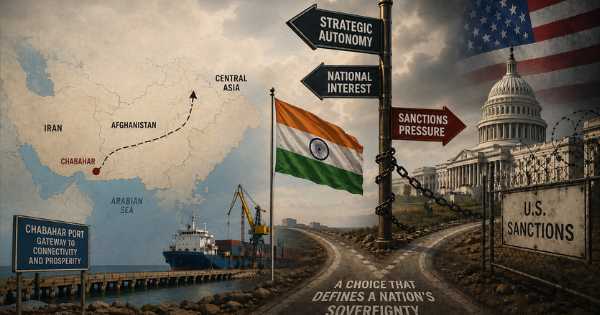
But today, that independence is being tested in a way that feels uncomfortably personal. The specific catalyst for this tension is the Chabahar port in Iran, a project that was supposed to be India’s gateway to Central Asia and a symbol of its strategic reach. With the United States allowing the sanctions waiver for this project to lapse, the silence from Washington speaks volumes. It is a signal that the era of special exemptions might be closing, replaced by a rigid demand for alignment that leaves little room for the nuances of regional necessity.
The history of Chabahar is a long and winding road, marked by moments of intense optimism followed by years of stagnation. It was back in 2003 that Prime Minister Atal Bihari Vajpayee first envisioned this project as a vital link that would bypass the geographic hurdles posed by a difficult neighbor. The idea was simple but profound: create a maritime and land corridor that would connect the Indian Ocean to the heart of Eurasia. For a country that is effectively landlocked to its west due to persistent friction with Pakistan, Chabahar was not just about trade; it was about breaking a strategic siege.
It was about ensuring that India could reach Afghanistan and the resource rich republics of Central Asia without asking for permission from those who would rather see it fail. For years, the project remained a dream deferred. The pressures of the international community regarding Iran’s nuclear ambitions meant that successive Indian governments had to move with extreme caution. The Manmohan Singh administration found itself walking a tightrope, trying to keep the flame of the project alive while responding to the growing demands of a blossoming partnership with the United States. They managed to build the Zaranj Delaram highway, a physical testament to India’s commitment to Afghan stability, but the port itself remained a work in progress, stalled by the complex mechanics of global diplomacy.
When the nuclear deal was signed in 2015, it felt like a new dawn. The Modi government moved quickly to formalize the trilateral agreement with Iran and Afghanistan. It felt as though the stars had finally aligned. India committed hundreds of millions of dollars, sent equipment, and began the hard work of turning a quiet coastal town into a bustling hub of commerce. The port became a lifeline, especially as the security situation in the region shifted and the traditional routes grew more precarious.
It was through Chabahar that India sent thousands of tons of wheat and life saving medicines to the people of Afghanistan, proving that the project had a humanitarian soul that transcended mere balance sheets. But the return of aggressive sanctions under the Trump administration changed the math overnight. The United States began a campaign of maximum pressure on Tehran, and India was caught in the middle. Initially, a carve out was granted, a recognition that India’s role in Afghanistan was beneficial to everyone involved. But that window has now slammed shut. The lapse of the waiver on April 26 is not just a technicality; it is a direct challenge to India’s right to choose its partners based on its own national interests.
There is a growing sense in New Delhi that the list of demands coming from Washington is getting longer and more intrusive. It started with oil. India was once one of the largest buyers of Iranian crude, a relationship that provided energy security and favorable credit terms. Under pressure, those imports were cut to zero. Then came the directives regarding Venezuela, another traditional energy partner. More recently, the conflict in Europe brought fresh demands to stop purchasing Russian oil, despite the fact that these purchases were essential for keeping the Indian economy afloat during a period of global volatility.
Now, the crosshairs are on Chabahar. If India walks away from this project, it is not just losing a port; it is losing a piece of its identity as a sovereign actor. The financial loss of over six hundred million dollars is significant, but the damage to India’s reputation in the region would be far greater. If a rising power cannot protect its own investments or fulfill its promises to its neighbors because of the diktats of a distant power, its claims of leadership begin to ring hollow.
The current global landscape makes this situation even more delicate. The war in West Asia has set the region on edge, making any engagement with Iran a lightning rod for criticism. There are voices that argue for a pragmatic retreat, suggesting that India should wait for the dust to settle before trying to rebuild what has been lost. This perspective suggests that maintaining a smooth relationship with the United States is more important than a single infrastructure project, no matter how strategic it may be. They point to the growing cooperation in technology, defense, and space as evidence that the partnership with Washington is the primary engine of India’s future growth.
But this logic ignores a fundamental truth: a partnership between unequals is not a partnership; it is a client relationship. If India accepts the idea that its foreign policy must be cleared by a third party, it sets a precedent that will be impossible to ignore in the future. Today it is a port in Iran; tomorrow it could be a trade agreement in Southeast Asia or a military purchase from a non Western source. The appetite for control tends to grow with every concession.
The pressure is not limited to bilateral projects. The rhetoric coming out of the United States has expanded to include threats against members of the BRICS grouping and any nation that seeks to create alternative financial systems. This is a direct shot across the bow for India, which has always sought to diversify its global engagements. India does not view the world as a zero sum game where one must choose between the East and the West. It sees itself as a bridge, a civilization state that can talk to everyone.
By trying to force India into a corner, the United States risks alienating a partner that it desperately needs for its own Indo Pacific strategy. You cannot ask a country to be a pillar of regional security on one hand while systematically undermining its strategic autonomy on the other. It is a contradiction that cannot hold for long without causing deep resentment.
The withdrawal of Indian personnel from Chabahar and the talk of transferring stakes to Iranian companies are signs of a tactical retreat, but they also reflect a deep sense of frustration. There is a feeling that India is being asked to sacrifice its long term interests for the short term political goals of an American administration.
The investment in Chabahar was supposed to be a generational commitment. It was meant to connect India to the International North South Transport Corridor, opening up markets in Russia and Europe that are currently difficult to reach. If this link is severed, India’s ambitions of becoming a global manufacturing hub will face a significant logistical bottleneck. It will remain dependent on a limited number of trade routes, many of which are vulnerable to the whims of geopolitical rivals.
The struggle over Chabahar is a microcosm of the struggle for a multipolar world. For decades, the global order has been defined by the rules and interests of a few powerful nations. But the rise of new powers, including India, was supposed to usher in a more balanced era where different perspectives could coexist. If the United States continues to use its financial and military leverage to squash independent initiatives, it is essentially signaling that it is not ready for a world of equals. This approach might yield short term compliance, but it builds long term instability. It forces countries to look for ways to circumvent the existing system, leading to the very fragmentation that the West claims to fear.
The path forward requires a rare blend of courage and cleverness for India. It cannot afford a total rupture with the United States, given the deep ties that bind the two nations. But it also cannot afford to be a silent spectator to its own marginalization. The decision on Chabahar will be a defining moment for the current leadership. If they choose to stay the course, they will face the wrath of American sanctions, which could hurt the economy and complicate other areas of cooperation. If they retreat, they will be seen as a power that can be pushed around, a perception that will embolden its rivals in the neighborhood. There is no easy answer, no magic formula that can satisfy both sides.
The tragedy of the situation is that India’s goals in Chabahar are not inherently anti-American. A stable, prosperous Afghanistan and a well connected Central Asia are goals that Washington has claimed to support for years. By facilitating trade and providing an alternative to Chinese dominated infrastructure, India is actually contributing to regional balance. It is a classic case of a policy that serves the interests of multiple parties, yet it is being sacrificed at the altar of a singular obsession with isolating Iran. This kind of tunnel vision often leads to unintended consequences. By pushing India out of Chabahar, the United States is leaving a vacuum that will inevitably be filled by others, likely those who are much less friendly to Western interests.
It is important to remember that foreign policy is not just about treaties and trade deals; it is about the soul of a nation. It is about the right of a people to chart their own course and define their own destiny. India has spent the better part of a century trying to reclaim its place in the world after colonial rule. To give up that hard won independence now, even under the guise of pragmatism, would be a bitter pill to swallow. The streets of New Delhi and the corridors of South Block are filled with people who remember the era when India was told what to do and what to buy. They are not eager to return to those days. The lapse of the waiver is a test of resolve, a moment to decide if the phrase sovereign autonomy is a living reality or just a convenient slogan used in speeches.
The coming months will be telling. Will India find a way to navigate the sanctions minefield, perhaps by using creative financial mechanisms or by engaging in a high level diplomatic offensive to convince the Americans of the project’s value? Or will the cranes at Shahid Beheshti terminal fall silent, becoming monuments to a dream that was crushed by the weight of global power politics? The implications go far beyond the concrete and steel of a port. This is about whether a rising India can truly be an independent pole in a multipolar world, or whether it is destined to be a junior partner in someone else’s grand strategy.
The world is watching and the stakes could not be higher. The ability to say no, to stand one’s ground when the pressure is at its peak, is the true mark of a great power. If India loses that ability, it loses a part of itself. The port of Chabahar might be thousands of miles away from the capital, but the battle for its future is happening in the very heart of the Indian state. It is a battle for the right to think, act, and lead as a sovereign nation, free from the dictates of those who believe they have the right to slice away at the independence of others. In this high stakes game of geopolitical chess, the next move will define India’s place in the world for a generation to come. It is a turning point that will either solidify India’s status as a global leader or mark its transition into a state that follows rather than leads. The costs of the former are immediate and painful, but the costs of the latter are permanent and profound.
There is a certain dignity in choosing the hard path, in refusing to let the light of an independent foreign policy be extinguished by the winds of external pressure. Whether that dignity can survive the cold reality of sanctions and diplomatic isolation is the question that now hangs over the nation. The answer will tell us everything we need to know about the future of the international order and India’s role within it. It is a time for steady hands and clear eyes, a time to remember that the true value of a nation is not measured in its treasury alone, but in its will to remain free. The story of Chabahar is still being written, and the final chapters will reveal the true character of those who hold the pen.