
By Dipak Kurmi
India’s recent bronze medal triumph at the latest edition of the Thomas Cup in Horsens, Denmark, once again underlined the country’s growing stature in international badminton. While it did not quite replicate the historic gold medal triumph of 2022, a watershed moment that was compared by many astute observers to India winning the 1983 Cricket World Cup, the podium finish reinforced India’s strong standing in the world game at the highest level. The campaign was characterized by immense grit, with the elite doubles pair of Satwiksairaj Rankireddy and Chirag Shetty leading from the front, alongside notable performances from Lakshya Sen and Ayush Shetty, before a string of untimely injuries ultimately disrupted their semifinal tie against France. Yet, this hard-earned bronze medal, a highly credible and historic feat in its own right, quickly gave way to a familiar and deep-seated debate about India’s true identity as a sporting nation. Rather than being enveloped in widespread national euphoria, the achievement was met with a subdued public response that exposed the systemic challenges non-cricket disciplines face in securing long-term real estate within the collective national consciousness.
The immediate aftermath of the tournament brought these structural disparities into sharp relief when Khel Ratna awardees Satwiksairaj Rankireddy and Chirag Shetty expressed their profound disappointment over social media regarding the relatively muted reception their world-class feat received back home. Their public vulnerability brought back a consistent and highly prevalent theme across the Indian sports ecosystem, raising the critical question of whether the country has genuinely transitioned into a comprehensive multi-sports nation. Prominent singles player HS Prannoy further elucidated this frustration by noting that the team nature of the Thomas Cup requires elite athletes to completely put aside personal schedules and individual rankings to pursue a collective national goal. When such an intense accumulation of sacrifice, preparation, and world-class performance is met with a collective cultural shrug, senior athletes find it increasingly difficult to motivate younger players to prioritize these prestigious team events over lucrative individual tournaments. The underlying sentiment is that despite significant structural advancements and increased state funding, a profound disconnect remains between the achievement of global sporting excellence and the receipt of sustained public validation.
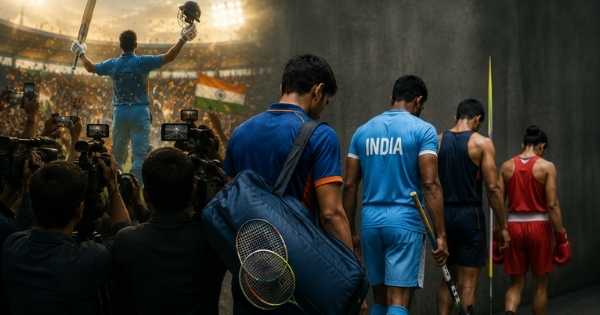
This particular grievance is hardly a novel occurrence in the contemporary sports landscape, as similar anecdotes have routinely bubbled to the surface across various Olympic disciplines. Two years ago, decorated Indian hockey player Hardik Singh recounted a deeply telling incident during an appearance on a popular podcast that highlighted this exact societal imbalance. As a pivotal midfielder who was instrumental in anchoring India’s bronze medal-winning hockey campaigns at both the Tokyo 2020 and Paris 2024 Summer Olympics, Hardik described a disheartening scene at a domestic airport where the descending crowd and intense media attention were entirely directed toward a transient social media influencer, while elite Olympic athletes who had literally bled for the national flag walked by virtually unacknowledged. This specific anecdote perfectly captured the silent, bubbling frustration that numerous non-cricket athletes have shared behind closed doors, while a courageous few have chosen to articulate it vocally to the press. It illustrates a strange cultural paradox where the general public passionately demands Olympic podium finishes every four years but remains largely indifferent to the arduous, unglamorous journeys and intermediate milestones that dictate elite athletic lifecycles.
To understand this imbalance, it is analytically necessary to recognize that cricket’s absolute dominance over the Indian imagination did not emerge by accident, nor did it manifest overnight. The ascendancy of cricket was meticulously constructed over several decades through sustained international success, expanding broadcast media access, and highly sophisticated, unmatched commercial engineering. India’s legendary victory at the 1983 Cricket World Cup is rightly remembered as the definitive transformative moment that altered the country’s psychological relationship with modern sports, but that historic victory was merely the foundational catalyst. The subsequent triumph at the 1985 World Championship of Cricket in Australia proved the team’s global dominance was no fluke, and this competitive excellence coincided perfectly with the liberalization of Indian markets and the rapid spread of satellite television in the 1990s. The emergence of globally marketable icons, most notably Sachin Tendulkar, allowed the sport to penetrate every socio-economic corner and linguistic demographic of the country. Over time, the Board of Control for Cricket in India successfully leveraged this massive television viewership to transform the sport into a corporate behemoth and a commercial powerhouse completely unmatched by any other athletic discipline on the subcontinent.
While other sporting disciplines in India have certainly produced their own era-defining moments of historical brilliance, none have altered the macroeconomic and sociological landscape of the country in quite the same permanent manner. For instance, Neeraj Chopra achieved legendary status by becoming India’s first-ever individual Olympic gold medallist in track and field at the Tokyo Games, subsequent to which he has maintained a remarkable, unprecedented level of consistency across the World Championships and Diamond League circuits. Similarly, the Indian men’s hockey team’s bronze medal at the Tokyo Olympics in 2021 carried an immense amount of historical and emotional significance, effectively ending a painful, four-decade-long drought for an Olympic medal in a sport that was once central to India’s national identity. The Indian women’s hockey team’s equally inspiring and courageous run to the semifinals at the very same Games was widely celebrated and lauded across modern media platforms. Over the course of the past decade, Indian athletes representing disciplines such as shooting, badminton, wrestling, weightlifting, and boxing have all consistently produced world champions, Olympic medallists, and landmark victories that signify a dramatic upward trajectory in international competitiveness.
It is entirely fair to state that the extraordinary performances of these elite athletes have not gone entirely unnoticed by the mainstream Indian public, as several trailblazers have successfully crossed over into household recognition. Icons like Abhinav Bindra, PV Sindhu, MC Marykom, Neeraj Chopra, Saina Nehwal, Mirabai Chanu, and Bajrang Punia, among several others, have undoubtedly become well-known and deeply respected names amongst the broader Indian sports-following public due to their exceptional, history-defying performances on the world stage. However, an objective analysis reveals a stark divergence: while these individual athletes are highly celebrated during major international events, the baseline institutional popularity and daily domestic consumption of their respective sports have simply not grown to match the pervasiveness of cricket. The public treats these Olympic triumphs as momentary bursts of nationalist pride rather than using them as catalysts to consume local badminton leagues, national shooting championships, or domestic hockey fixtures on a regular basis. Consequently, the athletes are deified, but the sports themselves continue to languish in a state of cyclical obscurity outside the quadrennial Olympic window.
In an ideal sporting ecosystem, athletic excellence across a diverse array of disciplines would naturally command sustained public engagement, regular media scrutiny, and equal corporate sponsorship opportunities. The prevailing reality in India, however, remains profoundly different, as cricket’s massive scale, astronomical financial power, and relentless year-round visibility continue to completely dominate the national sporting imagination. This structural asymmetry does not mean that athletes from other Olympic sports are entirely ignored or left unsupported by the state apparatus. In fact, through comprehensive government interventions such as the Target Olympic Podium Scheme and grassroots initiatives like Khelo India, elite athletes receive world-class training, foreign exposure, and robust financial stipends. But within an increasingly crowded, algorithmically driven modern media ecosystem, public attention spans are fundamentally finite, and cricket continuously possesses the capital and institutional machinery to occupy the lion’s share of that attention. The sport operates as an entertainment juggernaut that functions independent of seasonal cycles, effectively crowding out the oxygen required for other sports to build sustainable fan communities.
This sharp contrast becomes even more pronounced during calendar years that are heavily packed with major international cricket tournaments, where the narrative machinery of the sport operates at full capacity. In 2024, for instance, India’s dramatic victory at the ICC Men’s T20 World Cup ended a long, agonizing global title drought and subsequently generated a wave of nationwide euphoria that completely saturated television networks, digital media, and public spaces for weeks. Barely a month after these massive celebrations, the Paris Olympics began, representing the absolute pinnacle of athletic achievement for hundreds of non-cricket sportspersons. Despite the immense geopolitical and sporting significance of the Olympic Games, the general focus, prime-time television space, and advertising capital in the critical time period leading up to the event was evidently and heavily divided between cricket and the Olympics. The national conversation was continually dragged back to the aftermath of that memorable and long-due cricket title, making it exceptionally difficult for Olympic-bound athletes to build the organic momentum and widespread public backing that their global peers routinely enjoy.
The valid concerns raised by India’s badminton stars today, and voiced by various Olympic athletes before them, are clearly not isolated cases of individual petulance, but are rather a direct reflection of how sporting success is structurally valued across the country. There is little doubt that India today is far more diverse and highly accomplished in its holistic sporting achievements than it was even a mere decade ago, owing to better sports science, corporate philanthropy, and targeted coaching. The country is producing elite, world-class athletes across a multitude of technical disciplines with an increasing regularity that was once thought impossible. The fundamental challenge that lies ahead for administrators, media houses, and corporate sponsors is to actively cultivate a comprehensive, institutionalized sporting culture rather than restricting these magnificent triumphs across different sports to one-off, transient celebrations. Until the Indian sports consumer consciously decides to invest their time, attention, and gate money into non-cricket disciplines during the long intervals between major championships, the dream of becoming a true multi-sports nation will remain an elusive aspiration.
(the writer can be reached at dipakkurmiglpltd@gmail.com)