
Shillong, May 20: Calling the ongoing construction on the Shillong-Dawki Road “shabby and unscientific,” the Meghalaya High Court has held both the National Highways and Infrastructure Development Corporation Limited (NHIDCL) and the contractor responsible for endangering lives and driving up costs, while issuing a set of urgent safety directions.
A division bench of Chief Justice Revati Mohite Dere and Justice W Diengdoh was hearing a PIL filed after a massive boulder crushed a vehicle on the stretch, killing its occupants.
Advocate General A Kumar and Deputy Solicitor General of India Dr N Mozika told the Court that compensation of Rs 4 lakh and Rs 6 lakh, as directed in its April 29 order, had been credited to the accounts of the legal heirs of the deceased.
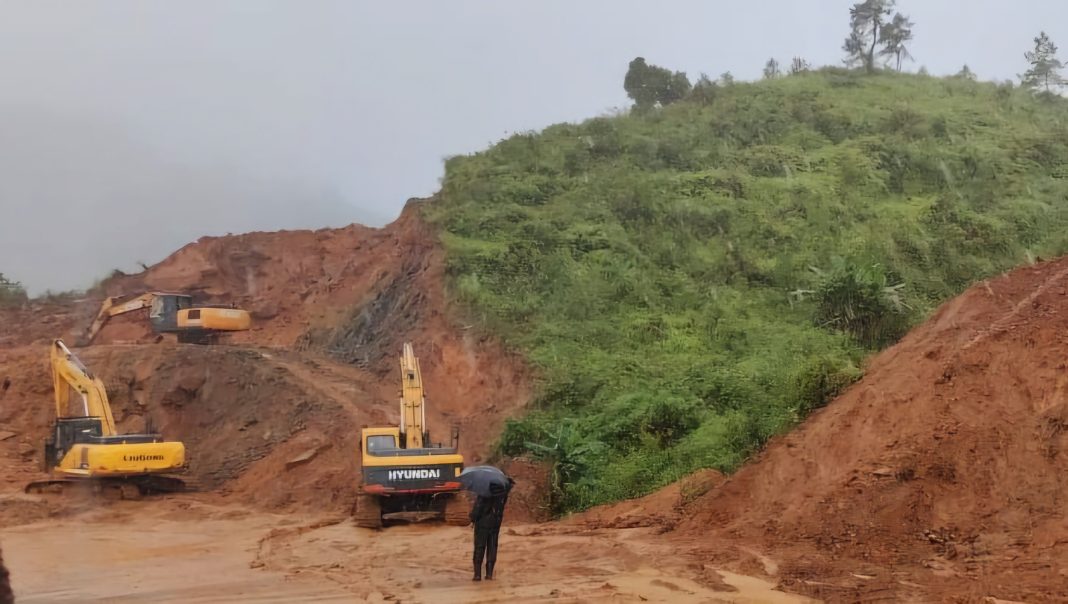
Amicus Curiae Philemon Nongbri, who inspected the road on May 14, tendered a report with photographs describing the surface as “in a deplorable condition.”
The report said the carriageway was “covered with loose mud and uncleared debris, rendering it barely motorable and extremely dangerous,” and noted an “absolute lack of proper, sturdy barricades” between live traffic and deep drops.
“The contractor has erected thin wooden sticks tied together with safety tape which offers absolutely no physical restraint or protection for vehicles,” it said.
Signage was flagged as “critically below acceptable standard,” with insecure flex banners reading “landslide prone area” and “drive slow” replacing high-visibility boards.
The report also cited missing reflectors, delineators, and “men at work” signs despite heavy fog and excavators operating during traffic hours, adding that the lapses violated Sections 9.4.1 and 9.4.2 of the Hill Road Manual.
NHIDCL submitted its own report along with a site assessment by empanelled hill road expert Ashish D. Gharpure.
He said “due to inadequate right-of-way provision and unattended slope stability aspect,” slope cutting works were creating “hazardous conditions either affecting the road user or the habitat/structure living/constructed on the borderline/adjacent to ROW.”
He criticized a “very lame and non-engineering explanation” for steep cuts and warned that continuing “un-engineered cut” would lead “not only to catastrophic damage but also loss of human life and eventual cost of construction which is multifold to initial provision.”
Gharpure said slope mitigation in such terrain is “an expert’s work” and called for a vulnerability assessment and DPR by specialist agencies.
The Court observed that it was “evident that the work is not being done as is required to be done and is being done in a shabby and unscientific manner by the contractor, thereby endangering human life and increase in the cost of construction.”
It added, “For this, prima facie, we are of the opinion that it is not only the contractor, but also the NHIDCL, who is responsible.”
Dr Mozika submitted that “it appears that the DPR itself was defective,” and the NHIDCL report admitted the contractor was chosen on financial capability, “and not whether he was an expert in constructing roads in the hills.”
The bench directed authorities to immediately replace makeshift flex banners with standardized retro-reflecting signs as per IRC guidelines, install strong physical barricades with reflectors in poor-visibility zones, clear loose mud to restore the carriageway, and deploy trained flagmen with communication devices and high-visibility gear near heavy machinery.
It ordered Gharpure’s report be placed before the highest NHIDCL authority, the Chief Secretary, and senior department officers.
Dr Mozika was asked to report on whether a school vacated from an area flagged in the expert’s report had been shifted and if children’s education was disrupted.
The Court also told the State and NHIDCL’s top officers to meet and ensure the work is completed “at the earliest, without compromising on the safety of people and quality of work.”
Advocate General Kumar was directed to ensure police deployment for smooth traffic, and instructions were sought on stationing ambulances near strategic locations for “immediate medical help… in the event there is an untoward incident.”
The case is listed next on June 3.