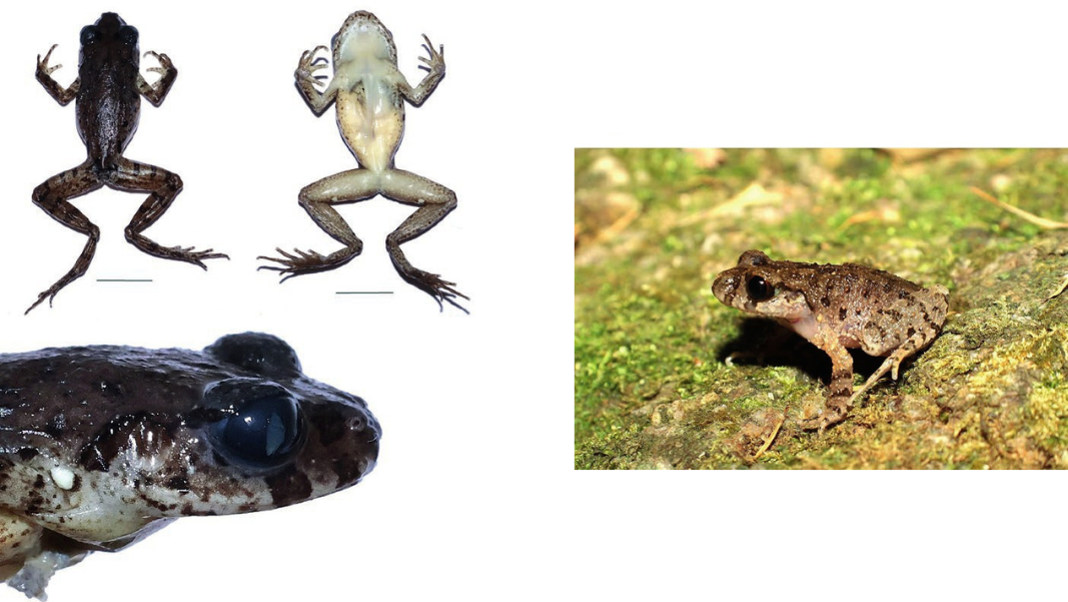

There is another encouraging finding – at the locations surveyed, the frog was found to be abundant. The authors believe it could occur in other protected areas beyond Nokrek National Park and Mawphlang Sacred Forest
ROOPAK GOSWAMI
Shillong, Aug 16: A frog once described as a distinct species from Meghalaya’s Garo Hills has been found to be the same species as a frog originally known only from the Khasi Hills, in a taxonomic finding that could significantly alter its conservation status.
The study by Ravi Shanthy Naveen of Pondicherry University and A.N. Dikshit Akalabya Sarmah of the University of Delhi, published in the journal Acta Herpetologica, concludes that Leptobrachella nokrekensis is a junior synonym of Leptobrachella khasiorum.
In simple terms, what had been considered two different frog species—one from the Garo Hills and the other from the Khasi Hills—are now considered a single species.
The finding also expands the known range of L. khasiorum, which was originally described from Mawphlang Sacred Grove and considered restricted to the Khasi Hills. Its extremely limited known distribution had led to its classification as Critically Endangered.
Genetic evidence changes the picture
Naveen and Sarmah reached their conclusion after combining molecular analysis of the 16S ribosomal RNA gene with detailed examination of specimens collected from the Khasi and Garo hills.
The researchers collected three specimens from a stream near Sakalgre village in the Garo Hills, at about 925 metres above sea level, and two from a stream flowing out of the Mawphlang Sacred Grove at about 1,575 metres. The specimens were collected in October 2024.
The study found that the frogs from the two areas were not genetically distinct enough to be treated as separate species. Morphological comparisons also supported the conclusion.
Some physical differences previously used to distinguish L. nokrekensis from L. khasiorum—including differences in colour and tuberculation—were found to be variable within the species and therefore unreliable for separating them.
There was also a nomenclatural question. Although L. nokrekensis had earlier been considered to have been described first, previous work established that its name became officially available only on June 3, 2010. L. khasiorum had already been made available on January 10, 2010. The latter therefore has priority.
From Mawphlang to Nokrek and Tura
The taxonomic change has widened the known distribution of the species considerably.
During their study, the researchers recorded L. khasiorum near Sakal Aduma and Tura Peak in the Garo Hills. A frog recorded earlier from Jirang in Meghalaya as Leptobrachella cf. khasiorum may also belong to the same species.
The updated records put the species’ estimated Extent of Occurrence at 4,027 sq km, across an elevation range of 800 to 1,600 metres.
There is another encouraging finding: at the locations surveyed, the frog was found to be abundant. The authors believe it could occur in other protected areas beyond Nokrek National Park and Mawphlang Sacred Forest.
That could have implications for its current Critically Endangered status.
The researchers say the species could qualify for downlisting from Critically Endangered under the IUCN Red List criteria, given the expanded distribution. But they stress that more field surveys are needed to establish its actual range and determine an appropriate conservation status.
Is there another species waiting to be merged?
The study leaves another question open.
Preliminary genetic evidence suggests that Leptobrachella tamdil, described from Mizoram’s Tamdil wetlands, may also be the same species as L. khasiorum. The authors, however, have not made that taxonomic change, saying further investigation is required.
If future work confirms that link, the known distribution of L. khasiorum could expand beyond Meghalaya into Mizoram and potentially change the understanding of the species even further.
For Meghalaya, the study underscores how much remains to be learnt about the state’s amphibians—particularly species that are difficult to distinguish by appearance alone.
The frog that once appeared to be a rare species confined to the Khasi Hills may, after all, be a much more widespread resident of Meghalaya’s hill forests.