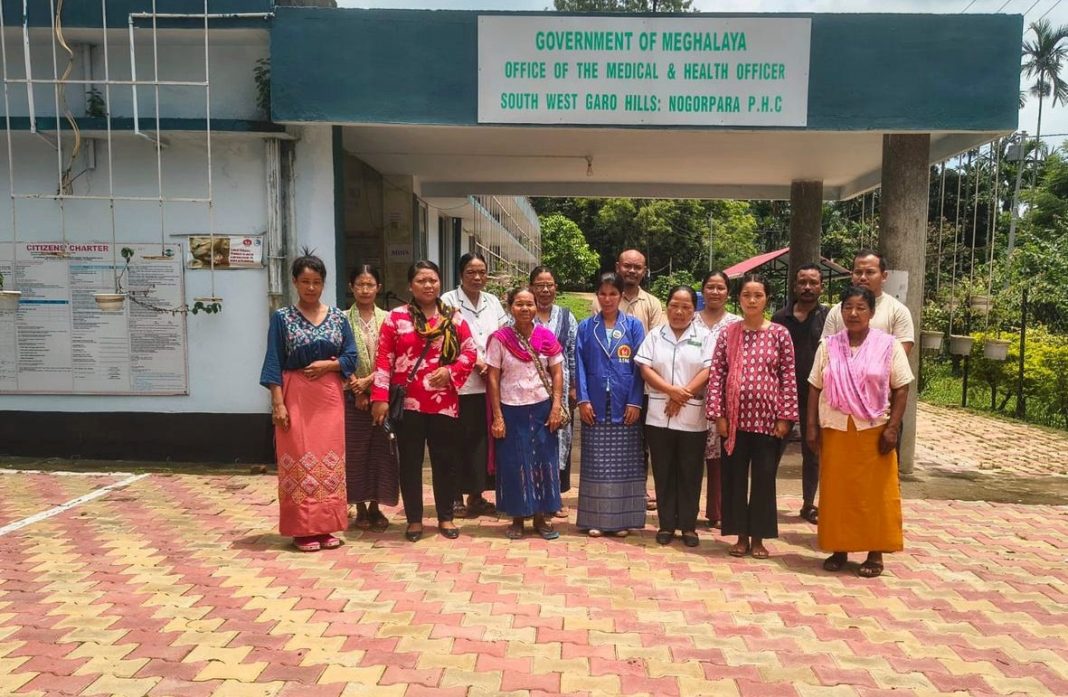

Shillong, Aug 23: A primary health centre in Meghalaya’s South West Garo Hills district has nearly doubled its institutional delivery rate over seven years by relying on early identification of pregnancies, repeated counselling and close coordination between health workers, community groups and the local administration.
The Nogorpara Primary Health Centre (PHC), which serves a population of just over 8,000 across 16 villages, increased institutional deliveries from 45.8 per cent in 2018-19 to 90.2 per cent in 2025-26, an increase of almost 97 per cent, according to an implementation learning note prepared by the State Health Systems Resource Centre (SHSRC), Meghalaya. The district’s institutional delivery rate increased by just over 64 per cent during the same period.
The learning note found that Nogorpara’s approach begins with identifying pregnant women as early as possible. ASHAs actively look for women who may have missed their menstrual period during routine village visits, while Anganwadi workers, Village Health Council members, self-help groups, neighbours and other community members also help identify possible pregnancies.
Pregnancy test kits are made available to ASHAs, allowing women to be tested in the community without unnecessary delay. Once pregnancy is confirmed, women are encouraged to register immediately and are subsequently followed up through home visits.
The PHC’s first-trimester registration rate has also remained above the district average in most years. The data presented in the learning note show Nogorpara’s rate rising from 75.4 per cent in 2018-19 to 80.9 per cent in 2025-26, compared with 60.6 per cent for South West Garo Hills in the latter year.
The facility also treats institutional delivery as a process that starts well before labour. ASHAs counsel pregnant women as well as husbands and other family members, recognising that decisions about where a woman delivers are often made at the household level.
Where families initially refuse institutional delivery, health workers do not close the case after a single counselling session. ASHAs make repeated visits, while Village Health Council members, self-help groups, village headmen and church leaders may join the effort. Cases that remain unresolved are raised through the Sector Team’s WhatsApp group and monthly meetings.
The sector meetings bring together officials from departments including Health, ICDS, Education and Meghalaya State Rural Livelihoods Society. Maternal health indicators, including first-trimester registration, antenatal care coverage and refusal cases, are reviewed and follow-up responsibilities assigned.
The learning note also found that refusal was not always linked to lack of awareness. Transport, childcare, financial difficulties and the need for referral to another facility could influence families’ decisions. In such cases, the Sector Team used ambulance services, community support, transport arrangements and the Vulnerability Fund to address some of the practical barriers.
The report cautions that Nogorpara has some advantages, including its relatively small catchment population and improved road connectivity. However, it argues that many of the practices behind the improvement are organisational and can be adapted elsewhere.
These include active identification of pregnancies, availability of pregnancy test kits, repeated counselling, engagement of family members and community leaders, structured escalation of refusal cases and regular inter-departmental review.
The learning note was prepared by SHSRC Meghalaya after interviews with health workers, community representatives, beneficiaries and Block officials, supplemented by district-level data on pregnancy registration, institutional delivery, village coverage and availability of ASHAs.