
By Satyabrat Borah
The digital era has brought the world to our fingertips, but it has also invited a silent and predatory menace into our pockets. The recent tragedy involving Nithin Raj, a young dental student in Kannur, serves as a heartbreaking reminder of how quickly a digital convenience can turn into a lethal trap. When he fell from that building, he was not just a victim of a single bad decision, but a casualty of a sophisticated system designed to exploit the vulnerable. His story is one of many that have started surfacing across Kerala and the rest of the country, revealing a dark underbelly of the fintech world where unregulated apps function in a legal gray zone, promising easy credit while delivering a nightmare.
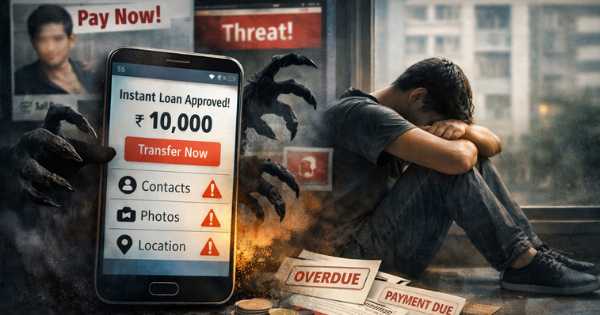
These applications target people who are often in desperate need of small, immediate sums of money. For a student or a low income worker, the promise of a few thousand rupees without the bureaucratic hurdles of a traditional bank feels like a lifeline. But the moment the app is downloaded, the trap is set. These platforms operate by gaining access to the most private parts of a person’s life. They request permissions that seem standard for a modern app but are actually tools for future blackmail. They pull contact lists, skim through personal photo galleries, and track GPS locations. This data is then moved to servers far away, often in different countries, where local laws cannot reach them.
The cycle of misery begins the moment a payment is missed or even just slightly delayed. The recovery agents do not follow any code of ethics or legal guidelines. They start with persistent calls, but the tactics quickly escalate into psychological warfare. Because they have the borrower’s contact list, they begin calling friends, family, and even workplace colleagues, informing them of the debt in the most humiliating ways possible. In many cases, they use the photos stolen from the phone to create morphed or suggestive images, threatening to circulate them online. For a young person like Nithin Raj, the social shame and the relentless harassment can feel like an inescapable wall, leading to a sense of total isolation.
While Kerala boasts high levels of digital literacy, there is a significant gap when it comes to financial literacy. People know how to use an app, but they might not understand the predatory math behind it or the dangers of giving away data permissions. These apps often lie about their status, claiming to be partnered with legitimate financial institutions when they are actually operating entirely outside the law. They hide their true interest rates and deduct massive fees before the money even reaches the borrower’s account. By the time someone realizes they are paying back three times what they borrowed, they are already caught in the web.
Stopping this requires more than just warning the public; it needs a fundamental shift in how we regulate technology and finance. One potential solution lies with the makers of our smartphones. If the operating system itself could recognize a financial app and put it in a digital sandbox, it could prevent that app from ever touching a user’s contacts or photos, regardless of what permissions are clicked. This would strip the predators of their primary weapon: the threat of social ruin.
The legal system needs to catch up. Currently, these operations are hard to pin down because they vanish and reappear under different names overnight. We need laws that carry heavy prison sentences and massive fines for illegal digital lending. The government could also force app stores to only list financial services that have a verified, cryptographically signed certificate from a regulated bank. If an app isn’t on an official whitelist provided by the central bank, it shouldn’t be allowed to exist on a public platform.
The Kerala government is already looking into new legislation to empower local police to act against these entities, even if they operate from other states. This is a crucial step because the current distance between the victim and the harasser is the predator’s greatest shield. We also need stricter rules for the companies that process the payments. If a specific digital ID is linked to high rates of complaints, it should be flagged or blocked immediately to stop the flow of money.
The tragedy of Nithin Raj and others like him highlights a failure in our digital safety net. Easy credit should not come at the cost of human dignity or life. As we continue to move toward a completely digital economy, the protection of the individual’s privacy and mental well being must be prioritized over the convenience of a quick loan. We have to ensure that the devices we carry to stay connected to the world do not become the very tools used to destroy our lives. It is a battle between the speed of technology and the slowness of law, and right now, the most vulnerable are paying the highest price. Education and strict enforcement are the only ways to turn the tide against this devious menace and ensure that no more lives are lost to a piece of malicious code.