
By Dipak Kurmi
In an era increasingly defined by the paradox of hyper-connectivity and profound fragmentation, the quest for a cohesive global order has moved from the realm of idealistic pursuit to an urgent necessity for survival. Our modern landscape is a complex tapestry of persistent geopolitical rivalries, cascading climate crises, and widening economic chasms that threaten the very fabric of international stability. While technological advancements have bridged physical distances, they have often failed to close the psychological and cultural gaps that foster distrust among nations. In this volatile scenario, the ancient Indian philosophical tenant of Vasudhaiva Kutumbakam—a Sanskrit phrase translating to “the world is one family”—emerges not merely as a relic of civilizational wisdom, but as a sophisticated, timeless framework for navigating the turbulence of the twenty-first century. This principle transcends the narrow confines of parochialism, offering a holistic worldview that views humanity not as a collection of competing entities, but as an interdependent biological and spiritual whole.
The ontological roots of Vasudhaiva Kutumbakam are found in the Maha Upanishad, a seminal Indian scripture that explores the depths of human consciousness and the universality of existence. The text explicitly contrasts the mindset of the narrow-minded, who obsess over the distinctions between “mine” and “thine,” with the perspective of the noble-hearted, for whom the entire earth constitutes a single household. This profound realization reflects an inclusive and expansive worldview that has been the cornerstone of Indian civilization for millennia, purposefully designed to move beyond the superficial boundaries of nationhood, creed, language, and ethnicity. By promoting a sense of shared responsibility and mutual respect, this philosophy challenges the modern atomistic view of society. It posits that our individual well-being is inextricably linked to the collective health of the global community, suggesting that no person or nation can truly thrive in isolation while others suffer in the shadows of neglect or hostility.
Unlike many contemporary political ideologies that are rooted in the Realist school of international relations—prioritizing national interest and zero-sum competition above all else—Vasudhaiva Kutumbakam advocates for a harmonious balance between enlightened self-interest and the collective welfare of the planet. It rejects the notion that the advancement of one state must come at the expense of another, proposing instead that empathy, compassion, and cooperation should serve as the primary guiding principles of human interaction. This ethical foundation is particularly critical today, as the world faces existential challenges that are inherently immune to unilateral solutions. By fostering a moral compass that recognizes our shared destiny, this philosophy provides the necessary intellectual and emotional infrastructure to address systemic global failures. It calls for a radical shift in how we perceive power, moving away from dominance and towards a model of stewardship and collaborative governance that honors the dignity of every global citizen.
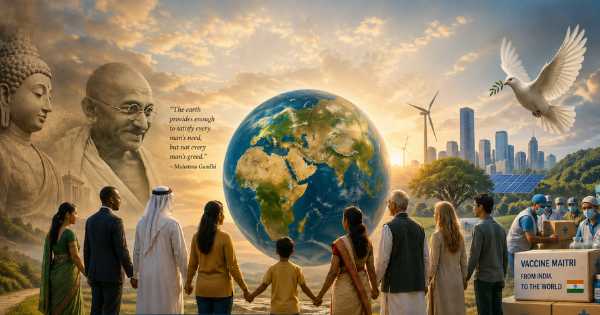
The historical trajectory of India provides a compelling testament to the practical application of this principle through a steadfast commitment to peace and non-violence. The foundational teachings of Lord Buddha and Mahavira emphasized the sanctity of all life, advocating for Karuna (compassion) and Ahimsa (non-injury) as the highest virtues. These ancient values found a powerful modern expression in the life and work of Mahatma Gandhi, who transformed the concept of non-violence into a potent tool for political and social metamorphosis. Gandhi’s philosophy was built upon the unwavering belief that humanity is an interconnected organism, and that true peace is not merely the absence of conflict but the presence of justice and understanding. His vision did not stop at India’s borders; it served as a catalyst for civil rights movements across the globe, proving that the ethics of the “one family” can successfully challenge even the most entrenched systems of colonial and racial oppression.
In the contemporary geopolitical arena, the relevance of Vasudhaiva Kutumbakam has intensified as the world grapples with crises that recognize no sovereign borders. Phenomena such as anthropogenic climate change, zoonotic pandemics, trans-border terrorism, and global economic volatility are proof that the fate of the global North and South are inextricably linked. These challenges demand a departure from isolated policy-making toward a spirit of genuine multilateralism. India has consistently championed this approach on the international stage, most notably during its G20 presidency where the theme “One Earth, One Family, One Future” was introduced. This slogan was not a mere rhetorical device but a modern translation of ancient wisdom, signaling a commitment to inclusive growth and environmental sustainability. By framing global issues through the lens of family dynamics, it encourages a more patient, nurturing, and equitable approach to international diplomacy and resource management.
India’s tangible actions during times of global distress further reinforce its commitment to being a responsible and compassionate global actor. The “Vaccine Maitri” initiative, launched during the height of the COVID-19 pandemic, stands as a prime example of this philosophy in action. While many developed nations engaged in vaccine nationalism, India supplied millions of doses to developing countries that had been marginalized by the global market. This humanitarian effort demonstrated a clear prioritization of global health over narrow domestic gains, illustrating the “noble outlook” described in the Upanishads. Furthermore, India’s consistent participation in United Nations peacekeeping missions and its rapid response as a first responder during natural disasters in its neighborhood and beyond reflect a deep-seated belief in the duty to protect and assist the global family. Such actions help build the social capital of trust that is currently in short supply within the international community.
Beyond the corridors of diplomacy, Vasudhaiva Kutumbakam has profound implications for social and cultural harmony in an increasingly polarized world. We live in an age where identity politics, religious extremism, and cultural misunderstandings often lead to social fragmentation and violence. This Indian principle offers an alternative narrative by suggesting that diversity should not be viewed as a source of friction, but as a rich tapestry that enhances the beauty of human civilization. It encourages active dialogue and tolerance, reminding us that different cultures are simply different expressions of the same underlying human experience. By embracing this pluralistic framework, societies can move away from the “clash of civilizations” mindset and toward a “confluence of civilizations,” where mutual respect allows for the peaceful coexistence of seemingly contradictory beliefs and traditions.
The role of education is paramount in ensuring that the values of this global family concept are passed down to future generations. To truly internalize the spirit of Vasudhaiva Kutumbakam, educational systems must evolve to instill a sense of global citizenship and ethical responsibility in students. This involves moving beyond nationalistic curricula to include lessons on global history, environmental interdependence, and the shared heritage of humanity. By cultivating empathy and inclusivity in the minds of the youth, we can create a new generation of leaders who view the world through a lens of cooperation rather than competition. Cultural exchange programs, international academic collaborations, and grassroots people-to-people connections are essential tools in this endeavor, as they break down the stereotypes and prejudices that are often born of ignorance and isolation.
India’s soft power also plays a significant role in disseminating this holistic philosophy across the globe. The worldwide adoption of practices such as Yoga, Ayurveda, and meditation reflects a growing global appetite for Indian civilizational wisdom that emphasizes the unity of mind, body, and spirit. The designation of the International Day of Yoga by the United Nations and its celebration across nearly every country is a vivid testament to how cultural heritage can transcend geographical and ideological boundaries. These traditions are not just about physical fitness; they are tools for achieving inner peace and harmony. The philosophy suggests that a peaceful world cannot be built by restless and conflicted individuals; rather, global peace is an outward projection of the inner tranquility achieved by individuals who recognize their connection to the universe.
However, the path toward fully realizing the ideal of Vasudhaiva Kutumbakam is fraught with significant challenges and structural obstacles. The current global order is still heavily dominated by realpolitik, where short-term economic competition and strategic dominance often override the long-term collective good. Many nations remain trapped in a cycle of mistrust, fueled by historical grievances and the perceived necessity of safeguarding their own interests at the cost of others. Bridging these deep-seated differences requires more than just philosophical agreement; it necessitates strong moral leadership and the courage to make decisions that may not yield immediate domestic political dividends but contribute to the stability of the global whole. The transition from a world of competing powers to a world of cooperating partners requires a fundamental shift in the collective consciousness of the global elite.
Despite these formidable hurdles, the principle of the world as one family remains the most viable and necessary path forward for a sustainable future. It is important to note that this philosophy does not demand the erasure of unique national identities or the abandonment of legitimate sovereign interests. Instead, it calls for an alignment of those interests with the overarching welfare of the planet. It encourages a shift in perspective—from a mindset of scarcity and competition to one of abundance and collaboration. By recognizing that we are all passengers on the same fragile vessel, we can begin to prioritize the commonalities that unite us rather than the differences that divide us. This shift is not merely a moral choice but a pragmatic requirement for addressing the complex, interlocking crises of the modern age.
Vasudhaiva Kutumbakam is far more than a sentimental ancient Indian ideal; it is a sophisticated and universal philosophy with immense practical relevance in our contemporary world. It offers a clear roadmap for constructing a global society that is more just, peaceful, and harmonious. By embracing the spirit of this principle, nations can finally move beyond the cycles of conflict and rivalry that have characterized much of human history, moving instead toward a future of collaborative growth and mutual flourishing. As humanity stands at a critical crossroads, facing challenges that threaten our collective existence, the civilizational wisdom of India provides a much-needed beacon of hope. It reminds us that despite our diverse backgrounds, we are all part of one global family, and our ability to thrive depends entirely on our capacity to live together in peace, dignity, and harmony.
(the writer can be reached at dipakkurmiglpltd@gmail.com)