
By Manoranjana Sinh
Writing from America
I have spent the past few weeks travelling through America, meeting academics, technologists, entrepreneurs, members of the Indian diaspora and people who, in very different ways, inhabit the enormous ecosystem connecting India and the U.S. Inevitably, China enters the conversation. Increasingly, artificial intelligence does too.
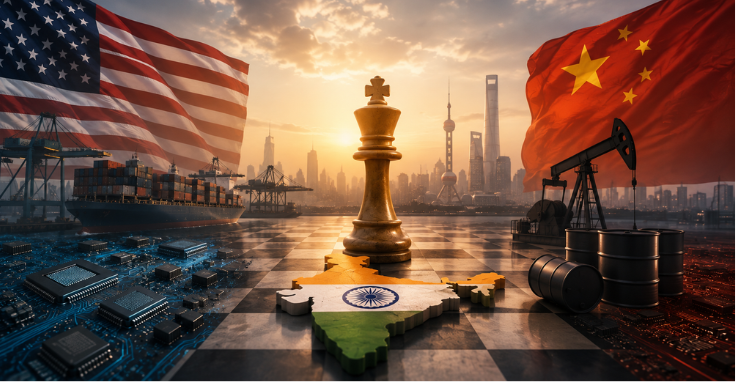
But what has struck me is something less obvious. Washington’s conversation about India is changing. India is important, certainly. Perhaps more important to America today than at any point in the relationship. But beneath the warmth of strategic partnership lies an increasingly transactional question: as the contest with China hardens, how much freedom of manoeuvre should America’s partners expect to retain?
For India, this is not an abstract question. Two developments in the past few days bring it sharply into focus. Reuters reported on August 14 that the U.S. is preparing to tell countries participating in Pax Silica, its initiative for securing the supply chains underpinning artificial intelligence, that they cannot simultaneously participate in China’s World Artificial Intelligence Cooperation Organization. India joined Pax Silica earlier this year.
At almost the same time came a number from an entirely different market. Russia supplied 50.83 per cent of India’s crude oil imports in July – an all-time high – amounting to approximately 2.47 million barrels every day. Oil and artificial intelligence would appear to have very little in common. For India, however, they are becoming part of the same geopolitical argument.
Washington has spent years questioning India’s purchases of Russian crude. It is now beginning to draw boundaries around the technological ecosystem it is constructing to compete with China. One concerns what keeps India’s economy running today. The other concerns what may determine India’s economic power tomorrow.
The New Price of Autonomy
Perhaps distance does this to a journalist. Sitting in America and looking back at India, some of the expressions we use rather routinely in New Delhi begin to sound different. “Strategic autonomy” is one of them.
We have repeated it for decades, through governments of very different political persuasions, almost as an article of faith in Indian foreign policy. It survived the Cold War, the Soviet collapse, Pokhran, India’s rapprochement with Washington, the Quad and the war in Ukraine. But autonomy is comfortable when nobody sends you the bill.
What happens when Washington attaches a cost to the Russian oil you buy? When Beijing remains embedded in industrial supply chains you cannot easily replace? When the world’s most powerful AI processors are technologies you do not manufacture? When access to those technologies increasingly becomes a matter of national security rather than ordinary commerce? That is the more difficult test India is approaching.
For decades, New Delhi became rather accomplished at compartmentalising its relationships. We could buy weapons from Moscow, build a technology relationship with America, trade extensively with China, negotiate with Europe and simultaneously claim leadership of the Global South. It was not always elegant, but it worked.
The technological contest between Washington and Beijing threatens to make that balancing act considerably harder because AI is not simply another product category. Behind the innocent-looking chatbot on a mobile phone sits an industrial structure of extraordinary complexity: critical minerals, semiconductor equipment, fabrication plants, advanced packaging, high-performance processors, data centres, electricity, cloud infrastructure, models and talent.
Control enough of that architecture and you possess something far more useful than technological prestige. You possess leverage over everybody who depends upon it. Washington has understood this rather well. So has Beijing.
Silicon Joins the Geopolitical Map
India, to its credit, is no longer standing still. The IndiaAI Mission carries an outlay of more than Rs 10,000 crore. The Government says the country’s shared compute facility has crossed 45,000 GPUs. Twelve semiconductor projects with an investment pipeline of approximately Rs 1.64 lakh crore have been approved.
These are significant numbers. A decade ago, a serious discussion about an Indian semiconductor ecosystem barely existed outside specialist circles. Today fabs, chip design, advanced packaging and sovereign AI have entered mainstream policy vocabulary. But we should resist congratulating ourselves too quickly.
There is an enormous difference between having access to GPUs and manufacturing them. There is a difference between semiconductor packaging and controlling frontier fabrication. And there is certainly a difference between building an Indian AI model and possessing the complete technological infrastructure required to train, deploy and continually improve it.
That distinction is sometimes lost in our enthusiasm for announcing technological sovereignty. India enters the AI age with an extraordinary hand, but not yet a complete one.
We have 1.4 billion people, one of the world’s largest pools of technology professionals, remarkable digital public infrastructure and a domestic market that no serious global technology company can ignore. We have linguistic diversity that makes India one of the world’s most interesting laboratories for artificial intelligence. Indian engineers are woven deeply into the American technology industry itself. Yet several of the most valuable layers of the AI economy remain outside our control.
That is why Pax Silica deserves much more attention in India than another passing headline about an American initiative. It stretches across critical minerals, energy, semiconductors, computing infrastructure and AI supply chains. And if the reported American position becomes policy – that participation in Pax Silica is incompatible with membership of China’s competing organisation – the vocabulary of technological partnership will have moved perceptibly closer to the vocabulary of geopolitical alignment. For India, that distinction matters enormously.
India Has More Leverage Than It Thinks
There is an old habit in India-U.S. relations that we should have outgrown by now. We are rather easily impressed by the choreography of strategic partnership: another summit, another joint declaration, another presidential handshake, another communique describing India as a “trusted partner”.
None of that manufactures a chip. None of it guarantees access to frontier compute. And none of it, by itself, gives India technological sovereignty. If Washington wants India embedded more deeply in the technological architecture it is building, New Delhi should be asking a rather more businesslike question: what precisely does India get in return? Not in diplomatic adjectives. In capabilities.
The question is particularly relevant because America’s determination to reduce its dependence on China actually increases India’s value. There are not many countries that can offer what India potentially can: enormous scale, engineering talent, a vast consumer market, democratic legitimacy, manufacturing ambition, a sophisticated technology sector and geopolitical weight.
That does not make India technologically equal to America or China. We are nowhere near that point. But neither are we merely another market waiting for admission into an American technology club. India has bargaining power, and sometimes I wonder whether Washington understands that better than New Delhi does.
The oil story is a useful reminder. India imports more than 90 per cent of the crude it consumes. In July, its merchandise trade deficit widened to $31.98 billion, the highest in six months. Imports reached $76.22 billion and the oil import bill alone stood at $18.31 billion.
Those are not footnotes to the Russian oil debate. They are the debate. It is easy to discuss Russian crude as a geopolitical or moral question in Washington. It looks somewhat different from New Delhi when the price of energy feeds into inflation, transport, manufacturing, fertiliser and the household budget of hundreds of millions of people.
Recent disruptions in Middle Eastern supplies made that reality even more acute. Indian refiners bought what was available and commercially viable, and Russia’s share consequently climbed above half of India’s crude imports in July. Washington may dislike that decision. But governments ultimately defend what they perceive to be their national interest. America certainly does. India must do the same.
What Washington Wants – And What Delhi Should Ask
The Russian oil dispute and the emerging argument over technological alignment should therefore not be treated as unrelated irritants in an otherwise expanding bilateral relationship. They tell us something about the direction in which American statecraft is moving.
What becomes much clearer when one is in America is that Washington no longer sees trade simply as trade. A barrel of oil, a semiconductor, a data centre, a rare-earth mine, a shipping route – each has entered the vocabulary of national security. The separation between economics and geopolitics is disappearing remarkably quickly. India would be unwise not to notice.
If Washington expects India to become a central participant in trusted AI and semiconductor supply chains, New Delhi should put its own requirements squarely on the table. India needs dependable access to frontier compute. It needs to move much further up the semiconductor value chain. It needs genuine co-creation of intellectual property between Indian and American institutions, rather than a relationship permanently built around licensing somebody else’s technology. It needs access to expertise, equipment and materials. And it will need enormous investment in electricity generation, grids and data-centre infrastructure if its AI ambitions are to become real.
There is also the uncomfortable matter of export controls. When Washington decides which advanced technologies can travel, where they can travel and to whom, where exactly does India sit? Is it genuinely inside the circle of technological trust, or does the language of partnership stop where America’s export-control regime begins?
These are questions friends should be able to ask each other. A mature India-U.S. relationship cannot depend indefinitely upon sentimentality about the world’s largest and oldest democracies. Nor should it. Nations do not conduct foreign policy on sentiment.
Autonomy Has to Be Built
There is, however, an equally uncomfortable message for New Delhi. India cannot demand strategic autonomy while outsourcing the material foundations that make autonomy possible.
We cannot import more than 90 per cent of our crude and pretend energy dependence has no geopolitical consequence. We cannot depend upon foreign processors for frontier AI and imagine compute will forever remain politically neutral. We cannot rely overwhelmingly on somebody else’s cloud infrastructure, platforms, semiconductor equipment or intellectual property and then announce technological sovereignty because the data centre happens to be located in India.
This is where India’s conversation must become more serious. Strategic autonomy in the AI age will have to be built in factories, laboratories, universities, power stations and data centres.
It will require semiconductor fabs and advanced packaging, certainly, but also indigenous chip design, critical-mineral partnerships, far greater electricity generation, a modern grid, serious research universities, patient Indian capital and an environment capable of keeping our best scientists and engineers at home. And it requires us to stop treating AI as the preserve of a technology ministry.
AI is now industrial policy. It is energy policy. It is education policy. It is foreign policy. Increasingly, it is national security policy.
That is perhaps the most important lesson I take from watching this debate from America. Washington already thinks in these terms. Silicon Valley may invent much of the technology, but Washington increasingly determines the strategic conditions under which that technology travels.
India’s answer cannot be to complain whenever America exercises that power. It must be to accumulate more power of its own.
We often describe India as an emerging “third pole” in a world increasingly shaped by the U.S. and China. I would like that to be true. But countries do not become poles because their commentators describe them as such, or because their leaders are courted at international summits. They become poles because other countries cannot easily proceed without them.
That is the position India should be building towards. And paradoxically, getting there may require a much deeper technology relationship with America, not a weaker one. The test is whether that relationship expands India’s choices or gradually narrows them.
For much of independent India’s history, strategic autonomy meant preserving the political right to make an independent decision. That definition is no longer enough. The harder question for India in this century is whether we possess the economic, technological and industrial strength to live with the consequences of an independent decision.
Sitting in America today, that seems to me the distinction worth watching. Because independence in the age of AI will not ultimately be measured by how often India says that it is strategically autonomous. It will be measured by how rarely India needs somebody else’s permission.