
ROOPAK GOSWAMI
Shillong, April 22: A rare dragonfly first described from Meghalaya over 50 years ago has helped scientists identify a new species from Assam after researchers corrected an earlier misidentification.
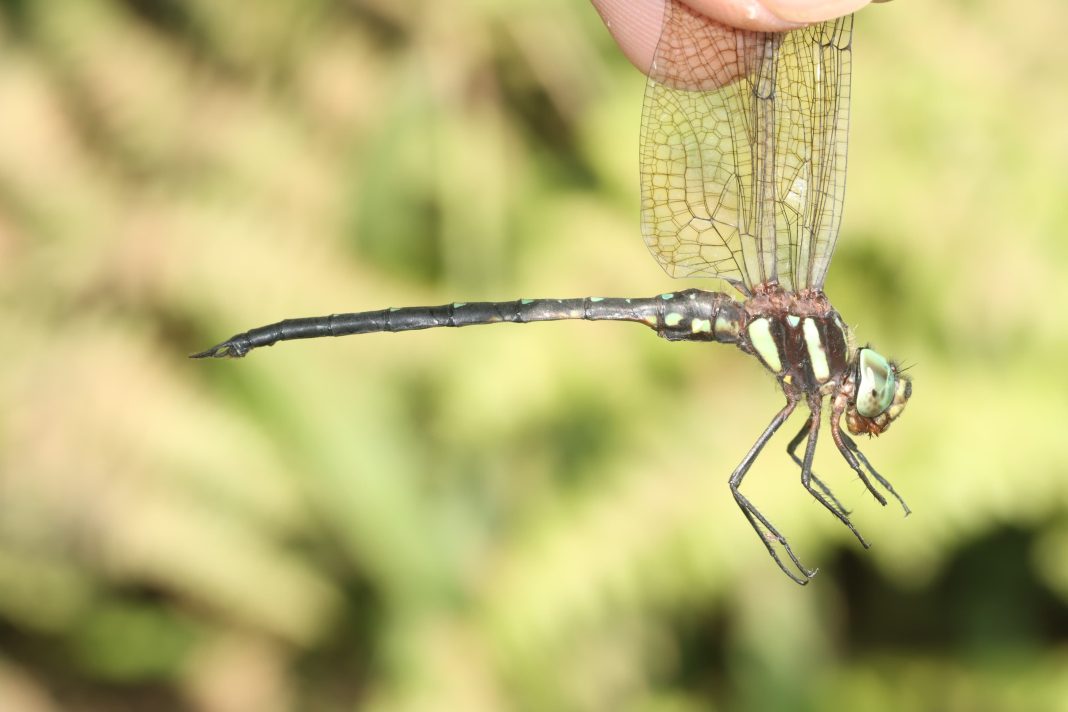
The species, Sarasaeschna khasiana, was originally described in 1968 from the Khasi Hills based on a single specimen. Limited material and incomplete descriptions had left gaps in understanding its identity.
Now, researchers including Fahim Khan and Krushnamegh Kunte have examined a fresh specimen from Sohra (Cherrapunji)—the species’ type locality—along with historical records, allowing them to clarify its defining features.
A specimen recorded earlier from Dosdewa in Assam had been identified as S. khasiana. However, closer examination of key anatomical features, particularly the male caudal appendages, showed that the identification was incorrect.
The Assam specimen has now been described as a separate new species, highlighting how re-examining earlier records can reshape scientific understanding.
The correction forms part of a larger study in which scientists have described three new species of dragonflies from Northeast India, underscoring the region’s rich but still underexplored biodiversity.
The research team—Shantanu Joshi and Krushnamegh Kunte, along with Dattaprasad Sawant, Ujwala Pawar, Fahim Khan, Rejoice Gassah and Vijay Anand Ismavel—conducted surveys across Assam, Meghalaya and Arunachal Pradesh.
The Meghalaya specimen was observed flying across open grassland near a hill stream along a roadside near Sohra, with patches of montane evergreen forest nearby.
This suggests the species may prefer open habitats adjoining forest streams, although researchers say more field studies are needed to better understand its ecology.
The finding highlights the importance of revisiting historical records and combining them with fresh field observations, especially in regions like Northeast India where biodiversity remains under-documented.
It also shows how misidentifications can mask new species, even in relatively well-known landscapes.
“The fact that several new species have been collected on the outskirts of Mouling National Park, in nearby community-owned forests, and from unprotected areas and roadsides near Sohra highlights the importance of both protected and community-managed landscapes for biodiversity exploration and conservation,” the researchers said.
Even in well-studied landscapes like Meghalaya, new species can still emerge—sometimes by correcting the past.
The new species from Assam ( Sarasaeschna dosdewaensis) was recorded first by a native citizen scientist, Rejoice Gassah, who is also an author of the species description. “It is important to highlight key contributions from local naturalists, and how a collaboration between people doing field work and museum work can be so productive,” a member of the research team said.